Religious Liberty Commission honors military service, faith at fourth hearing
Military servicemembers facing combat and potential death must be free to do so with the “eternal perspective” of their faith.
That’s the emerging sense of the Religious Liberty…
Military servicemembers facing combat and potential death must be free to do so with the “eternal perspective” of their faith.
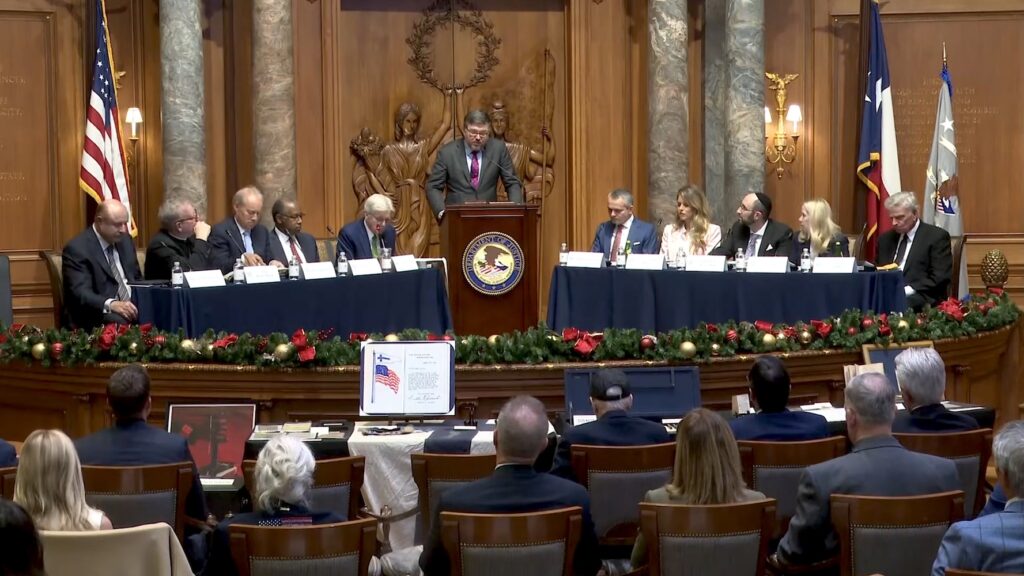
That’s the emerging sense of the Religious Liberty Commission, which was established by President Donald Trump and held its fourth hearing Wednesday in Dallas, Texas.
“Our servicemembers are heroes,” U.S. Associate Attorney General Stanley Woodward said in his opening remarks. “They deserve this designation for many reasons, but perhaps the foremost is that they are entrusted with life-and-death matters.
“For this reason, religious liberty and military service have a unique connection. The American military has, from beginning, shown that readiness and religious liberty strengthen each other.”
Texas Lieutenant Gov. Dan Patrick, chairman of the commission, said faith has been a profound element of military service since America’s founding.
“Our history is clear: since 1775, our country has encouraged religious liberty in the military, distributing millions of Bibles to soldiers and honoring their religious beliefs and practices,” Patrick said in a press release.
He explained how the Obama and Biden administrations violated military men’s and women’s religious rights, causing many to leave the service. The commission will submit several recommendations for restoring these liberties to American troops, Patrick said.
The commission heard from more than 15 witnesses including servicemembers, chaplains and veterans, after which Patrick concluded the hearing by referencing Jude 1:3, calling the committee to “contend earnestly for the faith.”
Woodward hailed military service members as those who deal with the marriage of first and last things.
“Religious liberty and military service have a unique connection. Our service members deal with first things: unwritten, undying truths, as Sophocles would say through the words of Antigone,” Woodward said. “But more so than the rest of us, service members, deal directly with last things, defined in the Christian tradition as death, judgment, Heaven and Hell.”
He also held a moment of silence in honor of the National Guard’s 385th birthday Dec. 13, and to honor the sacrifice of two West Virginia National Guard members who were attacked in a shooting near the White House Nov. 26. Specialist Sarah Beckstrom died from her injuries Nov. 27, and Staff Sergeant Andrew Wolfe remains in critical condition.
Woodward recognized the National Guard as “the first armed forces to take up the cause of defending our land.”
He shared the famous story of Desmond Doss – a Quaker who refused to take up arms but served as a medic in World War II, saving countless lives during the Battle of Okinawa in 1945.
“Yet it was this very sense of duty and his deep conviction of his duty to protect human life that led him to risk his own over and over, remaining exposed in enemy territory for hours to save his brothers,” Woodward said.
Doss was presented with the Medal of Honor for “his outstanding bravery and unflinching determination in the face of desperately dangerous conditions.”
“To remain clear sighted and courageous and compassionate in the face of constant danger and constant high stakes, our service members must have the ability to see their work through eternal perspective,” Woodward said.
Today, the committee is honoring those of the past and protecting religious liberty for all present and future Americans, he said.
“Our goal is simple, but it is ambitious: to restore religious liberty to its rightful place, not just now, not just for the next four years, but for generations to come.”