A tale of two books: Teachers’ union boss attacks school choice supporters while other work documents choice’s 200-year history
Two new books present vastly different sides of the public school vs. school choice debate – with one claiming the proverbial sky is falling while the other documents how school…
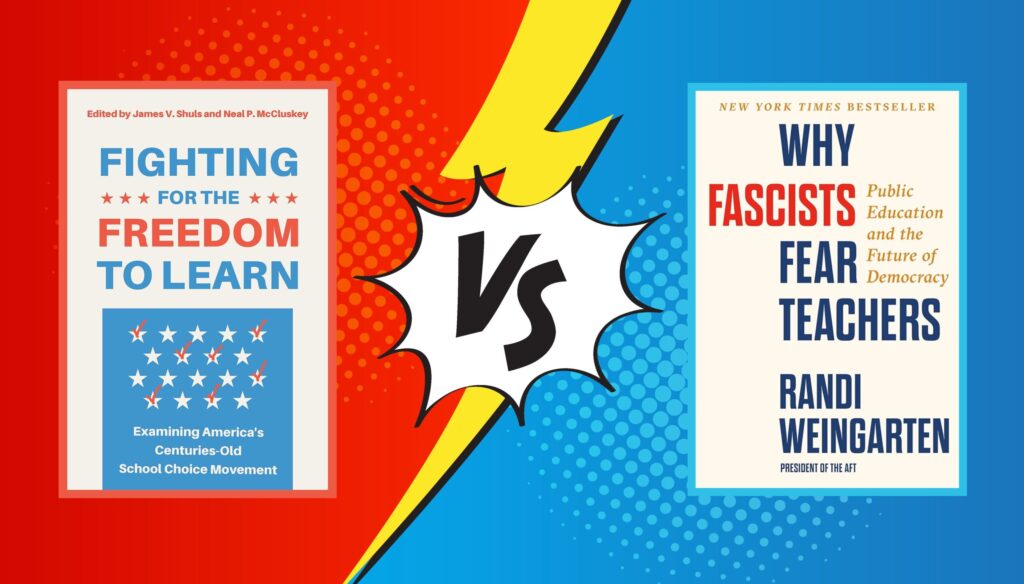
Two new books present vastly different sides of the public school vs. school choice debate – with one claiming the proverbial sky is falling while the other documents how school choice actually predates the current public school system.
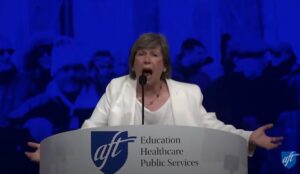
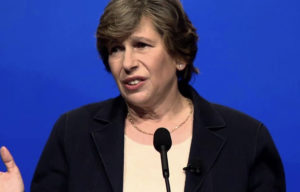
In Why Fascists Fear Teachers: Public Education and the Future of Democracy, American Federation of Teachers President Randi Weingarten argues school choice “will destroy the institutions responsible for educating our citizens and nurturing democracy,” Danyela Souza Egorov writes in a review in City Journal, a publication of New York’s Manhattan Institute.
“Weingarten characterizes the school-choice movement as a conspiracy orchestrated by Christopher Rufo, Moms for Liberty, and other right-wing activists,” Egorov writes. It’s a “plot to destroy public education,” she says, quoting from the book.
Weingarten, who runs the nation’s second-largest teachers’ union, further claims school choice was designed to keep schools segregated, and that 90% of American students attend public schools – though neither assertion is true.
“In fact, some teachers unions fought vouchers because they facilitated integration,” Egorov writes.
Meanwhile, public school enrollment has dipped to about 80% and may continue to fall, especially with the rise of homeschooling, school choice and other options.
Weingarten takes a swipe at “religious schools, whose very purpose is indoctrination,” Egorov writes, quoting from the book, but ignores the success of these schools, including how minority and disadvantaged students often fare better in them than in public institutions.
Then there’s Weingarten’s claim that she worked on a “plan to reopen schools as quickly and safely as possible” during the COVID-19 pandemic.
“Not so,” Egorov wrote. “Weingarten and her union colleagues kept American children out of schools until the government approved her request for a $750 billion federal aid package.”
Although schools in the South and Midwest generally reopened within months of closing, some districts on the East and West coasts were closed for more than a year.
“The book is primarily an attempt to rehabilitate Weingarten’s image after she backed the longest school closures in American history, which yielded the largest drop in student performance ever recorded,” Egorov concludes.
“Weingarten writes that the ‘fascists’ of her title ‘replace facts and critical thinking with propaganda that romanticizes the nation’s past.’ Yet this is precisely what her book does in misrepresenting her actions during COVID.”
The long history of school choice
On the other side of the issue, Neal McCluskey and James Shuls have edited a book for the Cato Institute comprised of 12 chapters describing America’s 200-plus-year history with school choice.
“Both opponents and proponents of school choice often write like the educational freedom movement started in the 1950s,” McCluskey, a Cato fellow, writes in an article about the book, Fighting for the Freedom to Learn: Examining America’s Centuries-Old School Choice Movement.
“Neither side is doing justice to school choice history with its focus on the ’50s,” he writes. “Education funding grounded in choice goes much farther back than the decade of doo-wop.”
In the book, historians and professors recount what education looked like “before the common school movement of the 1830s, including for-profit schools, religious institutions and more,” McCluskey writes. Discussions include how common values helped “religiously and ethnically diverse people of the middle-Atlantic colonies” coexist peacefully, and the many ways government funded what today is called private education “but people at the time would have just seen as education.”
It also reveals how the “common school ideology” spearheaded by Horace Mann “sought to replace the pluralist, community-based education provision then dominant with government uniformity and the distancing of children from the ideas of their parents.”
The book includes arguments for giving families more control over education funding, and that the post-COVID surge in school choice came more from red-state parents seeking alternatives to woke indoctrination in public schools than merely from knowing their children could be locked out of school.
In his chapter, Shuls, a professor at Florida State University, describes how the fight for religious civil rights in school choice coincided with the broader civil rights movement.
“When I see people today making the argument that school choice is a civil rights issue of our time, my pushback is it’s always been a civil rights issue,” he told school choice advocate EdChoice in an interview. “That’s what I try to highlight in my chapter, but also to push back on the idea that it started as a segregationist plot of some sort.”
School choice now has more than 1.3 million participants nationwide. There are programs in 35 states and Washington, D.C., with 18 states offering universal school choice. A federal choice program will start in 2027.