‘A yes to Trump’: Pakistan attacks Taliban in what may be ‘strategic opening’
The war between Pakistan and Afghanistan’s Taliban escalated Tuesday after a Pakistani airstrike on what Afghanistan called a drug rehab facility that Pakistan claims also stored…

The war between Pakistan and Afghanistan’s Taliban escalated Tuesday after a Pakistani airstrike on what Afghanistan called a drug rehab facility that Pakistan claims also stored ammunition.
Taliban officials said at least 400 people were killed and 250 injured in the strike on the 2,000-bed Omid facility in Kabul, Reuters reported.
If confirmed, it would represent one of the deadliest single strikes in the region in years.
Pakistan rejected the accusation that the facility was simply a drug rehabilitation hospital.
“We strongly refute and reject these allegations,” Pakistani Minister of Information Attaullah Tarar told Al Jazeera. “Pakistan has only targeted terrorist infrastructure and military locations.”
He pointed to secondary detonations as evidence that ordnance was stored at the site, reported CBS News.
The facility sits adjacent to Camp Phoenix, a former NATO military base.
Independent verification remains difficult because the Taliban systematically restricts media access and suppresses casualty reporting.
The U.S. previously expressed support for Pakistan.
“We continue to monitor the situation closely and expressed support for Pakistan’s right to defend itself against Taliban attacks,” U.S. Under Secretary of State Allison Hooker posted on social media.
The U.S. has a direct stake in the outcome.
A destabilized Pakistan, which is a nuclear-armed American partner increasingly aligned with the Trump administration, contradicts U.S. policy goals for the region.
The strike came hours after the U.N. Security Council unanimously passed a resolution calling on Afghanistan’s Taliban rulers to combat terrorism emanating from Afghan soil, reported the Associated Press.
The conflict is unfolding against the backdrop of the now 18-day-old U.S.-Israel war against Iran.
One Afghan analyst is saying the conflict represents an opportunity for both Pakistan and the U.S. relative to both operations.
“The timing of the Pakistani attacks, coinciding with the outbreak of war between Iran, Israel and the United States, creates a strategic opening for Pakistan,” Afghan researcher Sardar Rahimi told DW.com.
Rahimi explained the Pakistani attacks on the Taliban are figuratively “a ‘yes’ to Trump” on Iran.
The strikes signal Pakistan’s willingness to take on security against Taliban terror in the region, which some have feared would bleed across the Iranian border if the Tehran regime collapses.
The current Afghan-Pakistan war is the product of a strategic reversal decades in the making.
Pakistan’s intelligence services invested in the Afghan Taliban in the early 1990s as a tool of regional influence against India.
That investment collapsed after 2021 when the Taliban returned to power and promptly turned against Pakistan, similar to how Afghanistan turned on the U.S. after receiving American aid in its fight against the Soviet invasion during the 1980s.
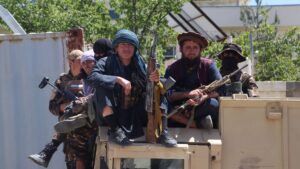
The Afghan Taliban gives safe haven to the jihadist militant group known as the Pakistani Taliban. The United Nations has found the group is operating from within Afghanistan, using it as a logistical hub for terror strikes inside Pakistan.
As of early 2025, the group maintained roughly 6,000 fighters, continued receiving logistical and operational backing from the Taliban government and kept tactical ties with ISIS, the U.N. report said.
The group has also carried out high-profile mass casualty attacks inside Pakistan with access to a significant weapons arsenal, according to the report.
But now that Iranian aid is practically cut off, the Taliban is finding itself increasingly isolated.
Still, “there are a lot of unknowns,” said Farah Pandith, a senior fellow and counterterrorism expert at the Council on Foreign Relations.
Further escalation could draw Chinese or Russian support to Pakistan, she said, a scenario where all the major powers would support action against the Taliban.
Neither China, India nor Russia are likely willing “to get involved in a war,” Pandith added.
The Taliban warned in February it would aid Tehran in case of a U.S.-Israeli attack on Iran.
Zabihullah Mujahid, the Taliban’s chief spokesman, said the previous joint attacks by the U.S-Israeli forces on Iran in June 2025 were an American defeat.
“You remember that when Iran was attacked, the result was that Iran emerged victorious,” he said. “I think this time will be the same.”
The rhetoric, however, is simply masking deep Taliban fears of a U.S. victory, analysts say.
“The Taliban statement should serve as a stark reminder of the regime’s disdain for the United States – and fierce opposition to the possibility of the U.S. assuming an expanded position of strength along Afghanistan’s western border,” said Joe Zacks, a former CIA deputy assistant director for counterterrorism.