
ACT scores hit 30-year low, students less ready for college
ACT scores have fallen to a 30-year low, indicating college readiness has not returned to pre-pandemic levels.
New data released by Center of the American Experiment, a…

ACT scores have fallen to a 30-year low, indicating college readiness has not returned to pre-pandemic levels.
New data released by Center of the American Experiment, a Minnesota think tank, show a steady decline in average ACT scores between 1996 and 2025 on both a state and national level.
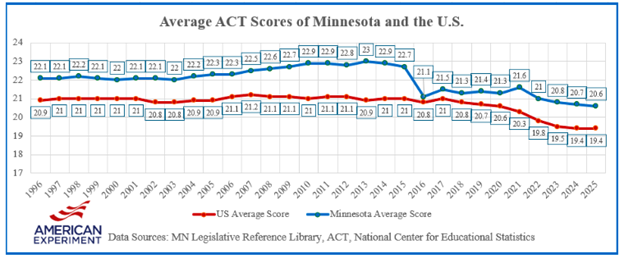
For more than 20 years, the average U.S. student scored around 21 on the ACT’s 1-to-36 scale. Scores dropped sharply after the pandemic, however, resulting in a new average of 19.4.
The decline suggests the average student entering college is not prepared for the rigor of university coursework.
The ACT’s “benchmarks” indicate a student has a 50% chance or higher of earning a B – or a 75% chance or higher of earning a C – in a corresponding college course.
The current benchmark scores are 18 for English, 22 for mathematics, 22 for reading and social science and 23 for science.
As of 2025, only 30% of students met three or more of the four benchmarks, while 43% met none.
Fewer students are also taking both the ACT and the SAT.
Since 2019, the annual number of ACT test-takers has dropped by about 400,000. SAT participation has declined by about 220,000.
The SAT reports a similar academic decline, with students scoring an average of 10 points lower in reading and 20 points lower in math.
While many experts initially blamed the pandemic for education declines, such explanations are increasingly difficult to justify six years later.
The ACT was modified in 2024 in an effort to make the test easier for students.
The exam was shortened by 44 questions, reading passages were reduced in length, total testing time was cut to two hours from three and the science section was made optional.
Despite lower scores on an easier test, more students are being accepted into four-year universities than in 2019.
According to 2024 National Assessment of Educational Progress data, the share of students deemed “academically ready” for entry-level college math declined from 37% to 33%, while readiness for reading fell from 37% to 35%.
During the same period, the percentage of 12th-grade students accepted into four-year universities rose from 51% to 53%.