AI learning program aims to make school as fun as vacation, adding new layer to educational choice
Can AI learning make kids love school more than vacation?
That’s the seemingly absurd premise 1990s tech baron Joe Liemandt has spent the last few years trying to fulfill – and he appears to…
Can AI learning make kids love school more than vacation?
That’s the seemingly absurd premise 1990s tech baron Joe Liemandt has spent the last few years trying to fulfill – and he appears to have cracked the code at Alpha School in Austin, Texas.
There, students engage in formal learning just two hours per day, and yet score in the top 1% on national tests.
The school is expensive at $40,000 annually, but students aren’t tested for academics prior to admission, adding significance to its success.
Now Liemandt’s looking to take the technology mainstream, releasing it for anyone who wants it – for free.

“The key to every kid’s happiness is high standards,” he told Colossus in an interview about Alpha and Timeback, the technology he pioneered. “It’s a combination of high support and high standards.”
Timeback is a program that monitors what students are learning, where they’re struggling and when they’re wasting time. It partners with learning apps such as Khan Academy and other proprietary programs.
The Timeback name – not a veiled Back to the Future reference – reflects Liemandt’s goal of compressing learning so children can get their “time back” and enjoy being kids.
It’s “the single best product I’ve ever built in four decades, by far,” said Liemandt, who made billions through Trilogy and its SalesBuilder software in the 1990s, along with other tech ventures.
If widely adopted, the AI tutor could upend how students learn, how adults teach and how schools operate. But in a world of entrenched education interests – with thousands of buildings, millions of employees and billions in funding – can such a radical shift make it through the door?
Regardless, the rise of AI learning tools parallels the surge in school choice, and both are disruptive forces that could reshape education for decades to come.
A winning formula
Alpha’s technology is good – very good. Students consistently outperform their peers, and in striking fashion. The school accepts them as they are, and the AI meets them where they’re at – then takes them higher.
“Your kids must love school,” said Alpha co-founder Brian Holtz, after Liemandt enrolled his two daughters. “They can learn twice as much as they were learning at your old school, and they can do it in two hours a day.”
The model is built on personalization, motivation and whole-child development.
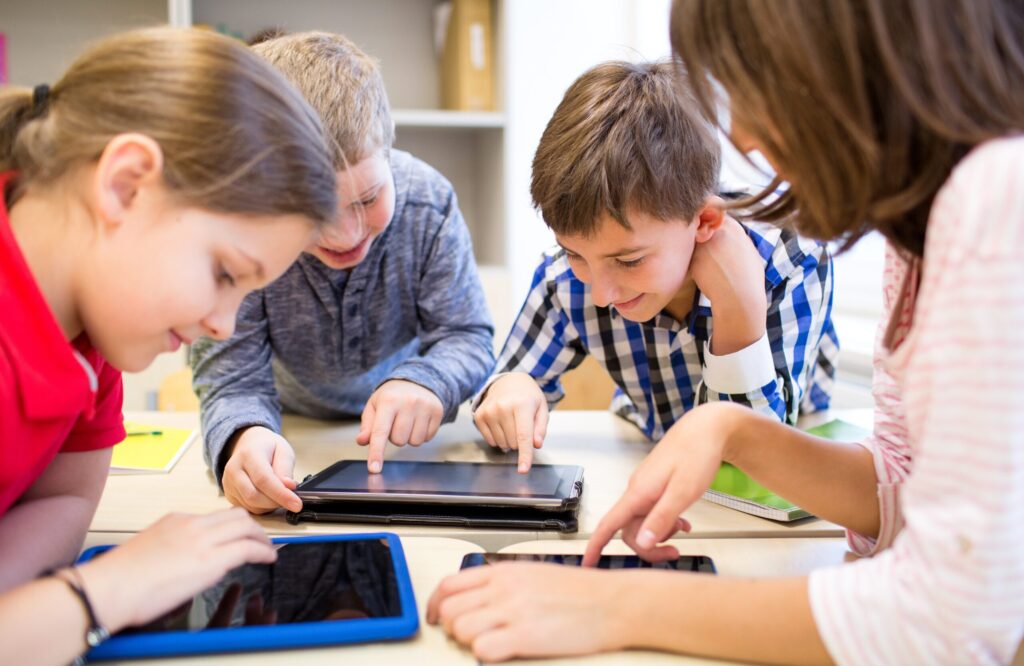
Each day begins with a morning rally, followed by a focused two-hour academic block using the AI tutor. The rest of the day is spent on enrichment activities – hobbies, group games and hands-on projects – guided by well-paid “coaches” instead of traditional teachers.
The results are striking. Second-graders completed a 5K race. Kindergartners climb a 40-foot rock wall and learn to accept feedback without crying. Fourth-graders pass the Wharton MBA Teamwork and Leadership Simulation – a graduate-level exercise. These activities promise to build confidence, resilience and leadership skills.
Nontraditional learning, Liemandt argues, can thrive only when students aren’t “sitting in class being bored with 5% retention, learning the stupidest way possible,” he told Colossus. “When you teach them 10 times better and then give them these cool workshops where they can learn these life skills that they really care about, they love it.”
Challenging an outdated model
The modern public school system emerged during the Industrial Revolution to keep children occupied while parents worked and to produce efficient workers for a growing economy. As populations grew and cities expanded, education became centralized into massive districts serving tens of thousands of students.
What those systems often lack, critics say, is personalization – something homeschooling, microschools and other alternative models are able to offer. These smaller environments emphasize mastery over grade-level progression and often mix multiple ages, echoing the one-room schoolhouses that served America well for its first century.
Timeback incorporates many of these ideas.
The AI tutor adapts to each student’s pace and ability, customizing lessons to individual interests. A student who likes cars might see math problems featuring vehicles; one who loves horses might see equestrian examples.
The software tracks whether students are struggling or wasting time through an on-screen “waste meter,” which shows how much free time they lose when they’re distracted. It can also reteach subjects to close learning gaps and help students advance faster.
“As a country we spend $20,000 or more per kid, and what do we get? Sixty percent of eighth graders can’t read, they feel stupid, and they hate school,” Liemandt said, contrasting how Alpha students love school and thrive.
Expanding success
Alpha has grown to 18 cities, including New York and Miami. One outlier is Brownsville, Texas, one of America’s poorest cities. There, tuition is $10,000, and half of the students are children of SpaceX employees while the other half are from the local community.
Four years in, the school has doubled in size, and students score in the top 1% or 2% nationally – showing the model can work across socioeconomic lines.
Texas is debuting a school choice program next year, offering scholarships of about $10,000, meaning most residents could attend Alpha Brownsville.
Through Timeback, Liemandt envisions an education marketplace where other schools can use it to teach their own material, customizing it to their needs. Developers could also build and sell programs that integrate with the system.
“When (generative AI) hit in 2022, I took a billion dollars out of my software company,” he said. “‘We’re going to take (the) 2x in two hours groundwork and get it out to a billion kids.’”
He believes the day is coming when a tablet costing under $1,000 can teach “every kid on this planet everything they need to know in two hours a day – and they’re going to love it.” He plans to release Timeback free sometime in the coming months.
AI and education: Friend or foe?
The release comes as schools nationwide wrestle with how to handle AI, often associated with cheating or shortcuts. Some districts have banned it, while others cautiously allow limited use. Many educators worry that overreliance on AI could leave students unable to think independently.
The National Education Association, the nation’s largest teachers’ union, warned last year that AI should not “displace or impair the connection between students and educators,” arguing that personal connection is essential to building well-rounded citizens.
“We envision AI-enhanced technology as an aid to public education, not as a replacement for meaningful and necessary human connection,” the NEA said in a statement.
Liemandt, however, believes AI can enhance rather than replace human relationships. Timeback’s results – both academically and in students’ enthusiasm for learning – suggest it can transform education into something children enjoy.
“When she was at a regular school district, it was, ‘I don’t want to go to school,’” one Alpha Brownsville mother said in a promotional video. “Now she doesn’t want to miss school.” Her daughter adds proudly: “I’m a third grader, but I’m doing fifth-grade math.”
The link to school choice
School choice is expanding rapidly, with 18 states now offering universal or near-universal programs and a federal initiative set to begin in 2027. Parents increasingly expect the ability to direct their child’s education rather than rely solely on local public schools.
“The education landscape has changed so much in the last few years,” said Christine Cooke Fairbanks, an education policy fellow at Utah’s Sutherland Institute. “There’s a hunger for options, and I see (Timeback and AI schooling) fitting really well into that landscape.”
Fairbanks said teachers’ unions will likely resist such change to preserve jobs, but public attitudes toward AI “will shift over time.” She pointed to Pew Research findings released this year showing nearly one-third of experts believe AI could replace teachers or put their jobs at risk within 20 years.
Even so, she said, “I think the environment is ripe for serious change. Declining enrollment is something people are asking questions about. There are obviously changes that need to happen.”
Fairbanks added that the combination of school choice and new technology could give families unprecedented freedom.
“I think the piece that will change education is the culture of saying, ‘I can choose what I want. I don’t have to accept this,’” she said. “That right there is the catalyst.”
Balancing technology and tradition
Some parents remain uneasy about AI and screen time. Studies have shown excessive device use can harm academic performance and social skills. AI can also introduce risks such as bias, misuse or cyberbullying.
Liemandt agrees – to a point.
“If you deploy ChatGPT to every student in America, we will become the dumbest country on the planet,” he said. But purpose-built tools such as Timeback can track students’ progress, shore up gaps and boost performance – helping them get off screens once learning is done.
“People think it’s witchcraft, but it’s literally just science,” he said. “It’s how we can take a kid the conventional school system calls ‘two years behind’ and catch them up in 40 to 60 hours. It’s how we give kids their time back.”
As the technology becomes widely available, parents will decide how far they want to embrace it. Some may love the freedom and flexibility; others will prefer classical or Montessori models. Either way, Fairbanks said, school choice ensures families can choose what aligns with their values.
“AI certainly is going to give new options,” she said. “Ultimately, I think the momentum is moving toward more education choice – and parents are going to keep driving that change.”