
Analysts: New York skews reading, math scores to create ‘illusion’ of improved student performance
New York State is skewing reading and math proficiency rates to make K-12 schools appear more effective, according to a recent policy analysis.
On Aug. 11, the New York State Education Department…

New York State is skewing reading and math proficiency rates to make K-12 schools appear more effective, according to a recent policy analysis.
On Aug. 11, the New York State Education Department (NYSED) released the 2024-25 reading, math and science scores for elementary and middle school students, claiming slight increases in each category.
Reading proficiency in grades 3-8 rose to 53% from last year’s 46%, according to its report. Math rose to 55% from 52%, while science in grades 5-8 rose to 44% from 35%.
However, Bill Hammond, a Senior Fellow at the Empire Center for Public Policy, smelled something fishy.
“Why are New York’s public school students showing steadily higher proficiency levels on state-administered tests when their scores on federal tests have been getting worse?” he asked in a recent analysis.
Indeed, federal testing shows proficiency rates far lower than state scores.
According to NAEP 2024 test results, just 26% of the state’s eighth graders were at grade level, even though the state reported 47%.
Similarly, NAEP found only 31% of eighth graders proficient in reading, while the state estimated proficiency at 52%.
Hammond attributes the disparity to New York lowering its grading standards.
“Over the past dozen years, the department has been gradually lowering ‘cut scores’ – the minimum number of questions students have to answer correctly in order to be considered proficient at each grade level,” Hammond wrote.
“This raises concern that the rising proficiency levels reported by the state Education Department have been an illusion, the result of lowered standards rather than improved student performance.”
The following graph, created by the Empire Center, shows how the state has lowered the cut score – the score required to attain “proficiency” – over the past decade.
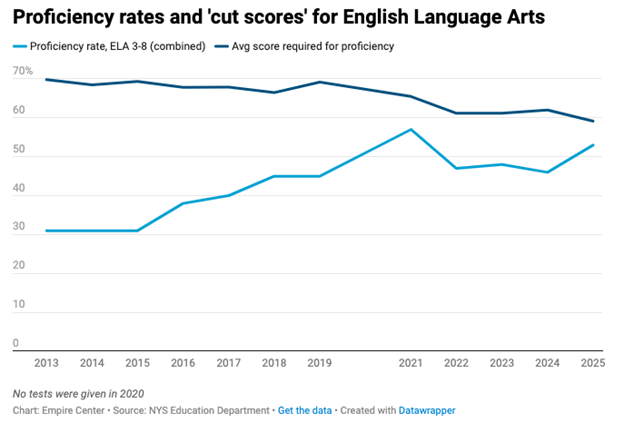
When the cut score was 70%, only a third of students were reading at grade level. But now the cut score is less than 60%, over half of students are ostensibly proficient readers.
The same is true in math.
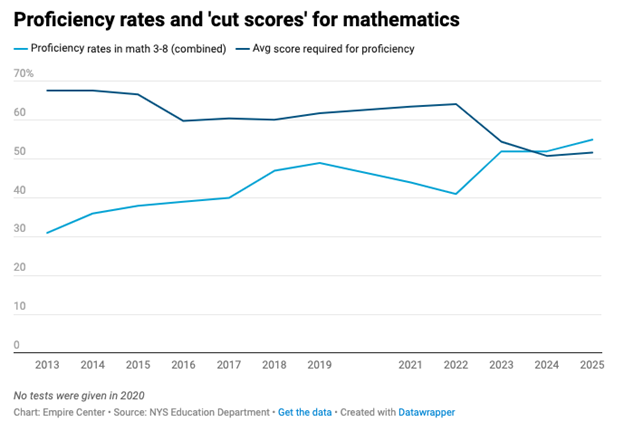
In 2013, the cut score was almost 70%, and only a third of students were proficient. Now, the cut score is just above 50%, with more than 50% of students claiming proficiency.