Arizona data show strong growth, expanding reach for universal school choice
Universal school choice may seem new, but three years of data from Arizona – the first state to grant universal access – are enough to show some clear and encouraging trends.
An analysis by…

Universal school choice may seem new, but three years of data from Arizona – the first state to grant universal access – are enough to show some clear and encouraging trends.
An analysis by school choice advocate EdChoice found consistent overall growth, as well as increases in the number of special needs students and those coming from public schools. The numbers point to a program that is working as intended – and will continue to grow with increased public exposure – said John Kristof, an EdChoice senior researcher who studied the numbers.
“A lot of parents seem to be looking at this as an option, particularly if they are parents of younger kids,” he told The Lion in an interview. “We also saw a large influx of students with disabilities, despite the program being open to them before the 2022-23 school year.”
The Grand Canyon State expanded its Empowerment Scholarship Accounts in 2022 from serving mainly special needs students to allowing all students to receive funding to attend the school of their choice, including private schools. While students who were already in private school were among the earliest participants, the number of students coming from public schools has increased steadily.
Kristof said this is common when school choice programs start, since private schools have an incentive to tell their students about the program – something that rarely happens in public schools. Most “departments of education are not putting out flyers letting people know that this stuff exists,” he said.
Arizona’s total ESA usage tops 91,000 students – still less than 1% of the state’s 1.1 million public school students. However, 12.5% of kindergarten parents opted for the scholarship in 2023, the only time more than 10% of a single grade level did so, according to a report from EdChoice.
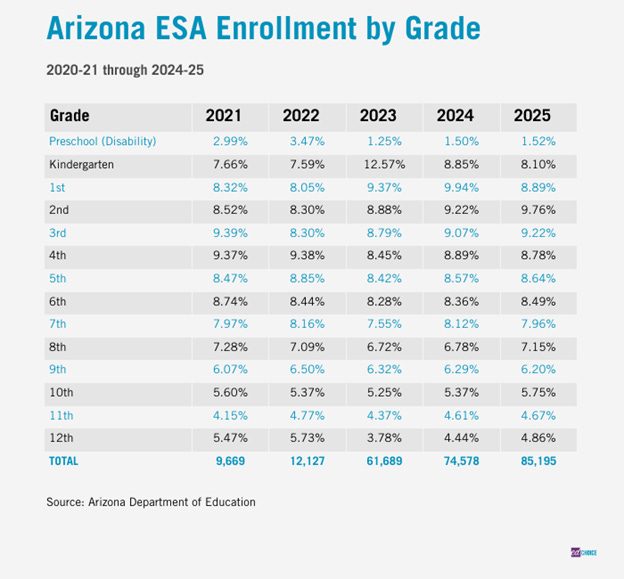
Further research shows the vast majority of school choice participants wouldn’t be in private school without the scholarship. That figure – a better measure of school choice’s effectiveness – was 63% in the expansion’s first year and 89% in its second. Still, if only former public school students are measured, that number rose from 33% in 2024 to 39% this year, a jump of about 20%.
Because kindergartners have made up the largest percentage of school choice participants by grade over the last three years, those students rarely qualify as former public school enrollees, further skewing the statistic.
“What we do know is that more kids who are not already in private schools are participating in the program over time, which is what we would expect,” Kristof said.
Growing through visibility
What’s also significant about Arizona is that it shows how school choice programs grow as visibility increases. There is a well-defined “diffusion of innovation,” where different populations adopt new technologies and ideas in different phases. Innovators and early adopters come first, followed by the early majority and then the late majority.
Kristof said school choice is “still in the early stages,” meaning many people are just hearing about it or have not yet considered it. But as word gets out, more people enroll. The growth in special needs students is proof of this.
While Arizona had offered the ESA to such students for a decade before the expansion, their numbers increased from 10,400 to 16,300 since.
“That tells me there may be some awareness issue that was addressed by the program being expanded,” Kristof said. “As the program expanded, it received a lot more attention – both good and bad – and more people became aware of it. So maybe a lot of parents of kids with disabilities learned this was a program at all.”
Another reason for that growth could be special needs parents were able to put all of their children in private school, making it an easier choice.
It’s not “welfare for the wealthy”
While critics say a lower adoption rate among public school students is evidence school choice isn’t working, Kristof said to give it time. Those numbers don’t always tell the whole story, and the trend is likely to keep spreading.
“Every public program faces awareness issues,” he said, citing SNAP, or low-income food assistance, as an example. “There are millions of dollars that are left on the table annually. There are a lot of public programs where people leave free money on the table even if it’s something that would benefit them.”
As school choice grows, it will eventually hit a saturation point, but that number is “very far” away, meaning there is much potential for growth. And since research has shown most people learn about school choice through word of mouth, the program should expand exponentially as more families join.
“It’s just such a disruption of the norm that we’ve seen for decades in our education system that if you’re not plugged in, you might not know about it unless somebody you know – a friend, a colleague – shares an experience that they’ve had or something that they’ve heard.”
Over the next three years, Kristof expects the “switcher rate” – the number of students leaving public school for private – to “make up a higher and higher share of this program.”
“I think we’ve already seen the wave of people who were already in private school or another school choice program,” he said. “The growth that we’re seeing from here on out is from new people.”
He also sees a move toward “unbundled” education, where students learn from a variety of sources. Such options are already popular in Utah and Florida, where students can custom-tailor their learning from a mix of public, private and online offerings.
When examined closely, the Arizona numbers help counter arguments that school choice supports wealthy students who are already attending private schools instead of opening up educational opportunities for all learners.
“I think we’re seeing the tip of the iceberg of what is possible here,” Kristof said. “It’s going to be exciting to see where things go. But even if you are only looking at that, you’re still seeing the numbers move toward a way that looks less and less like the ‘welfare for the wealthy’ narrative.”