Arkansas homeschool dad urges families to speak out on EFA limits
When education freedom advocates lost a battle against Arkansas imposing new restrictions on its school choice program, many thought the fight was effectively over.
But Paul Bradley, father…

When education freedom advocates lost a battle against Arkansas imposing new restrictions on its school choice program, many thought the fight was effectively over.
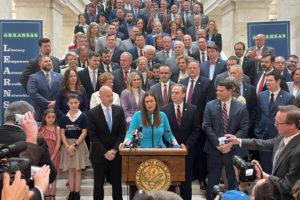
But Paul Bradley, father of an Arkansas homeschool family, wants other homeschoolers to be more vocal about the legislation to change how it is implemented.
“If you have an opinion, you can say it nicely,” he wrote in a piece published by Opportunity Arkansas, a conservative think tank. “It may not turn out the way that you want, but it’s important for us to use our voice.”
The regulations, passed last year, restrict families to using no more than 25% of their Educational Freedom Account money for extracurricular activities, physical education programs or educational field trips. That impacts homeschool families the most, since they don’t pay tuition but use curriculum and experiences to teach their children.
When the state solicited public comment about how to implement the law, only about 250 families responded, which is just a fraction of the more than 18,000 homeschoolers who use the EFA.
“Homeschool families need to be aware that if you want our voice to be heard, you’ve got to say something,” said Bradley, of Conway. “It may not turn out the way that you want, but it’s important for us to use our voice.”
The state says it is trying to limit fraud and abuse, but Bradley – and many homeschool families who testified about how they use the funds – think it is “overcorrecting.”
“I think that there is a way to hold people accountable that doesn’t shut everyone out and cut people off,” he said. “The EFA gives families flexibility to allow their kids to participate without breaking the budget. Removing that eligibility could hurt families financially and also inhibit their kids from playing at all.”
He said his family “used our EFA funds to cover registration fees and uniform fees for team sports,” explaining that “there are a lot of good character lessons that can come out of sports and athletics,” such as hard work, taking direction and learning to win and lose.
“My daughter is very artistically minded, and basketball has allowed her to work on her confidence level,” he wrote. “She can practice and put effort into something and then show on the basketball court where that effort is paying off. Basketball has helped her grow past perfectionism and lean into doing the very best that she can possibly do.”
He said this may seem unnecessary to school choice opponents – despite millions of taxpayer dollars spent on public school athletics – but noted that sports can cost larger families thousands of dollars per year, money the EFA helps cover.
The Natural State has been a leader in school choice, establishing its program in 2023 and granting universal access in 2025.
Although the program is popular, lawmakers wanted to tamp down “any potential risk of the possibility of a bad news story about fraud by an ESA recipient,” Alex Wolf, policy analyst at EdChoice, told The Lion last month.
The state did approve an additional $32 million from its reserves in January to cover rising demand during the current school year. For next year, the scholarship is set to rise to $7,208, a 5% increase.