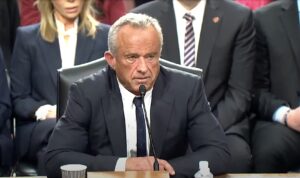
At 6 months, MAHA is leading, America is following
Health and Human Services Secretary Robert F. Kennedy, Jr. has undertaken the most sweeping reforms on food and health since the 1970s.
In six months, he’s implemented his Make America Healthy…

Health and Human Services Secretary Robert F. Kennedy, Jr. has undertaken the most sweeping reforms on food and health since the 1970s.
In six months, he’s implemented his Make America Healthy Again (MAHA) agenda without passing a single new law.
Instead, Kennedy used a combination of the bully pulpit, regulatory powers and America’s growing distrust of government to reach a conclusion other leaders can only dream of: consensus.
America is not healthy, the consensus goes, and what we eat is a primary factor.
Kennedy, 71, is attempting to remake American health by protecting food sources, ensuring the safety of infant formula, studying chronic childhood diseases and killing the cozy relationship between big pharmaceuticals and government.
One of the health reform movement’s first milestones came in February when President Donald Trump created the MAHA Commission on chronic childhood diseases.
By May, the commission issued a preliminary report identifying four key drivers harming childhood health: poor diet, ultra-processed foods (UPFs), toxins, sedentary lifestyles and excessive vaccine/medication use.
Kennedy at the same time launched Operation Stork Speed, asking infant formula manufacturers to enhance safety and nutrition standards.
The combined measures have led to the first review of baby formula labels since 1998, and the first possible changes to formulations since 1980, half a century ago.
Targets for study in formulas include heavy metals, corn syrup, seed oils and basic recipes, each of which may cause inflammation in babies, suspected of being a driver of chronic disease.
Then in April, in another major milestone, the Food and Drug Administration (FDA), under pressure from Kennedy, announced the phasing out of petroleum-based food dyes such as Red No. 40.
The dyes have been implicated in increased cancer risk and behavioral problems in children, as well as other diseases, noted Professor Emily Barrett at Rutgers School of Public Health.
“Suspicions about the health impacts of food dyes have been around for many decades and, in fact, received much more attention from the research community in the 1970s, 80s, and 90s than in recent years,” said Barrett.
The current administration has put them under scrutiny again.
Even before the FDA finished the regulatory phase out of dyes, companies announced they would voluntarily stop using the petroleum additives in certain products.
Some of the MAHA changes, however, have also come at the state level as local legislatures have answered the message about improving the health of America’s food supply.
In April, Kennedy began a multi-state MAHA tour, celebrating state laws banning UPFs, harmful dyes and fluoride in schools.
According to a study by Northeastern University, UPFs accounted for 73% of the U.S. food supply, while Salisbury University said UPFs account for 53% of calories consumed.
Northeastern noted foods marked “natural” such as orange juice can still be ultra-processed, because it’s separated into three constituent unit parts by producers.
Natural orange juice processing has complicated rules and regulations controlled by the FDA. Eventually, the constituent parts are recombined after processing into a “natural” product, that’s only 43% juice.
Sugar has also been identified as a problem, though Kennedy has acknowledged it’s an uphill battle.
As a compromise, Trump and Kennedy have convinced companies such as Coca-Cola to replace corn syrup with cane sugar in their products as a “more healthy alternative.”
More controversial for experts, but less controversial for the public, is Kennedy’s review of vaccine oversight. Kennedy has kicked out 17 current members of the vaccine advisory board.
He accused the vaccine industry and the government regulators of “conflicts of interest, persecution of dissidents, a lack of curiosity and skewed science” undermining public trust not just in vaccines, but in government and medicine, notable in the debate about the controversial mRNA COVID-19 vaccine mandates.
“A clean sweep is needed to re-establish public confidence in vaccine science,” said Kennedy.
The HHS secretary said he’s trying to restore the reputation of America’s health regulators, who were previously known for “integrity, scientific impartiality and zealous defense of patient welfare.”
Notably, Kennedy and the MAHA movement have accomplished all this without requiring Congress to do a thing.
“More than a dozen major food companies have made MAHA moves in recent weeks,” said HHS on X. “@SecKennedy is leading a historic shift in U.S. nutrition policy—from fixing dietary guidelines to restoring whole milk in schools. This is how we Make America Healthy Again.”