
Autism link to Tylenol use during pregnancy discovered, Trump says
Recent studies show the increase in autism in America correlates with the use of acetaminophen, the active ingredient in Tylenol, during pregnancy, President Donald Trump said in a press briefing…
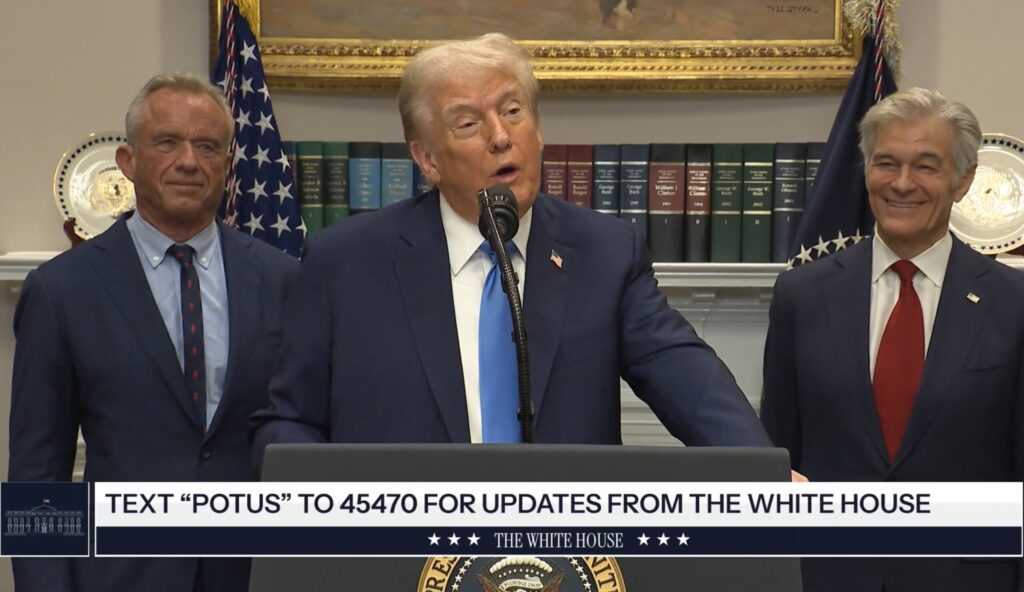
Recent studies show the increase in autism in America correlates with the use of acetaminophen, the active ingredient in Tylenol, during pregnancy, President Donald Trump said in a press briefing Monday.
The president was joined by U.S. Health and Human Services Secretary Robert F. Kennedy, Jr., who is helping spearhead the research, which is ongoing.
“Today, the FDA will issue a physician’s notice about the risk of acetaminophen during pregnancy and begin the process to initiate a safety label change,” Kennedy said. “HHS will launch a nationwide public service campaign to inform families and protect public health.”
Kennedy also announced a promising therapy that can aid children diagnosed with autism.
“We have also identified an exciting therapy that may benefit large numbers of children who suffer from autism,” Kennedy said. “Peer reviewed literature has documented that up to 60% of folate deficient children with ASD (Autism Spectrum Disorder) can have improved verbal communications.”
U.S. Food and Drug Administration Commissioner Martin Makary cited numerous studies linking acetaminophen use during pregnancy to prenatal neurological developmental disorders.
Boston University and Johns Hopkins researchers found “consistent associations between acetaminophen in pregnancy and autism,” Makary said. The Nurses Health Study with researchers from Yale University, Columbia University and Harvard University surveyed 9,000 children and linked acetaminophen use in pregnancy to neuro-developmental disorders, he continued.
“Four weeks ago, a Mount Sinai Harvard study reviewed all the existing literature and found the overwhelming body of evidence points to an association,” Makary said, explaining that they could no longer wait for more evidence and decided to announce right away.
Makary also said this research has “opened the door for the first FDA recognized treatment pathway for autism.” Based on NIH research, the FDA announced the approval of the prescription leucovorin for the treatment of autistic children, Makary said.
This research came after updated statistics in May reported 1 in 31 children in America are diagnosed with autism, according to the U.S. Centers for Disease Control and Prevention.
“The autism epidemic has now reached a scale unprecedented in human history because it affects the young,” Kennedy said in an April press release. “Autism is preventable and it is unforgivable that we have not yet identified the underlying causes. We should have had these answers 20 years ago.”
Autism is more than three times as frequent in young boys as young girls, CDC reported. Although diagnoses of autism now include “high functioning” individuals, this expansion does not account for the significant rate of increase in the past two decades, according to the press release.
Nearly two-thirds of children diagnosed with autism suffer “severe or borderline intellectual disability,” the release said. At Monday’s briefing, Trump said autism rates are nearly zero among communities who abstain from most modern medicine – such as the Amish.
Dr. Dorothy Fink, director of the Office on Women’s Health, who is also a pediatrician and mom, addressed the parental concerns of whether to take acetaminophen during pregnancy.
“It’s hard to hear information that challenges the status quo,” Fink said. “We are sharing this information not to confuse but to empower parents to make the best choices when taking medications during pregnancy. …
“Pregnant women who need high fever or pain reduction during pregnancy should take the lowest effective dose of acetaminophen for the shortest possible duration,” Fink said. “Most women will not meet these indications during their pregnancies.”
The Autism and Developmental Disabilities Monitoring (ADDM) Network of the CDC first began tracking the rate of autism in 2000, when the rate was 1 in 150 children. At a cabinet meeting in April, Kennedy said the rate was 1 in 10,000 during his childhood (late 1950s).
“That’s a horrible statistic,” President Donald Trump said in April. “There’s got to be something artificial out there that is doing this.”
RFK assembled a team of “world-class scientists” to determine the “origins of the epidemic,” according to the HHS press release.
On Monday’s briefing, Trump implied and Kennedy confirmed an investigation into the potential relation of vaccines to the rise of autism is ongoing.
“Autism is a complex disorder with multifactorial etiology,” Kennedy said. “We are continuing to investigate multiplicity potential causes with no areas of taboo. One area that we are closely examining, as the President mentioned, is vaccines.
“Some mothers who have children with autism believe that their child was injured by a vaccine. President Trump believes that we should be listening to these mothers instead of gas lighting and marginalize them.”
Dr. Jay Bhattacharya, director of the National Institutes of Health, announced an additional $50 million devoted to studying the causes of autism.
“Genetics alone can’t explain such a sharp rise in autism prevalence over the just a few decades, as the President said,” he said.
Two mothers of autistic children also spoke, thanking the Trump administration for its research.
HHS also published a press release with the announcement.