Blue state governors face decision on new federal school choice program
Public schools are failing too many children across the U.S., and blue state governors can help change that by opting in to the new federal school choice program.
That’s the word from Ian Rowe,…
Public schools are failing too many children across the U.S., and blue state governors can help change that by opting in to the new federal school choice program.
That’s the word from Ian Rowe, a senior fellow at the American Enterprise Institute, and Jorge Elorza, head of Democrats for Education Reform.
The pair authored an article explaining the crisis in public schools and how leaders of blue states – most of which lack school choice programs – can give struggling students more options.
“According to the Nation’s Report Card, in 2024, 40 percent of fourth-graders across the country performed below basic proficiency, the worst reading scores in more than 30 years,” the authors wrote. “These children struggle with understanding simple stories or comprehending the meaning of common words. Many of their parents hold onto a dream of something different for their child.”
Too often, their only option is “a zoned neighborhood school that, for decades, has graduated single digit percentages of students ready for college.” But a school choice provision included in the “one big, beautiful bill” signed by President Donald Trump in July would open school choice to residents of any state – as long as the state’s leadership opts in.
ECCA empowers taxpayers and families
The Educational Choice for Children Act (ECCA) allows taxpayers to receive a federal tax credit of up to $1,700 for donated funds to a scholarship-granting organizations (SGOs). The SGOs then distribute scholarships to qualified students whose families earn less than 300% of the regional median income. Most U.S. families would qualify since nationally, the average cap would be a household income of $256,000 for a family of four.
While Rowe and Elorza call the program a “no-brainer,” they acknowledge concern that Democratic governors, “under political pressure from national teachers’ unions, may refuse to participate, effectively cutting off tens of thousands of students from these scholarships.”
They note how federal programs cut both ways, calling this the “education equivalent of the decision faced by Republican governors in 2012 whether to accept or reject Medicaid expansion dollars under the Affordable Care Act.”
Political pressure
“Loud voices on the left are already pressuring Democrats to reject the funding – which would be a mistake,” the authors wrote. “Randi Weingarten, president of the American Federation of Teachers, has falsely claimed that ECCA is ‘literally taking money from our most vulnerable students’ and handing it to ‘rich folks’ for vouchers. But ECCA uses voluntarily donated dollars to expand access to education, not shrink it.”
Diane Ravitch, another activist, “is mobilizing state petitions to reject the funding as a purported ‘bait-and-switch … a calculated effort to close neighborhood schools and hand taxpayer dollars to private schools and homeschool operators.’”
But polls have found widespread support for school choice, including among both Republicans and Democrats. Universal school choice, present in 18 states, is especially popular.
The potential for good is significant: If just 1% of New York taxpayers donated the $1,700 credit limit, it would generate $170 million, enough to give 34,000 students a $5,000 scholarship – enough to cover tuition at inexpensive private schools or make other schools more affordable.
So is the potential for loss: Besides thousands of students remaining trapped in failing schools, Rowe and Elorza note that taxpayers in non-participating states can still give through the ECCA, but the money would go to scholarships in states that have opted in.
“The math is clear. The politics are clear. And the moral choice is clear. For the sake of millions of children, let’s hope governors and legislatures make the right call.”
Dem-heavy states weighing the options
Blue states are already considering their options.
Washington Gov. Bob Ferguson, a Democrat, has directed his staff to “analyze whether we can use these funds in a way that benefits public school students,” but says he is “deeply skeptical of voucher programs that could harm our public school system.”
However, Vicki Murray of the Center for Education at the free-market Washington Policy Center says it’s not a voucher program – a term often used by school choice opponents – and it doesn’t take money from public schools.
“This is a win-win for virtually all Washington school children and Washington taxpayers,” she told The Center Square. “A voucher scholarship is paid for with public funds or government appropriations. But tax credit scholarships are privately financed scholarships.”
Participation would boost limited school choice options in the Evergreen State and “enable families with limited means to access private and religious schools and supplement instruction and resources for students at district public schools,” write Peter Murphy of the Invest in Education Coalition and Jason Mercier of Mountain States Policy Center.
“States participating in this federal tax credit is a “win-win” scenario that provides students scholarship opportunities to pursue the public or private education model that fits their learning needs at no state cost,” they said. “Governors should choose to help all the children of their states with greater private resources for K-12 education. The choice is obvious.”
Flexibility for blue states that opt in
In a separate article, Jon Valant of the left-leaning Brookings Institution said another reason Democratic governors may want to opt in is to help struggling students who remain in public schools, since the ECCA can fund needs such as tutoring, transportation and enrichment services in underserved districts.
“My hope is that blue states take a hard look and ask: Can this be used to address our own needs?” Valant told Stateline.
School choice is booming in the U.S., with about half of all students being eligible by next school year, according to estimates by FutureEd, an independent think tank at Georgetown University.
Red states that have programs in place will likely join the federal effort, leaving blue states to decide if they want to take part or let the money go elsewhere.
Valant said one incentive for states to opt in is they can shape their own guidelines for the program within the broad rules established by the federal government. That could mean lowering the income limit or limiting participation to certain schools with favorable policies.
“There’s quite a lot of room here for state regulation,” he said.
States have until January 2027 to submit a list of qualified SGOs to the U.S. Treasury Department in order to participate, The Center Square reported.
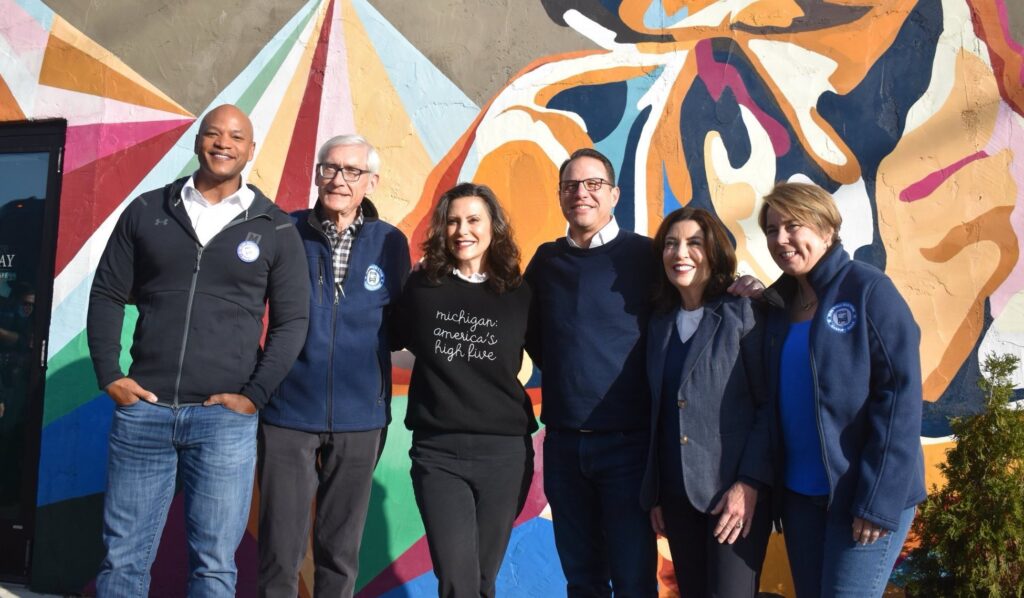
Featured Image: Democratic Governors Association (Facebook)