
Drone warfare dominates Russia-Ukraine war as peace prospects dim
The drone war over Ukraine entered a darker chapter this week as Russia launched wave after wave of unmanned aerial attacks targeting civilians.
Meanwhile, Ukraine President Volodymyr…
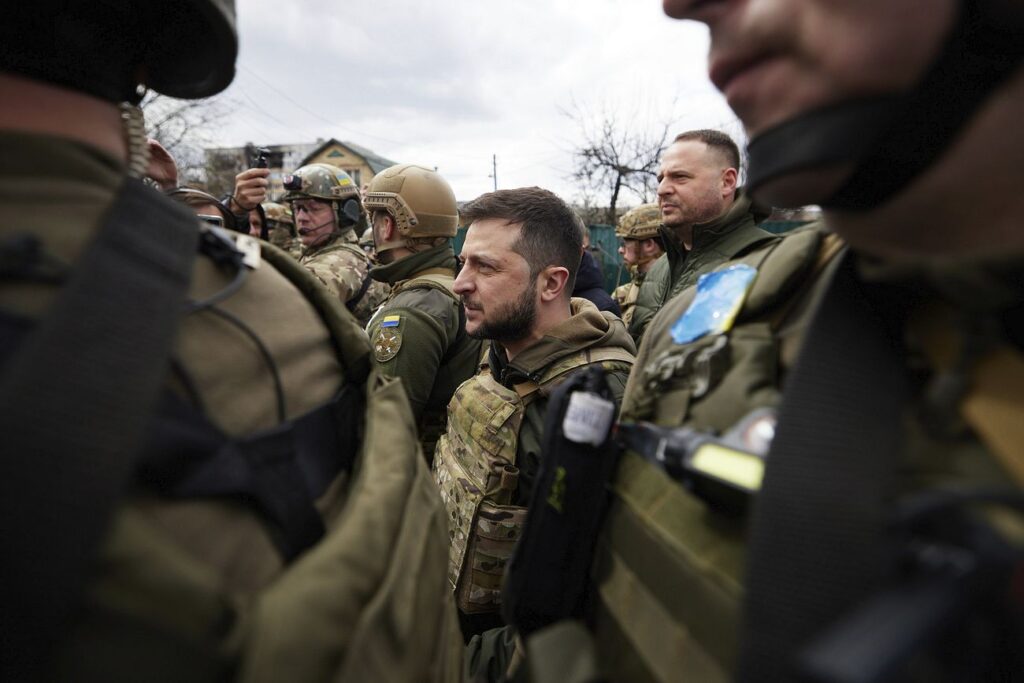
The drone war over Ukraine entered a darker chapter this week as Russia launched wave after wave of unmanned aerial attacks targeting civilians.
Meanwhile, Ukraine President Volodymyr Zelenskyy flew to Istanbul for talks that produced photo-ops but few results.
A Russian drone strike on Ukraine’s southern port city of Odesa killed two women and a toddler Sunday night, while Ukrainian long-range drones struck Russia’s key Black Sea export port at Novorossiysk, Zelensky said.
“Sixteen people have been wounded,” he said on X. “Eleven of them have been hospitalized by our medics, including a pregnant woman and two children. The youngest is not even a year old. Two people have also been injured in the Kharkiv region.”
The strikes resulted in the deaths of 10 people with several dozen more nationwide listed as wounded, officials on both sides said, according to the Associated Press (AP).
Rescuers working under floodlights pulled four people from the rubble of a heavily damaged apartment block, noted the AP.
The numbers tell the story of war machines running at full throttle on both sides.
Over the past week alone, Russia launched more than 2,800 attack drones, nearly 1,350 powerful glide bombs and more than 40 missiles of various types at Ukraine, according to Zelenskyy.
Russia is following a deliberate attrition strategy using area bombing against indiscriminate targets on a scale not seen since World War II.
Russia has used mass drone and missile strikes against civilians in a deliberate strategy to erode Ukraine’s will to fight “through volume, persistence, and psychological strain,” according to the Center for Strategic and International Studies.
Russian tactics of nighttime and daytime strikes are similar to how Iran has used such strikes against Israel and the Gulf, noted an analysis at the Kyiv Post.
Ukraine is answering the attacks with increasing sophistication.
In March 2026, for the first time in the war, long-range drones launched by Ukraine at Russia was equal to or greater than the number Russia launched at Ukraine, according to a tracker at the Kyiv Post.
Ukraine’s domestically developed long-range drones now reach targets some 1,500 kilometers inside Russia, the AP said.
Russian State Duma Deputy Andrei Gurulyov said Russia is too vast to fully shield from Ukrainian drone strikes according to the Kyiv Post. Russia “lacks the air defense forces needed to create a continuous protective shield…(forces) are stretched too thin,” added the Duma member, who is also a retired lieutenant general.
Over the weekend, retired U.S. General David Petraeus said Ukraine now had the upper hand on the battle space, noting one Ukrainian contractor would be manufacturing 3 million drones this year.
“Over the last two months, the Ukrainians have actually made greater incremental gains than have the Russians,” he told CBS News over the weekend, claiming drones are creating a new type of warfare.
That may be true, but peace doesn’t come from incremental gains – at least not for Russia and Ukraine.
Zelenskyy, meanwhile, touched down in Istanbul, Turkey, for what the foreign policy establishment hoped was a diplomatic breakthrough.
Turkish President Erdogan received Zelenskyy on April 4 for what officials described as “substantive” security talks, after speaking with Putin by phone earlier that same day, urging him to avoid escalation.
“We are working to strengthen our partnership to ensure the real protection of lives, advance stability, and guarantee security in Europe and the Middle East. Joint efforts always yield the best results,” Zelenskyy said after arriving in Istanbul, noted the AP.
Erdogan told Zelenskyy that Turkey would continue to support negotiations between Ukraine and Russia to end the war.
Erdogan offered Istanbul as a platform for peace talks with Russia, while Zelenskyy said Ukraine is ready for a meeting of leaders in any format.
But Russia isn’t interested.
Russian President Vladimir Putin’s position remains unchanged: it’s not going to give up territory it already holds.
And the prospect for ending the conflict with a peace agreement meeting Russia’s conditions of more territorial concessions by Ukraine is also slim.
The Institute for the Study of War assesses that Russian forces will likely shift their long-range strike campaign toward Ukrainian water supply and logistics targets in the spring and summer of 2026.
With mass drone attacks continuing and neither side gaining much ground, it seems more like an aerial version of trench warfare than the revolutionary breakthrough Petraeus has described.
Still, at least one analyst is noting the war is not necessarily a stalemate, but is accelerating, with peace largely out of the hands of the Ukrainians.
Three vectors will define the war’s end: whether Putin mobilizes more troops, whether Europe pays up and whether China’s president, Xi Jinping, goes all in, said Nigel Gould-Davies, senior fellow for Russia and Eurasia at the International Institute for Strategic Studies.
“The grand strategic future depends on Russia’s home front, Europe’s finances and China’s calculations,” he concluded.