Education lobby gearing up for funding fight in Kansas, as formula review begins
(The Sentinel) – The Kansas Education Funding Task Force has begun meeting to discuss potential changes to the school funding formula before it expires in 2027, and the battle lines are already…

(The Sentinel) – The Kansas Education Funding Task Force has begun meeting to discuss potential changes to the school funding formula before it expires in 2027, and the battle lines are already drawn. Several student-focused members are looking for ways to encourage better student outcomes, and the system-focused members just want more money.
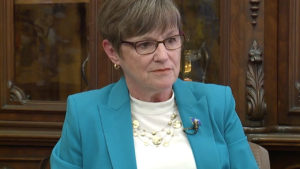
State Rep. Susan Estes (R-Wichita) said threats of lawsuits have been popping up before the task force has taken a vote on any changes to the formula.
“I’ve been disturbed that I’m getting phone calls from superintendents who are saying they are being told, ‘we’re going to need a lawsuit, districts with less than 100 students are going to cease to exist, and then…down the road, those with less than 250,’” Estes said. “I think it’s very important that things that have not even been voted on not be put out there as something that is going to happen.
“It breaks my heart that we don’t even have a formula, and already some people are headed to a lawsuit, and we haven’t even made a single decision.”
The task force is working on a new school funding formula to replace the one the Kansas Supreme Court agreed to in 2019, which ended the long-running “Gannon” lawsuit over school funding in Kansas.
It’s far from the first time the education lobby has threatened a new lawsuit, and, indeed, partially over the same issue brought up in the most recent meeting — special education, or “SPED” funding.
The State Supreme Court determined in 2019 that the Legislature met the Court’s definition of adequate school funding, including increases in SPED funding. But that didn’t stop education officials in 2024 from threatening another lawsuit over special education funding, even though the Legislature has provided the increases it promised the Court — an initial increase of $44 million plus $7,5 million annually thereafter.
The Court’s acceptance should have prompted legislators to remove the statute that requires the state to reimburse school districts for 92% of their excess SPED costs, but they didn’t. Now school leaders are threatening to sue again.
Court ruling aside, the formula to calculate 92% of excess costs does not credit the state with all funding provided that is related to special education. Local Option Budget funding is counted toward the regular education costs of special education students, but the LOB generated by special education funding is not. If all funding is counted, the state provided 104% of excess costs last year.
Moreover, Taskforce Chairwoman Sen. Renee Erickson (R-Wichita) said she had also been approached at a meeting about potential lawsuits.
Erickson said at an event that someone who had attended a recent Kansas Council of Superintendents meeting told her that districts were being encouraged to join “Schools for Fair Funding” because they were “gearing up for a lawsuit.”
“I said, ‘Can you please send me documentation of this?’” Erickson said. “In a few hours, I had the most startling statement made during our discussion that schools with student populations of less than 100 will cease to exist within the next three years.
“Now I’m not saying who made those comments, but I am saying, if we are going to come to this table in good faith, there has been poisoning of the well against this process already, and superintendents are worried,” she said. “It doesn’t benefit anyone to poison the well and already start gearing up for an expensive lawsuit without even having anything to sue over yet.”
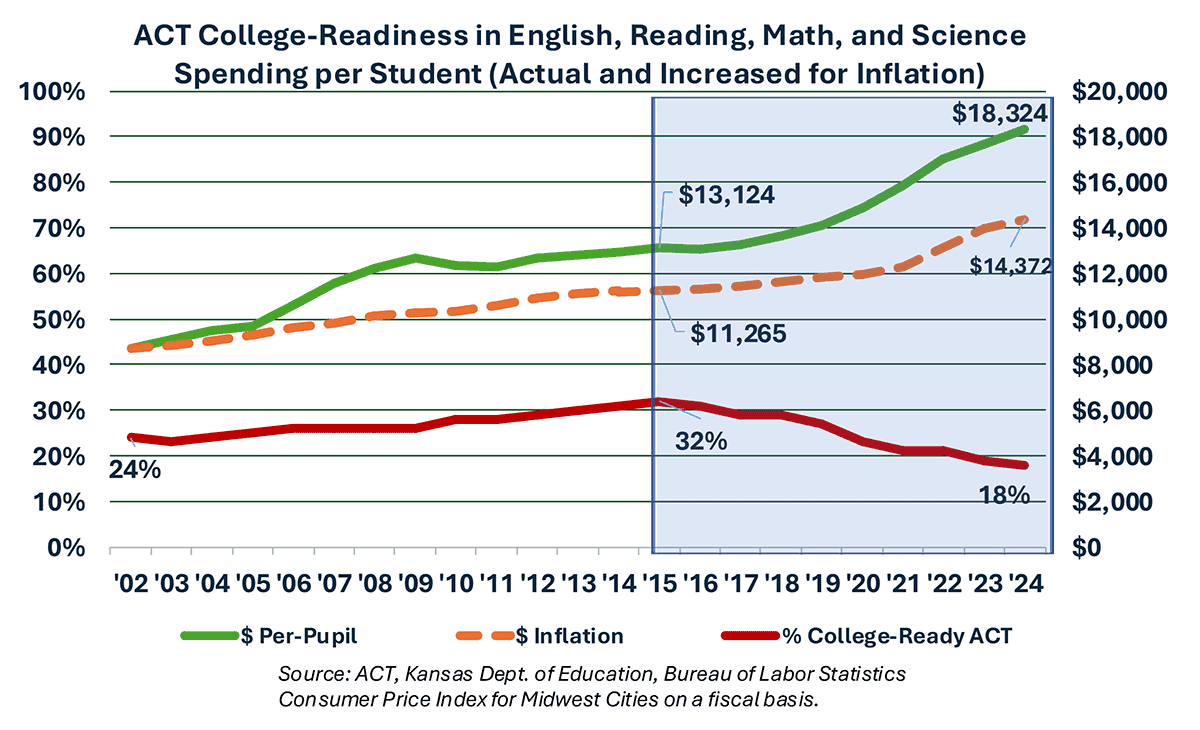
The current funding formula has produced large increases in per-student funding, but outcomes still declined. Only 18% of 2024 Kansas graduates were college-ready in English, Reading, Math, and Science on the ACT,, down from 32% in 2015.