EXCLUSIVE: Energy experts urge Congress to act as energy crisis looms: ‘just do it’
American power demand is surging while an outdated grid and stifling policies strain the system, according to leading experts urging Congress for reform.
At a Senate Energy and…
American power demand is surging while an outdated grid and stifling policies strain the system, according to leading experts urging Congress for reform.
At a Senate Energy and Natural Resources Committee hearing Wednesday, several energy policy experts testified that Congress must enact meaningful permitting reform and allow for a competitive electricity market.
One testifying expert, Cato’s Director of Energy and Environmental Policy Studies Travis Fisher, told The Lion in an interview that the U.S. bulk power system has remained largely unchanged for a century.
Fisher noted during the hearing that even Thomas Edison would recognize parts of the current American power grid because of this lack of innovation.
“To put it charitably, we’ve had precious little innovation, and I think in part, that’s because policymakers initially were focused on universal service, getting electricity to everybody [and] making sure that rates were just and reasonable,” Fisher told The Lion. “The focus was not on a dynamic, competitive industry … [so] the bulk power system as we know it is mostly the same. The utilities that the father of the modern utility Samuel Insull built are essentially the same ones that we have today.”
Fisher explained utilities were once considered “natural monopolies,” which ushered in regulations and capping returns – “the first wrong step,” he said. “I don’t know that any monopoly is natural per se, and it’s definitely unnatural if the government regulates it and ensures it. So, there’s this irony: [utilities] are monopolies, but they have remained so because they’ve been legally protected for a century.”
If the system were privatized, states would no longer be “gatekeepers on investment,” meaning that utilities would be free to invest in the grid without additional bureaucracy, Fisher told The Lion.
“If it’s a private network, you don’t have to ask anyone. You just do it. So, that’s why I’ve termed it ‘quintessentially American.’ Just do it,” Fisher said, noting that he has seen private networks gain traction in regions such as New Hampshire, Ohio and Utah.
Also testifying Wednesday was Liza Reed, director of climate and energy policy at the Niskanen Center and Todd Snitchler, president and CEO of the Electric Power Supply Association. They both argued Congress can help remove regulatory barriers necessary for competition and innovation.
It comes as the Trump administration has been warning about a potential power grid crisis, with the Department of Energy (DOE) noting in July 2025 that blackouts could increase by a factor of 100 by 2030 if the U.S. continues to phase out retiring power sources without replacing them. Several Democrat-led states have mandates to phase out conventional power sources such as coal to reach certain emissions goals, and one Institute for Energy Research analysis notes that blue states tend to have higher energy costs than red states.
Affordability continues to be a major talking point for Democrats and Republicans heading into the November midterms, with some lawmakers looking to pin rising energy costs on data centers and supply chain disruption due to the U.S. strikes on Iran.
Notably, Independent Vermont Sen. Bernie Sanders and Democratic New York Rep. Alexandria Ocasio-Cortez introduced legislation Wednesday that would pause building new data centers “to give democracy a chance to catch up” and ensure AI development will not raise electricity costs.
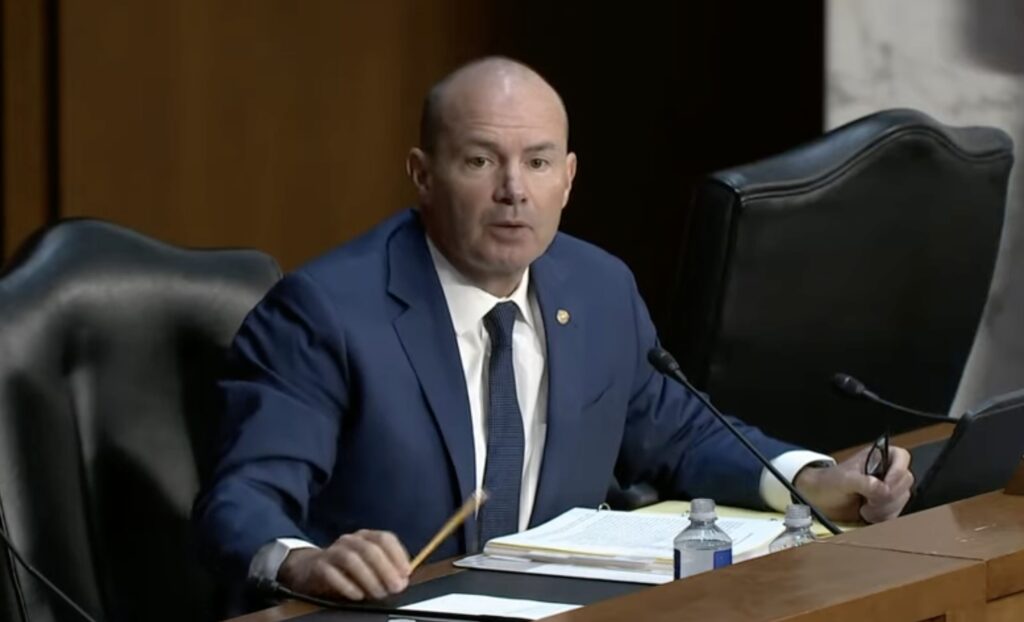
Republican Utah Sen. Mike Lee, the energy committee’s chairman, stated during the hearing that “over the past decade, we in the United States have retired dozens of gigawatts of reliable, dispatchable generation. For a time, that may have been manageable. … Without additional supply, we face severe consequences: higher costs, greater volatility and increased risks to reliability.”
Though demand was relatively flat for more than a decade, Lee noted, as artificial intelligence (AI), onshore manufacturing and electrification grow, the U.S. will need more dispatchable power.