Fighting erupts on Thai-Cambodian border as Trump expects both countries to honor agreement
A peace deal brokered by President Donald Trump is in danger as Thailand and Cambodia continued a second day of fighting on Monday in six separate border provinces.
The BBC is reporting the death…
A peace deal brokered by President Donald Trump is in danger as Thailand and Cambodia continued a second day of fighting on Monday in six separate border provinces.
The BBC is reporting the death toll so far is 10, including seven Cambodian civilians with thousands of others being displaced from their homes.
The BBC reported three Thai soldiers have been killed.
The fighting represents decades of unresolved issues regarding border demarcations caused by the French hasty retreat from Indochina in the 1950s.
Thailand has also complained about illicit drug smuggling and human trafficking by Chinese criminal rings made possible by cooperation with Cambodian military authorities.
In July, Thailand closed border areas with Cambodia to combat illegal trade, including Chinese call center scam operations that rely on trafficked human labor, as previously reported by The Lion
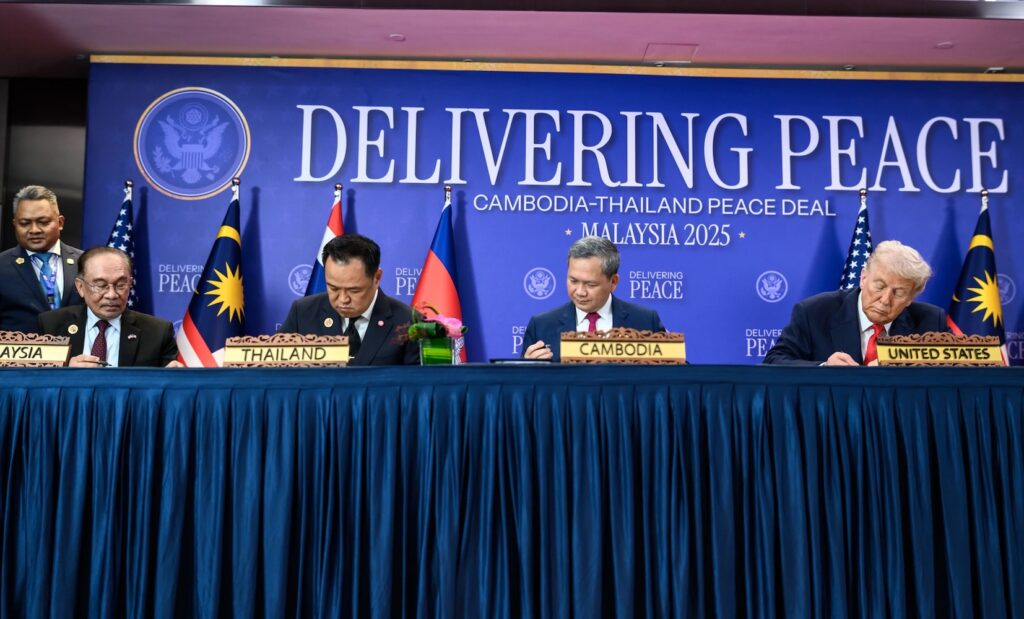
In October, Trump secured a peace deal between the two rival states as he brokered trade deals with Malaysia and Cambodia in Kuala Lumpur.
Thailand said of the most recent fighting that it won’t consider a ceasefire until Cambodia makes diplomatic moves to prove it sincerely wants an end to the conflict, reported the Associated Press (AP).
“We’ve got to do what we’ve got to do,” said Thai Prime Minister Anutin Charnvirakul, according to the AP. “The government will support all kinds of military operations as planned earlier.”
Thailand’s Foreign Minister Sihasak Phuangketkeow told Reuters in an interview that Cambodia could simply stop the fighting if it wanted a ceasefire.
“If the other side feels that they want to really end the conflict, then we’re waiting to listen to what they have to say,” he said. “What Cambodia can do is stop what they’re doing and say that they’re ready to have talks.”
Thailand claims that seven of its soldiers have been wounded by landmines placed by Cambodia around the border regions, a principal cause of the renewed fighting.
Royal Thai F-16s reportedly leveled a border casino on Tuesday that was being used by Cambodian forces to host military facilities and drone operations, said the Bangkok Post.
The Post said the facility was used to conduct artillery strikes into Thailand, along with operations that used air-dropped munitions resulting in the death of one Royal Thai soldier.
Cambodia for its part said it’s open to bilateral negotiations with Thailand.
“Let’s say one hour from now, both sides agree to be on the table and then start communication,” Suos Yara, senior adviser to Cambodian Prime Minister Hun Manet, told Reuters in a video interview from Phnom Penh. “This would be a very good idea.”
Suos said the placement of landmines is no excuse to go to war.
President Trump hasn’t commented publicly, but administration officials told the Turkish news agency the president expects both Thailand and Cambodia to keep their agreements made in the recent ceasefire he negotiated.
“President Trump is committed to the continued cessation of violence and expects the governments of Cambodia and Thailand to fully honor their commitments to end this conflict,” the official, who spoke on the condition of anonymity, told the Anadolu Agency, Turkey’s state-run news service.
Trump previously used trade negotiations with Cambodia and Thailand to encourage them to sign the October agreement.
The Thai foreign minister said this time around he doesn’t think the threat of tariffs should be used to bring the parties back to negotiate.
“We don’t think tariffs should be used to pressure Thailand to get back to the joint declaration, to get back to a dialogue process,” Sihasak Phuangketkeow said in an interview with Reuters in Bangkok, referring to the ceasefire agreement. “You have to separate the issue of Thai-Cambodia relations from the issue of the trade talks.”
But it’s likely Trump will invoke tariff pressure to again get the two sides to the table, as the administration seeks Indo-Pacific stability, while the US defense posture is increasingly realigned to face China as the main competitor.