Florida teachers, students recount ‘all good things’ after cellphone bans: higher test scores, retention, learning
Want more engaged students who participate actively in classrooms, improve academic performance and connect more closely with their peers?
Then consider banning cellphones throughout the…
Want more engaged students who participate actively in classrooms, improve academic performance and connect more closely with their peers?
Then consider banning cellphones throughout the schoolday, suggests Tona Cooksey, who teaches math at North Fort Myers High School in Florida.
“I have actually seen an improvement in scores, in retention, and in emotional connection. They are much more willing to get up, move about the room. I love it. I’ve just seen all good things,” said Cooksey, who has taught for 22 years. “This year’s students are probably a little bit further ahead than last year’s kids. It just tells me that we’re picking back up where we need to be.”
WINK News reported on the statewide ban passed in the 2025 legislative session, which built on previous efforts allowing teachers to limit cellphone use in classrooms during “instructional time.”
Now, the ban extends to all students during school hours.
“I love it that they don’t have their phones in hand, and for those who are struggling with that, I’m working with them to be able to part with their phones,” said Tara Basile, another math teacher. “It was just a distraction, because all they wanted to do was pull the phone out to text or scroll through TikTok, rather than do the work that they’re supposed to be doing in class.”
‘No time for dilly-dallying on your phone’
Even students such as Justin Stevens, a junior at the school, credit the ban with improving their overall learning experience.
“I definitely think the change is positive,” he said. “I think it has many more benefits than it has cons. I like that everyone’s focused, everyone’s talking with one another. It’s much livelier than it was the past two years.”
However, the new policy didn’t pass without student pushback.
“According to the Lee County School District, in the first month of the new policy, school administrators at North Fort Myers High confiscated 351 phones,” WINK News wrote.
Over time, school officials recorded a steady decline in confiscations – dropping to 23 repeat offenders in October compared to 40 in September, according to the news article.
“If they see your phone, they will definitely take it 100%,” Stevens noted. “Everyone’s focused, everyone’s attentive. There’s no time for dilly-dallying on your phone.”
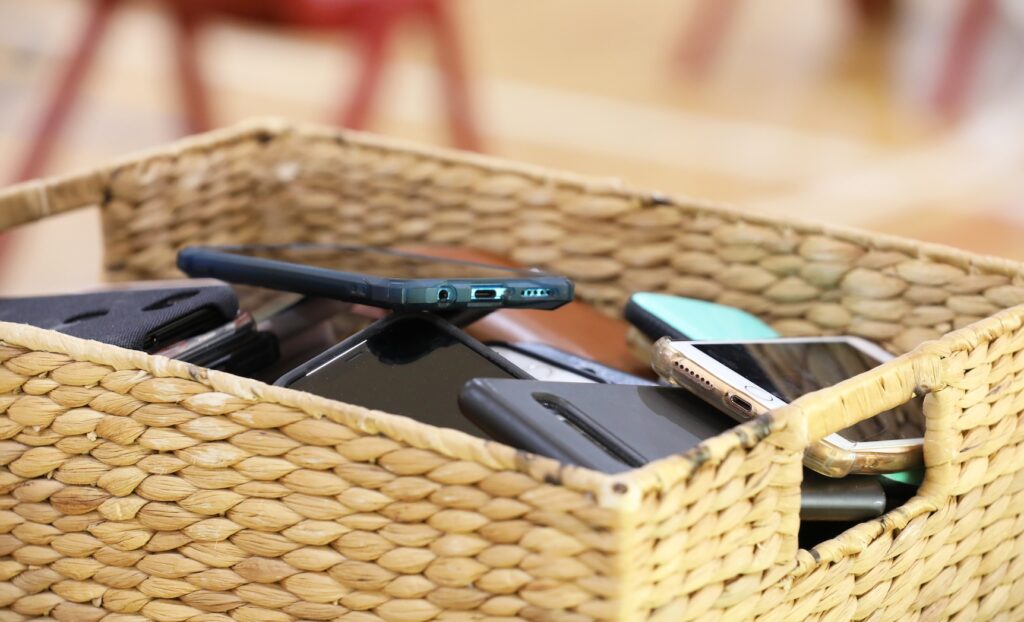
While phones are allowed on school campuses, they must stay in backpacks from 7 a.m. to 2 p.m., explained the school’s principal, Debbie Diggs.
“I think big picture is it’s been a really good thing for all of our schools, across the board, the level of engagement when you talk to teachers, and even when you talk to kids, they’ll kind of laugh about it in the halls,” Diggs said. “We’re seeing a big difference even in the halls. When we were just walking the halls, you know, (it) used to be that kids would have their phones out in the halls, and there was just a feel of a lot more drama during the day from a behavior standpoint.”
Recently, Central Florida Public Media acknowledged a recent report from the National Bureau of Economic Research finding improved test scores and student behavior statewide after Gov. Ron DeSantis signed cellphone regulations into law.
“Beginning in 2023, as part of a collection of state laws known as the ‘Teachers’ Bill of Rights,’ K-12 students were not allowed to use their phones during instructional time,” the news outlet reported.
“The report published this month initially found suspensions spiked in the policy’s early adoption, especially amongst Black students.
“But after the first year, disciplinary actions were down. By the second year, fewer Florida kids were absent from class and test scores had improved.”