
Increased Chinese activity in Arctic highlights Trump’s emphasis on US shipbuilding
Fixed wing U.S. Coast Guard (USCG) aircraft overflew two Chinese intelligence vessels operating in the U.S. portion of the Arctic – part of an increasingly active Chinese presence there, the USCG…
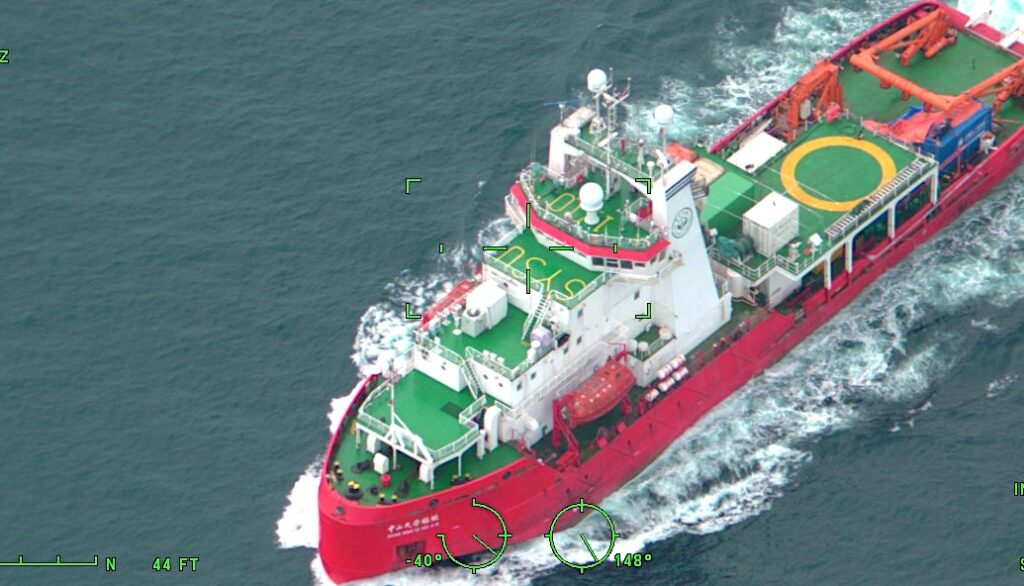
Fixed wing U.S. Coast Guard (USCG) aircraft overflew two Chinese intelligence vessels operating in the U.S. portion of the Arctic – part of an increasingly active Chinese presence there, the USCG says.
“The presence of these vessels is consistent with a three-year trend of increased activity from Chinese research vessels operating in the U.S. Arctic,” said the USCG.
The incident also highlights President Donald Trump’s urgency in rebuilding U.S. shipyard capacity to match China and Russia stalking claims to the polar territory.
In addition to the two intelligence vessels operated by research universities under the Chinese fusion strategy – which uses research to disguise military intelligence collection – three other Chinese vessels have also been detected in the Arctic.
In response, the Coast Guard launched an aircraft to intercept and observe the vessels.
“On Aug. 5, a C-130J Hercules fixed wing aircraft from Air Station Kodiak responded to the Chinese research vessels Ji Di and the Zhong Shan Da Xue Ji Di. Both vessels were transiting northeast in the Bering Sea,” the Coast Guard said.
The War Zone (TWZ) previously reported five total Chinese vessels operating in the area, calling the appearance of so many “research” vessels “unprecedented.”
Using criteria under a UN formula, the U.S. has declared rights in certain exclusive economic zones (EEZ) and the extended continental shelf (ECS), which stretch 200 nautical miles to the adjacent seas.
The Xue Long 2 was detected 290 nautical miles from Utqiagvik, Alaska, in the U.S. EEZ, making an unannounced visit, which suggests intelligence gathering.
EEZ territorial rights also include the water column from the top to the bottom of the sea, whereas the ECS only include seabed and subsoil rights.
The number of Chinese ships operating in the Arctic is 2.5 times the numbers of total U.S vessels currently capable of operating in the region, TWZ noted.
Over the weekend, the USCG commissioned its newest icebreaker/research vessel, the Storis (WAGB-21), which brings the total U.S. icebreaker fleet up to three, although dozens more are planned for construction.
The most advanced ships, however, are not expected to come online until 2030.
The USCG notes it’s the only U.S. surface fleet operating in the Arctic.
Typically, the U.S. Navy uses submarines with ice-breaking capability to patrol the Arctic, but sea melt is allowing the deployment of surface fleets as well. The U.S. Navy’s submarine fleet has an estimated 10-20 vessels currently capable of operating in the Arctic.
Sea melt is increasingly leading China to consider ways it can exploit the Arctic by shortening its transportation routes into Europe, exploiting mineral and other resources and gathering intelligence.
In an executive order dated April 9, Trump said the U.S. would rebuild its maritime ship construction capacity to enhance national security – specifically calling out Arctic threats.
“Within 90 days of the date of this order, the Secretary of Defense, in consultation with the Secretary of Transportation, the Secretary of Homeland Security, and the Commandant of the Coast Guard shall develop a strategy that identifies the vision, goals, and objectives necessary to secure arctic waterways and enable American prosperity in the face of evolving arctic security challenges and associated risks,” the order read.
The USCG called the recently passed One Big Beautiful Bill Act the largest single funding commitment in Coast Guard history, including $4.3 billion for Polar Security Cutters, $3.5 billion for three Arctic Security Cutters and $816 million for light and medium domestic icebreaking cutters.
“The Coast Guard Arctic District works in conjunction with international partners, U.S. Northern Command, and Alaskan Command to constantly monitor the activity of foreign vessels operating near U.S. sovereign waters and the extended outer continental shelf to ensure homeland security, homeland defense, and compliance with U.S. and international law,” the USCG said about Chinese incursions.
Photo: US Coast Guard (link)