Iowa, Indiana and Oklahoma seek flexibility on federal education funds
States including Iowa and Indiana are asking the federal government to let them spend money intended for low-performing schools as they see fit, possibly expanding educational freedom.
Iowa,…
States including Iowa and Indiana are asking the federal government to let them spend money intended for low-performing schools as they see fit, possibly expanding educational freedom.
Iowa, Indiana and Oklahoma – all leaders in school choice – are asking the Department of Education to group smaller grants into a single block grant to cut down on restrictions and allow the states more flexibility in using the funds.
Iowa and Oklahoma submitted their applications in March; Indiana will submit its proposal in September following a period of public comment.
The states are eyeing education funds allocated under the Every Student Succeeds Act, or ESSA, which support schools with high populations of low-income students, English-language learners, after-school programs, teacher training and other efforts.
In 2021-22, the federal government provided about 13.7% of what states spend on education, or about $2,233 per student. The states are seeking waivers and flexibility to use parts of those funds as they see fit, instead of being limited by federal mandates.
Oklahoma State Superintendent Ryan Walters says the block grant will eliminate restrictive “strings” attached to ESSA funds, allowing the state to address local needs and avoid redundancies.
“This historic waiver will empower parents, get politics out of the classroom, and put students first,” he said in March.
Iowa Gov. Kim Reynolds, whose state was first to submit its application in early March, said excessive requirements “prevent states from scaling innovative programs” such as ones that promote literacy and better math outcomes.
Indiana’s proposal would specifically allow it to spend funds intended to turn around low-performing charter and traditional public schools on any school that’s “actively seeking to serve students that would have otherwise enrolled in the eligible school,” Chalkbeat reported. This includes microschools, charter schools and creative partnerships with businesses or colleges and universities, and the schools would not need to be designated low-performing.
Struggling public schools would still be eligible, but the state would focus on making sure “students and families have timely access to better options when needed,” the state’s proposal says. “This flexibility ensures students and families no longer depend solely on political will for innovative opportunities to materialize.”
Indiana has embraced educational innovation, with one public school district even launching microschools to better serve students.
All three states have universal school choice, giving parents maximum freedom to choose the school or educational environment that’s right for their child.
The DOE has not responded to the states’ requests but is reportedly working with them to find waivers for specific requirements and modernize how certain rules are interpreted to allow for greater flexibility.
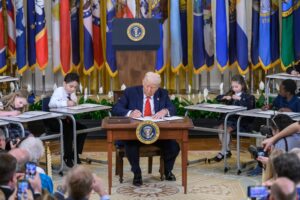
President Donald Trump and Education Secretary Linda McMahon have said their goal is to disband the Education Department and return control of education to the states. Trump signed an executive order in March to that effect.