Iran attacks could provide relief for African Christians
The massacres of Christian communities in eastern Congo and Nigeria by Islamic extremists could diminish with U.S.-Israeli action against Iran.
That’s because the weapons killing…
The massacres of Christian communities in eastern Congo and Nigeria by Islamic extremists could diminish with U.S.-Israeli action against Iran.
That’s because the weapons killing Christians in Africa have a supply chain, and that supply chain has Iranian fingerprints on it.
Those fingerprints may belong to a network that is degrading faster than many in the Christian world have noticed.
Alex Traiman, CEO and Jerusalem bureau chief of the Jewish News Syndicate, described an Iranian regime already showing serious structural cracks.
Traiman told The Lion the original strikes by U.S. and Israeli forces were an “incredible way to start the war that gives an indication that it can actually be some final battle.”
Most importantly for Africa’s Christians, Iran’s ballistic missile force is being systematically reduced, he said.
Traiman estimated the total stockpile of Iranian rockets at around 2,500 but said it has been greatly diminished because of a key bottleneck.
“Their ballistic missile force is being whittled down,” he said. “They’re burning through launchers, and if they’re pushed back to older liquid-fuel systems, that’s a serious step backward.”
The destruction of mobile rocket launchers would force Houthi proxies operating in Yemen toward older liquid-fuel systems. Those systems are vulnerable during extended preparation windows as rockets are fueled.
In the African arms trade, those rocket systems operate as a key defense, keeping Yemen secure as a depot for Iranian arms.
Breaking the supply chain
A comprehensive 2025 report documented that the Houthis, supplied with Iranian weapons, have been trafficking surplus small arms into Somalia for profit. It identified Somalia as a transshipment hub for Iranian-Houthi weapons, with Iranian Revolutionary Guard operatives coordinating weapons flows across the Red Sea into Africa.
The corridor connecting Iran, Yemen, Sudan and the Horn of Africa is not theoretical. It mirrors routes Iran has used globally to support militant groups.
“These arms of Iran – we saw that with narco-terrorism, for example, Hezbollah and all its activities in Latin America and the drug cartels – those are connected,” Ruthie Blum, a Tel Aviv-based journalist and political commentator, told The Lion.
From East African coastlines, weapons move west through Sudan into central Africa, ultimately reaching groups accused of massacring Christian communities.
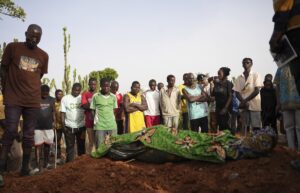
In eastern Congo, an ISIS-backed attack on a Catholic parish killed 64 Christians last year in what witnesses described as a premeditated attack on mourners, The Lion previously reported.
It was one of dozens of attacks that pushed the death toll past 600 Congolese Christians killed by the Allied Democratic Forces, a militant Islamist group, in 2025 alone.
ISIS claimed credit for an earlier July attack on a Catholic church in Ituri province.
On Palm Sunday, at least 40 Christians were killed by Fulani militants in Nigeria’s Plateau state, with thousands more displaced.
Enemies united against Christians
Some have dismissed the ADF-ISIS-Iran connection because of theological differences between Sunni groups such as ISIS and the ADF and Shiite Iran.
Blum disagreed.
“The Shiites and Sunnis are enemies theologically to a great extent; however, they are also allies when it comes to common enemies,” such as Christians, she said.
The weapons sustaining these campaigns do not materialize locally, according to reports. They move inland from Sudan.
The entry point feeds into an established smuggling network documented in reports that track serial numbers on weapons to Iran. The arms move west through Sudan and south through the Great Lakes region toward areas where Christian communities have been targeted.
The military implications of Houthi degradation extend beyond Red Sea shipping lanes. A Houthi network pushed off mobile launchers and onto liquid-fuel systems is a network less capable of sustaining its own activities.
It also would be less able to serve as a weapons transshipment hub for Iranian logistics reaching into Africa.
Christians in Nigeria, Congo and central Africa were not the intended beneficiaries of U.S. and Israeli military operations in Yemen and Iran, but the weapons supply chain connecting Tehran to militant groups runs through nodes now being targeted.
“Jihadists all over the globe have been slaughtering Christians,” Blum said. “And of course Iran is the greatest state sponsor of that. It’s very underreported, the slaughter of Christians all over the world.”
It is a logistical dynamic that Western policymakers, Christian advocacy organizations and the Vatican have yet to fully address.
The military campaign degrading Iranian capacity in the Middle East could prove significant for African Christians.
Last month, several House Republicans introduced legislation to combat the persecution of Christians in Nigeria.