Jeb Bush: States should help create more private school options for families
Former Florida Gov. Jeb Bush, who helped launch the state’s school choice revolution 25 years ago, said government needs to do more to increase the supply of private school…
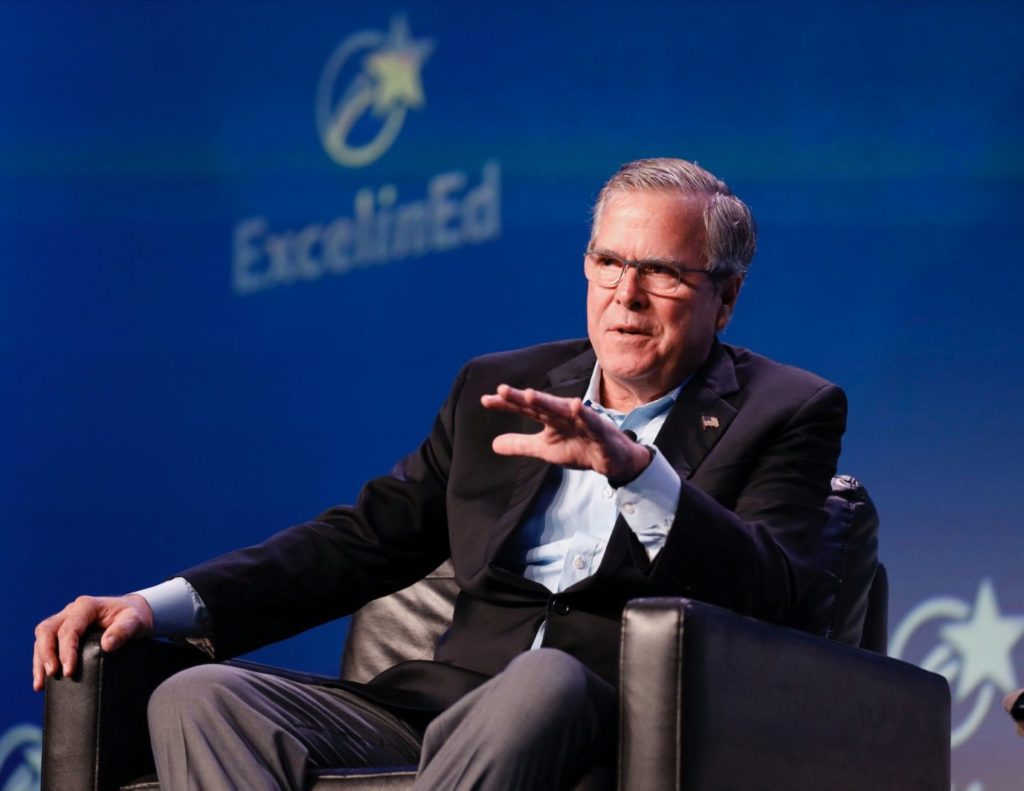
Former Florida Gov. Jeb Bush, who helped launch the state’s school choice revolution 25 years ago, said government needs to do more to increase the supply of private school seats.
Speaking to Michael Horn on The Future of Education podcast, Bush, who was joined by Primer school network founder Ryan Delk, said the state has a responsibility to ensure there are options for students who want them – and that includes increasing the supply side.
Private schools rely on private capital, but “this should be a state responsibility as well,” Bush said. “This is where we’re moving and there’s still – it’s work in progress.”
He compared school choice to Medicaid, where the government provides insurance but most of the care is provided by private providers, saying “the same mindset” should be applied to education.
“My hope and dream is that there’ll be a superintendent in Miami-Dade County or some other place that says every child that goes to school in my county is my responsibility, and I’m going to create a menu of options for parents, and I’m going to try to do everything I can to make sure that every child succeeds,” he said.
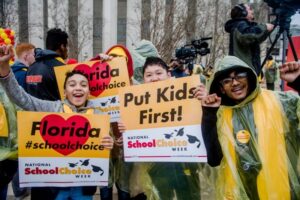
The Sunshine State has a nation-leading 530,000 students in its private school choice programs, which include Education Savings Accounts and tax credit scholarships. Additionally, it has a strong network of charter schools and public school enrollment policies such that the majority of students attend something other than their locally zoned school.
Even so, 41,000 school choice scholarships went unused last year because of a lack of seats.
Delk’s network is expanding its microschools and partnering with Schools for America to reform zoning laws, one of the main barriers to new schools opening or expanding.
Delk praised Bush for going “to the mat” for education freedom, including helping legitimize alternative schools such as microschools, which are now “celebrated and empowered.”
While Bush is delighted to see his legacy carried on by other governors, he warned about efforts to regulate school choice, especially to combat supposedly widespread fraud.
“I’ll use Florida as an example. We have several hundred thousand … ESA kids in our state. So you could have 1/10 of 1% of those transactions take place in a way that is inappropriate as they’re trying to sort out. You’re dealing with scale, it’s hard to do all that.
“And so then you know, ‘Senator Schmidlap’ will want to say, ‘Well, we need to like regulate this and regulate that.’ That’s the biggest danger is Washington getting involved or states trying to re-regulate to deal with the tiny fraction of problems. That impacts 99.9% of families.
“We should trust parents to make these decisions and then give them the tools to be informed consumers and give them an array of choices.”
The approach is one that school choice evangelist Corey DeAngelis repeatedly advocates: funding “students, not systems” and trusting market forces “to raise all boats.”
The podcast praised Bush for having the vision to fight for school choice. The brother of President George W. Bush and son of President George H.W. Bush said it came from his belief “that parents deserve to have this power to choose where their kids go to school.”
“If they do that, then there will be schools like Primer, more tools for homeschool kids. Charter schools will emerge. The religious schools that were in decline in terms of providing education to their students would see growth, all of that,” he said. “I was hopeful it would happen, and I’m proud that Florida has been a leader. But it’s also exciting to see it happen across the country.”
School choice has grown to more than 1.5 million participants across 35 states, up from 1 million two years ago. A federal school choice tax credit takes effect in 2027 and will expand school choice to more students and more states.