
Jewish woman once used in Nazi propaganda as ideal Aryan dies at 91
A Jewish woman whose infant photograph was unknowingly used by Nazi propagandists as the ideal image of the Aryan race has died at age 91.
Hessy Levinsons Taft died Jan. 1, 2026, at her…
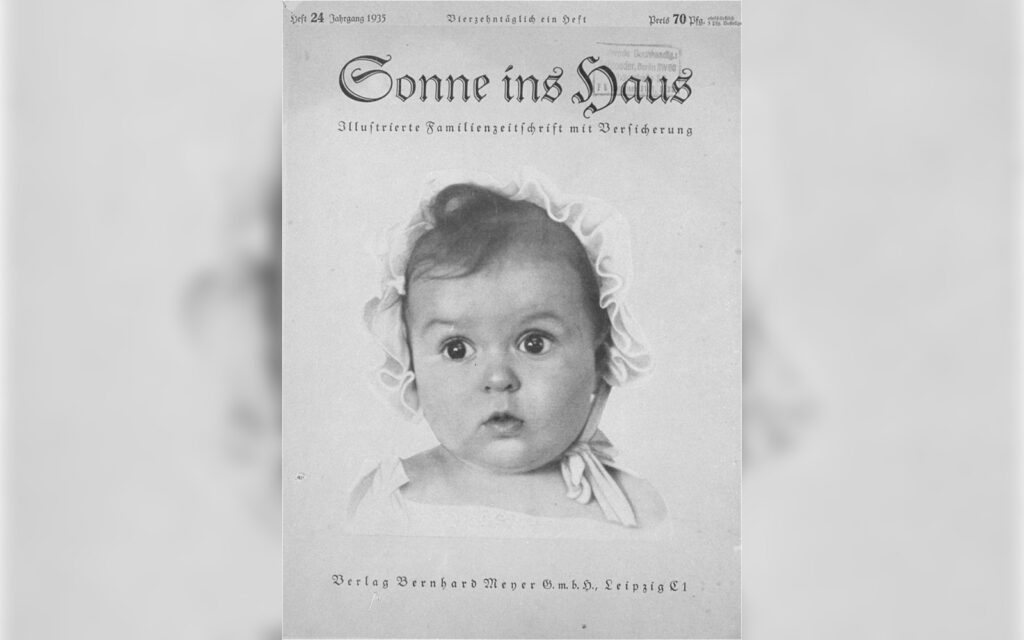
A Jewish woman whose infant photograph was unknowingly used by Nazi propagandists as the ideal image of the Aryan race has died at age 91.
Hessy Levinsons Taft died Jan. 1, 2026, at her home in San Francisco, according to The New York Times. She is survived by her children, Nina and Alex Taft, four grandchildren and her sister, Noemi Pollack.
In 1935 Berlin, Taft – then just 6 months old – was selected by a Nazi propaganda official as the face of the Aryan race for a pro-Hitler magazine, despite being Jewish.
“It is the story of a Jewish baby selected by loyal Nazis to serve as an archetypal example of the Aryan race, the theory which the Nazis’ leadership seized every opportunity to promote. I was that baby,” Taft wrote in Muted Voices: Jewish Survivors of Latvia Remember, a collection of essays edited by Holocaust survivor Gertrude Schneider.
Taft was born May 17, 1934, to two Jewish Latvian opera singers living and performing in Berlin. The family later changed its name from Lewinsohn to Levinsons.
A housekeeper first discovered the propaganda use of Taft’s photo after recognizing it on the cover of Sonne ins Haus – “Sun in the Home” – a pro-Nazi magazine that rose to prominence after Adolf Hitler shuttered thousands of other publications.
“On the inside of the magazine were pictures of the army with men wearing swastikas,” Taft later told the U.S. Holocaust Memorial Museum. “My parents were horrified.”
Taft’s mother confronted the photographer, Hans Ballin, who said the Nazis had asked him to submit baby photos for a contest seeking the “epitome of the Aryan race.” Nazi propaganda minister Joseph Goebbels ultimately selected Taft’s photo.
“I wanted to make the Nazis look foolish,” Ballin told Taft’s mother, according to The Times. “I wanted to allow myself the pleasure of this joke. You see, I was right. Of all the babies, they picked this baby as the perfect Aryan.”
The image spread widely. Taft’s face appeared in advertisements for baby products, and portraits of her were displayed in German homes. Fearing discovery, her parents kept her indoors, rarely even taking her outside for walks.
“I can laugh about it now,” Taft told Tablet magazine in 2022. “But if the Nazis had known who I really was, I wouldn’t be alive.”
Taft later praised Ballin’s courage.
“I thank him for having the courage to do that, as a non-Jew, to challenge his own government,” she told Reuters. “It was an irony that needed to be exposed.”
In 1937, the family fled Berlin for Latvia and later Paris, though concerns about Taft’s notoriety followed them. A physician, after commenting what a cute child Hessy was and hearing the ironic story of the magazine, suggested the family publish the story in a Paris newspaper to encourage Nazi opposition. The father refused.
“You know Mr. Levinsons, you have no reason to be fearful. You are not in Germany anymore,” the doctor said, as The Tablet reported.
In 1940, German forces entered Paris and government officials fled. The Levinsons escaped to Cuba and eventually immigrated to New York in 1949.
Taft earned a bachelor’s degree in chemistry from Barnard College in 1955 and a master’s degree from Columbia University in 1958. She later spent more than 30 years with the Educational Testing Service in Princeton, New Jersey, overseeing Advanced Placement chemistry exams. At age 66, she became an adjunct professor of chemistry at St. John’s University, where she also researched water sustainability.
The family preserved three copies of the magazine that featured Taft’s photo. One was donated to the U.S. Holocaust Memorial Museum in 1990 and another to Yad Vashem in Israel in 2014. Taft’s children retained the final copy.
Reflecting years later, Taft said the irony of her story carried a sense of vindication.
“I feel a sense of revenge,” she said. “Good revenge.”
(Image credit: Wikimedia Commons)