Lee Strobel says science points to God. A new film explores the evidence.
A 2025 Pew Research Center survey found that about half of Americans believe science and religion are in conflict, yet a new film seeks to challenge that assumption – arguing that science itself…
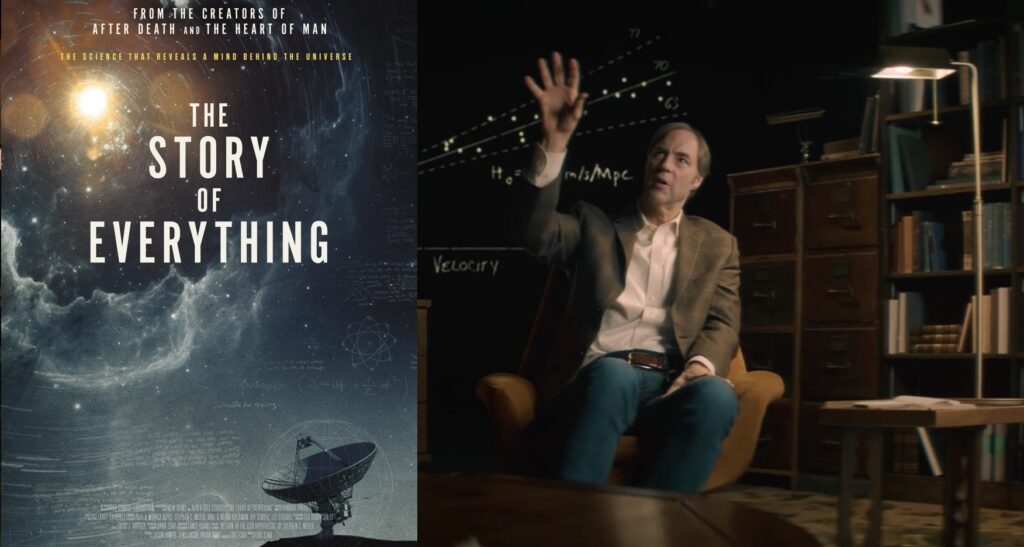
A 2025 Pew Research Center survey found that about half of Americans believe science and religion are in conflict, yet a new film seeks to challenge that assumption – arguing that science itself offers some of the strongest evidence pointing to the necessity of a Designer.
The Story of Everything launches April 30 in theaters for a one-week run, featuring some of the nation’s leading scientists presenting evidence within the realms of cosmology, physics and molecular biology that the best explanation for the universe’s existence is not materialism – but an intelligent Creator.
It was inspired by the book Return of the God Hypothesis by bestselling author Stephen Meyer, who is featured in the film and leads the Discovery Institute’s Center for Science and Culture. Other scientists and philosophers in the film include Jay W. Richards, John Lennox and Peter Thiel.
Christian apologist Lee Strobel is an executive producer.
“These are brilliant people, and they believe the evidence points toward the existence of a supernatural creator,” Strobel told The Lion. “Now, does that make it true? No, but it challenges us to say, ‘Hmm, maybe I should check it out. Maybe I should investigate it. Maybe I should go further.’”
Much of the film serves as a modern-day reframing of the classic teleological and cosmological arguments for God advanced by Thomas Aquinas, who pointed to order and purpose in nature as evidence of design (teleological) and argued that the universe itself requires a first cause (cosmological). Even so, the film pushes far beyond Aquinas, engaging contemporary theories from figures such as Albert Einstein and Stephen Hawking and contending that modern science strongly points to an intelligent Designer as the most compelling explanation.
“I think you get a lot out of the cosmological argument for God,” Strobel said. “In other words, where did the universe come from? And it’s a very simple argument: Whatever begins to exist has a cause behind it. All scientists now agree the universe began to exist at some point in the past. Therefore, there must be a cause behind it.”
By following that line of reasoning to its logical conclusion, Strobel said, the nature of that cause begins to come into clearer focus.
“What kind of a cause can bring a universe into existence? He must be transcendent or separate from creation. He must be spirit because He existed before the physical world. He must be eternal or timeless, because He existed before physical time came into being. He must be powerful, given the immensity of the creation event. He must be smart, given the precision of the creation event. He must be personal, because He had to make the decision to create. He must be creative, because, my goodness, just look at the universe. He must be loving, because He’s so carefully crafted a habitat for us to flourish in. And then the scientific principle of Occam’s Razor says it would be just one Creator.
“Just from that one argument, it rules out all polytheistic religions that believe in many gods. It rules out all pantheistic religions who say that everything is God. And it also contradicts Eastern philosophy that says that the universe is cyclical. So just that one argument gets you a long way toward the existence of a creator who, again, matches the description of the God of the Bible.”
To be fair, the film does not lean on Bible-based Christian apologetics but instead emphasizes natural theology – building its case from scientific evidence and philosophical reasoning. But Strobel said that approach can be a powerful first step.
“I’m hoping it becomes an instigator for the audience – especially young people – to pursue further information, to be so captivated by the film that they go: Man, I need to delve into this further. And that’s good for Christianity.”
Meanwhile, Strobel hopes the film strengthens the faith of believers – and perhaps even sparks them to invite a friend.
“And then just go to coffee afterwards and chat about it. You don’t have to be a super apologist. You don’t have to be the Bible Answer Man. Just talk about how God influenced your life – and see if this begins a journey for that person toward Jesus.”