
Majority of teachers disapprove of ‘equitable’ grading practices that ‘enable laziness,’ survey shows
Most K-12 teachers are giving equitable grading practices an F, a recent survey discovered.
Michael Petrilli, president of the Fordham Institute, explains equitable grading policies were invented…

Most K-12 teachers are giving equitable grading practices an F, a recent survey discovered.
Michael Petrilli, president of the Fordham Institute, explains equitable grading policies were invented by those who believed traditional grading unfairly disadvantaged certain students.
“In recent years, traditional grading practices have been criticized for failing to correct longstanding social inequities,” Petrilli writes.
“Proposed ‘reforms’ – which supposedly promote ‘equity’ – include awarding half-credit for assignments that are never completed, allowing students to retake tests and quizzes without penalty, and giving no credit for homework or classroom participation.”
To find out what educators thought, Fordham surveyed nearly 1,000 K-12 teachers and found the majority disapproved of the so-called equitable grading practices being implemented in public schools.
The survey focused on five examples of equitable grading:
- No zeros – teachers must give a minimum grade (such as 50%) for missing or failed assignments
- No late penalties – students can turn in assignments late without penalty
- Unlimited retakes – students can retake tests and quizzes without penalty
- No homework – teachers cannot factor homework assignments into students’ final grades
- No participation – teachers cannot base students’ grades on class participation
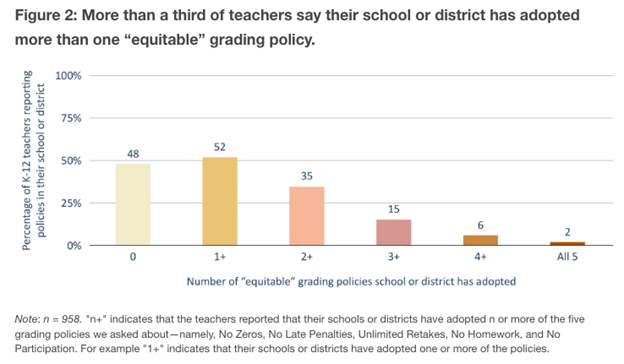
Over half (52%) of survey participants said their district had one of these five equitable grading policies. One-third of districts had two, 15% had three, and a handful had them all.
Of the five policies listed above, the most common involved unlimited retakes (31%), no late penalties (29%) and no zeroes (27%).
However, most teachers believe such practices are counterproductive to education.
For example, 81% of educators agree it’s harmful to give partial credit when no work is turned in. Some noted 50% is the lowest grade their school allows them to give, calling the practice “ridiculous” and saying what it does is “enable laziness.”
“Equity grading is not leveling the playing field,” one teacher told Fordham. “It is simply lowering standards so that school districts look like they are meeting kids where they are, when in fact they are hiding their failures behind ‘equitable’ policies.”
These grading practices make it easier for students to achieve higher grades without mastering content or engaging in the learning process – also known as grade inflation.
“Grade inflation is pervasive,” another teacher observed. “It’s almost impossible to fail. A’s are passed out like Halloween candy. Whether a student learned anything is nearly irrelevant.”
But even when teachers want to hold their students to high standards, district officials don’t always let them. A shocking 84% of educators said their supervisors would be “concerned if I give too many low grades.”
“Our school will start the year demanding we be consistent and set clear expectations,” one educator recalled. “But at the end of the grading period, when they see so many students with failing grades, we are supposed to do a 180 and be mindful and ease up.”
“Teachers are pressured to pass all students,” said another.
“Sometimes they pass a student even if they failed,” observed a third.
The Fordham Institute offers several recommendations, such as ending equitable grading practices and incentivizing administrators to uphold higher standards.
“If districts and states truly want to provide their students a rigorous public education, they must deemphasize graduation and course-passing rates and emphasize external measures of academic success, such as end-of-course exams,” Petrilli concluded.
“Only then will our public schools deserve the sorts of grades they are awarding to students.”