Michigan’s homeschool numbers continue rising as parents explore ‘huge variety’ of resources
Almost a decade ago, Michigan State University staffers recognized homeschooling as an “evolution in American education” poised for strong growth – even before the COVID-19…
Almost a decade ago, Michigan State University staffers recognized homeschooling as an “evolution in American education” poised for strong growth – even before the COVID-19 pandemic.
“In my own research, I have seen how diverse homeschoolers now are,” wrote Kyle Greenwalt, an associate professor in the department of teacher education, in February 2017. “This diversity challenges any simplistic understanding of what homeschooling is and what impact it will have on the public school system.”
Today, Wolverine State homeschoolers continue to confound previous assumptions on what learning can look like.
Their numbers reached a peak of 11.3% of K-12 students statewide by the end of 2020, then dropped to 5.04% in the 2022-23 school year.
However, the 2023-24 school year saw another increase to 6.58%, according to the Johns Hopkins University School of Education.
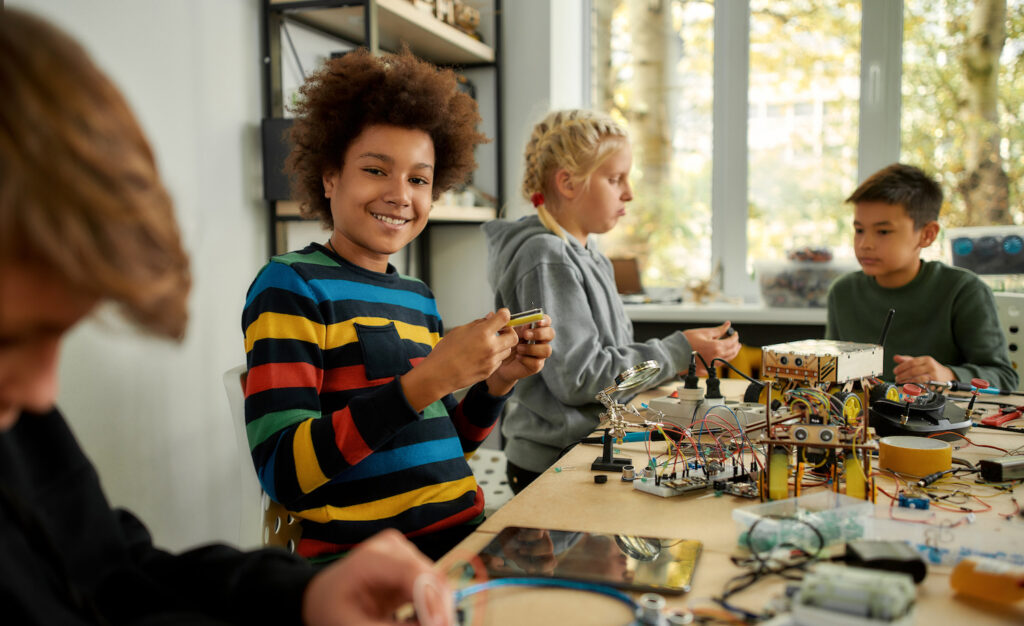
“We use a huge variety of curricula to accomplish academic goals, which is one of the beautiful things about homeschooling,” explained Andrea Larsen, a second-generation homeschooler and co-founder of Michigan Homeschoolers for Freedom. “We can use whatever tool for learning works best for our students.”
‘Not a one-size-fits-all education’
Larsen, who is also a former college classroom instructor, believes homeschool parents are increasingly exploring options “including online learning programs and a plethora of social activities and classes offered by businesses and other organizations.”
“Homeschoolers now are most often involved in group meetups with other homeschoolers, classes offered in their local communities, clubs, sports, activities and serving in their communities in various ways,” she concluded.
Most homeschoolers in Michigan “not only meet, but exceed” required courses for K-12 students, Larsen told journalists.
“It is not a one-size-fits-all education. Students can take subjects at their own pace,” she said.
Meanwhile, the state’s public education system has drawn increasing scrutiny over dismal student outcomes.
Despite rating 98% of its public-school teachers as effective, the state discovered only 41% of its elementary students were proficient in reading and 36% proficient in math, according to spring 2025 test scores.
“There is a significant disconnect between what the teacher evaluation is supposed to be measuring and what the [ratings] produce,” said Molly Macek, education policy director at Michigan’s Mackinac Center for Public Policy.
“It sends the message that [parents] really can’t trust this data that the districts are sharing as an accurate reflection of how their school or the teachers are actually doing.”