Nepal’s prime minister quits as youth riot death toll hits 19
Protests led by Nepal’s youth turned into the deadliest anti-government unrest the country has seen in decades, leaving 19 dead and several buildings smoldering.
The uprising was sparked…
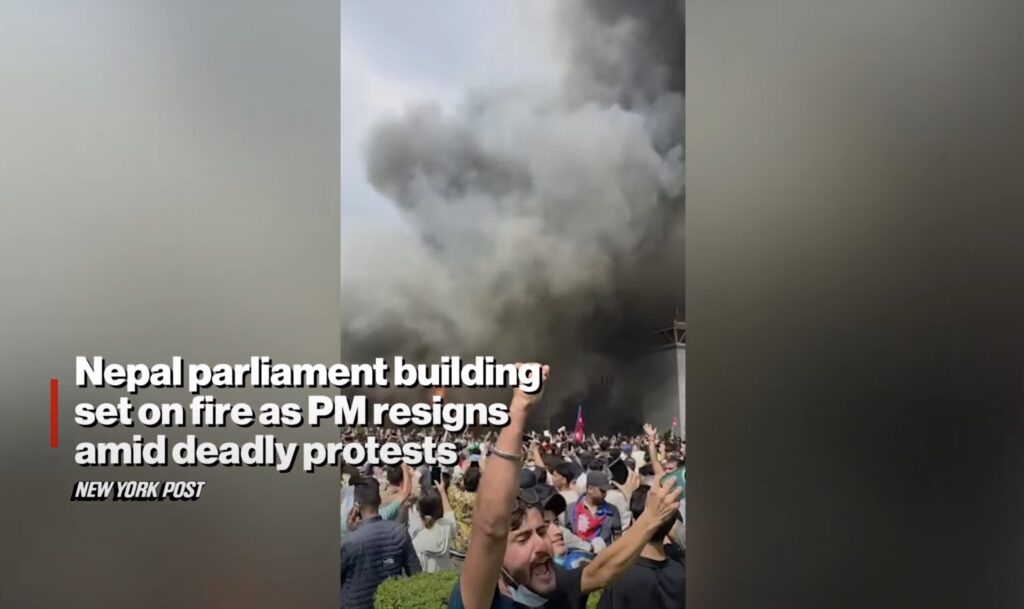
Protests led by Nepal’s youth turned into the deadliest anti-government unrest the country has seen in decades, leaving 19 dead and several buildings smoldering.
The uprising was sparked by a short-lived social media ban, which was quickly lifted but continued as young protestors expressed frustrations over corruption and nepotism in the South Asian country.
On Monday, Nepal’s government blocked access to popular platforms such as Facebook, Instagram, X and YouTube after the companies failed to register under tighter new regulations, Reuters reported.
Authorities argued the policy was aimed at curbing misinformation and abusive content, but many considered it a thinly veiled attempt at censorship.
Protestors, who were predominantly teenagers and young adults, descended on the central business districts around the country.
In a particularly brutal incident the wife of former Prime Minister Jhalanath Khanal was trapped in her home in Kathmandu’s Dallu neighborhood when Gen Z protesters set it ablaze, reported multiple media outlets.
The woman, Rajyalaxmi Chitrakar, later died at the hospital of her injuries.
Reports also surfaced of Foreign Minister Arzu Rana Deuba being physically assaulted as protesters breached her residence, according to the Associated Press (AP).
As the protests escalated, key government properties and elite residences became targets.
In addition to the parliament, protesters set fire to the homes of prominent figures, including Prime Minister K.P. Sharma Oli and President Ram Chandra Poudel, the AP said.
A private school owned by the foreign minister’s family was torched, as well as the offices of the local communist party.
In the face of mounting bloodshed and destruction, Oli announced his resignation effective immediately.
“In view of the adverse situation in the country, I have resigned effective today to facilitate the solution to the problem and to help resolve it politically in accordance with the constitution,” Oli wrote in his resignation letter, reported Reuters.
Demonstrators in Kathmandu, clad in school uniforms, surged toward Parliament, shouting slogans demanding an end to corruption and censorship, Reuters said.
Rioters then stormed the gates of Parliament, set fire to an ambulance, overturned police barricades and set fire to the building. Security forces responded with water cannons, tear gas, rubber bullets and eventually live ammunition, the AP said.
By the end of the day, at least 19 people had been killed and over 100 injured, many with gunshot wounds. Hospitals and blood banks were inundated with the wounded, according to the wire service.
“Many of them are in serious condition and appear to have been shot in the head and chest,” Dr. Badri Risa told the AP.
While the social media ban served as a tipping point, the Gen Z protesters are voicing much deeper discontent with political patronage, systemic corruption, and a failing economy offering few paths forward.
“I am here to protest about the massive corruption in our country,” Bishnu Thapa Chetri, a student, told the AP. “The country has gotten so bad that for us youths there is no grounds for us to stay.”
Social media videos chronicled extravagant lifestyles of politicians and their children – called “nepo kids.” Youth unemployment, by contrast, hovers around 21%.
The army is appealing to Gen Z protesters to act with restraint, while expressing sympathy for the loss of life.
“Considering the current situation, it is our shared responsibility to prevent further escalation, preserve social harmony, and maintain national unity. The Nepali Army calls upon all youth and citizens to act with restraint,” said the statement appearing in the Himalayas Times.
The army has imposed a nationwide curfew in some areas as early as 3:30 p.m., according to the national newspaper.
Even with Oli’s departure, protesters remained active in the streets, demanding wide reform, not merely a change in regime leadership.
“We are here to protest because our youths and friends are getting killed, we are here to see that justice is done and the present regime is ousted,” said Narayan Acharya, who was among the protesters outside the battered wall of the parliament building Tuesday.
Nepal has struggled with chronic political instability since its transition from monarchy to republic, with 14 governments since 2008 and none completing a full five-year term.
The nation’s modern turbulence traces back to a shift from hereditary rule in the 1950s, a party ban under the Panchayat monarchy system (1961-1990) and a Maoist civil war in the 1990s claiming over 17,000 lives, according to a summary by Reuters.
The abolition of the monarchy in 2008 with a new federal constitution established in 2015 just transferred the instability to a democratic process, with Oli forming five of the elected governments in the last 10 years.