
New survey reveals most religious states. Where does yours fall?
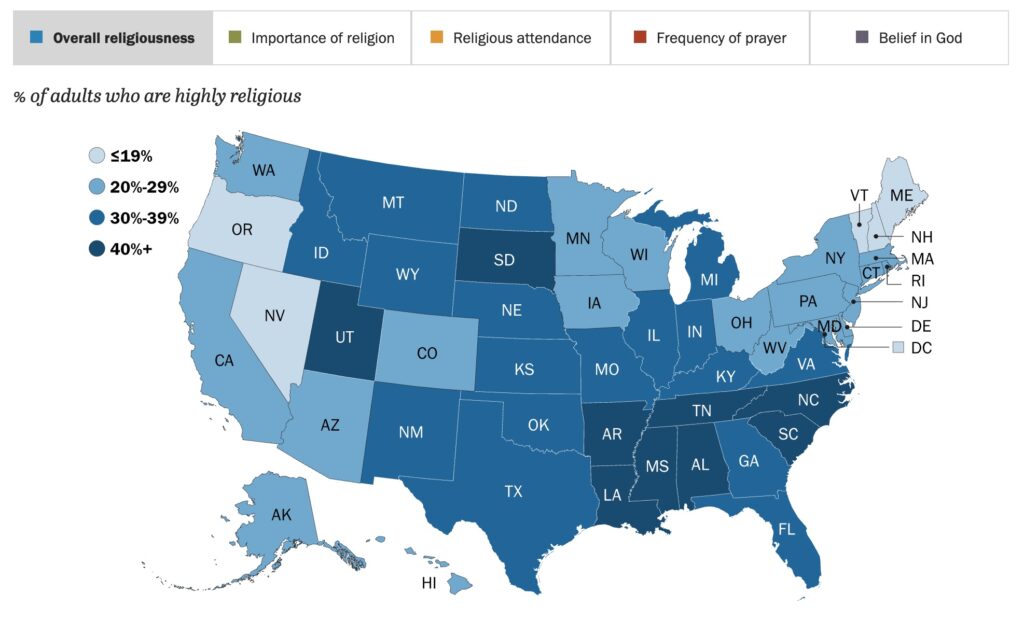
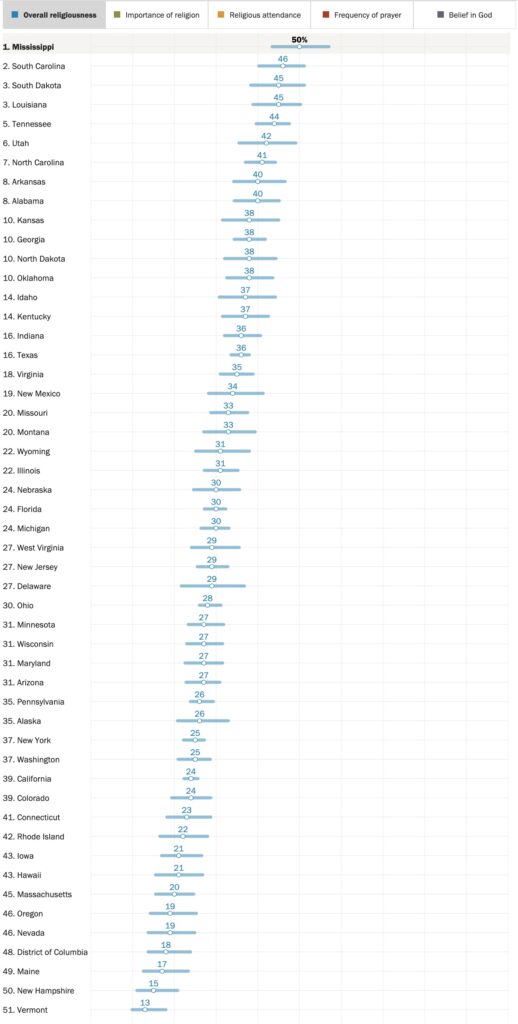
A new Pew Research study ranks states according to religiosity, revealing Mississippi as the most religious and Vermont as the least.
Generally southern states are among the most religious, and…

A new Pew Research study ranks states according to religiosity, revealing Mississippi as the most religious and Vermont as the least.
Generally southern states are among the most religious, and northeastern states the least.
In Mississippi, 61% of adults say religion is very important; 54% say they attend a religious service monthly; 62% say they pray daily; and 74% say they believe in God or a universal spirit.
After Mississippi, South Carolina placed second with 46% of residents who are “highly religious.” South Dakota and Louisiana tied for third with 45% of residents who are “highly religious.”
Vermont is the least religious state with only 13% of residents who portray themselves as “highly religious.”
Pew Research Center’s 2023-24 Religious Landscape Study (RLS) surveyed nearly 37,000 individuals across all 50 states and the District of Columbia. The survey spanned from July 17, 2023, to March 4, 2024, in both English and Spanish among a “nationally representative sample” of participants.
The RLS presented four questions, asking individuals if they “pray daily”; “believe in God or a universal spirit with absolute certainty”; “consider religion to be very important in their lives”; and “attend religious services at least once or twice a month.”
Each response received a score between 0 and 2, with a score of 2 being the highest religiosity. For every individual, the four categories tallied to a score between 0 (for those who scored four 0s) and 8 (for respondents who scored four 2s).
The “highly religious” category represented all respondents who scored a 7 or 8. The survey then ranked each state by the percent of residents in the “highly religious” category.
Nine states in America (listed alphabetically) have more than 40% of residents who are “highly religious:” Alabama, Arkansas, Louisiana, Mississippi, North Carolina, South Carolina, South Dakota, Tennessee and Utah.
In addition to ranking each state, the RLS published an interactive map that evaluates various major cities. The map divides religious affiliations into three categories: “Christians” – including Catholic, Protestant, Latter Day-Saints, and Jehovah Witness – “Other religions” – including Buddhist, Hindu, Jewish, Muslim – and “Religiously unaffiliated.”
Of the cities represented, Portland, Oregon is the least religious with 44% of residents religiously unaffiliated and 42% Christian.
The RLS map displayed religiosity by region, with the South reporting the highest percent (68%) of Christians. The South recorded 25% of adults as religiously unaffiliated, compared with 35% in the West – the least religious region.
The West reports 55% of adults who are Christian. The Northeast is split 58% to 30% Christian to religiously unaffiliated, respectively. In the Midwest, 64% of adults are Christian, and 30% are religiously unaffiliated.
In the United States as a whole, 62% of adults identify as Christian and 29% as religiously unaffiliated.
The interactive map also categorizes the population by demographics such as age, sex and income. Of adults ages 18 to 29, 45% are Christian and 44% are religiously unaffiliated. Of adults ages 65 or older, 78% are Christian and 15% are religious unaffiliated.
When compared by sex, 59% of men are Christian, and 66% of women are Christian. In the same demographic, 31% of men are religiously unaffiliated and 27% of women.
Marriage increases the likelihood of religiosity, according to the data. Of those who are married, 68% are Christian, compared with 50% of those who have never married.
Religious beliefs across income brackets remain relatively consistent for any household earning less than $100,000 annually. Of these adults, between 63-64% are Christian and 28-29% are unaffiliated.
Individuals in households earning more than $100,000 annually are split 57% Christian and 33% unaffiliated.
Although Pew Research has previously conducted the RLS, the survey cautioned against comparing with past reports because of the change in methodology.