
‘No longer the most powerful voice in the room’: Study finds teacher unions losing influence, especially in red states
Although teachers’ unions have wielded significant influence over education policy for years, their power is waning nationally, according to a new report.
Researchers at…
Although teachers’ unions have wielded significant influence over education policy for years, their power is waning nationally, according to a new report.
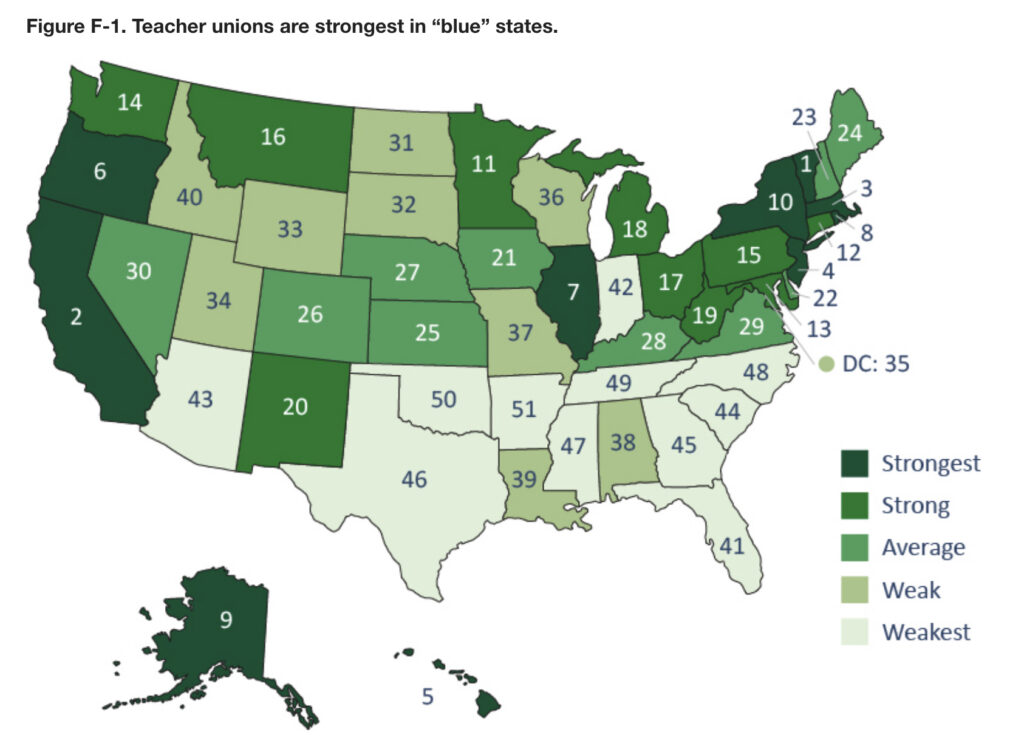
Researchers at the Thomas B. Fordham Institute found unions are considerably weaker in red states such as Arkansas, Oklahoma and Tennessee. While they remain influential in blue states including New York, California and Illinois, “in many places, teacher unions are no longer necessarily the most powerful voice in the room.”
The report, based on publicly available data and a survey of K-12 stakeholders in all 50 states, found the education landscape has become increasingly crowded and contested over the past 15 years, since the first such report was conducted.
Researchers pointed to several factors behind the shift: growing school choice programs, legal reforms that allow teachers to opt out of unions, the rise of parent advocacy groups and backlash against prolonged COVID-19 school closures.
“The Covid-era pivot to remote learning thrust teacher unions into the national spotlight again, mostly in ways that seemed to undermine their standing, as evidence of learning loss mounted and criticism of the lengthiest closures intensified,” Amber M. Northern and Michael J. Petrilli wrote in the report’s foreword.
At the same time, education reform organizations expanded their influence. “State-level reform groups are now active in almost every state,” Northern and Petrilli wrote, meaning unions are no longer the only major voices shaping education policy debates.
Unions – chiefly the National Education Association and the American Federation of Teachers, along with their state affiliates – were positioned to benefit from the 2015 Every Student Succeeds Act, which gave states greater control over education. However, reforms allowing employees to opt out of unions and stop paying dues weakened their influence.
Notably, the Supreme Court’s 2018 Janus v. AFSCME decision ended the mandatory collection of fees from public employees who declined union membership. Union opt-outs have accelerated since then, with nearly 15,000 educators joining Teacher Freedom Alliance, which provides free liability insurance and opportunities to earn professional development credits. The Freedom Foundation reports more than 276,000 opt-outs across all employment sectors, costing unions an estimated $810 million in lost dues.
“When teachers are free to opt out, they do – and membership and influence are collapsing across most of the country,” Teacher Freedom Alliance CEO Ryan Walters, a former Oklahoma state superintendent, told The Lion in an email. “Oklahoma is the proof of concept: we made it easier for teachers to leave, gave them real alternatives to the union, and put power back with teachers and parents – and now the unions there are among the weakest in the nation.”
Walters said he is taking the model “national, including into the deep-blue states where the unions still hold teachers hostage. The Teacher Freedom Alliance exists to give every teacher that same freedom and an army to back them up.”
Educator unions still wield significant influence, especially in deep-blue cities such as Chicago and Los Angeles, where they continue to secure raises and concessions despite struggling district finances.
But union membership fell in 45 states, and political contributions – which typically go to Democrats – declined in 34 states, the report found.
“Our survey of education stakeholders suggests that most no longer view their state’s teacher union as an uncontested force in K–12 education,” the foreword says.
Although teachers’ unions still influence state education policy, even in states where they lack formal bargaining rights, the report says other voices now compete for influence.
Corey DeAngelis, a research fellow at The Heritage Foundation and senior fellow at Americans for Fair Treatment, said school choice is one of the strongest factors driving the shift.
“Families now have the freedom to take their kids – and the funding that follows them – to higher-quality options outside the union-controlled government school system,” he told The Lion in a message. “That’s starving the beast from the outside.”
DeAngelis also pointed to what he called “stunts” by the American Federation of Teachers, including spending $1.4 million to promote a book by its president, as reasons some teachers are opting out.
“Less than 10% of the National Education Association’s budget actually goes toward representing teachers,” he said. “Union bosses did this to themselves by acting like fools and prioritizing activism over academics and member support.”
He argued there are already signs of weakening union influence even in Chicago, where union members voted down an $800 annual dues increase and Chicago Teachers Union-backed candidates performed poorly in spring primaries, with some Democrats even hiding their union endorsements. The union has a negative 26% net favorability rating among voters, he said.
“The union monopoly will break in ultra-blue cities and states the same way it’s cracking everywhere else: keep expanding school choice so parents can vote with their feet, empower more teachers to opt out and starve the beast financially, and watch Democrats start listening to parents the way Republicans already are.
“If that happens, union bosses will have nowhere else to go politically. Maybe then they’ll finally get out of politics, focus on educating kids, and actually take care of the teachers they claim to represent.”