Novel ‘Theo of Golden’ a remarkable tale of God-inspired kindness amid pervasive suffering
Allen Levi wrote his extraordinary novel Theo of Golden with no plans to publish it and an audience of one in mind.
“I thought to myself very consciously: when I die, I will take this…
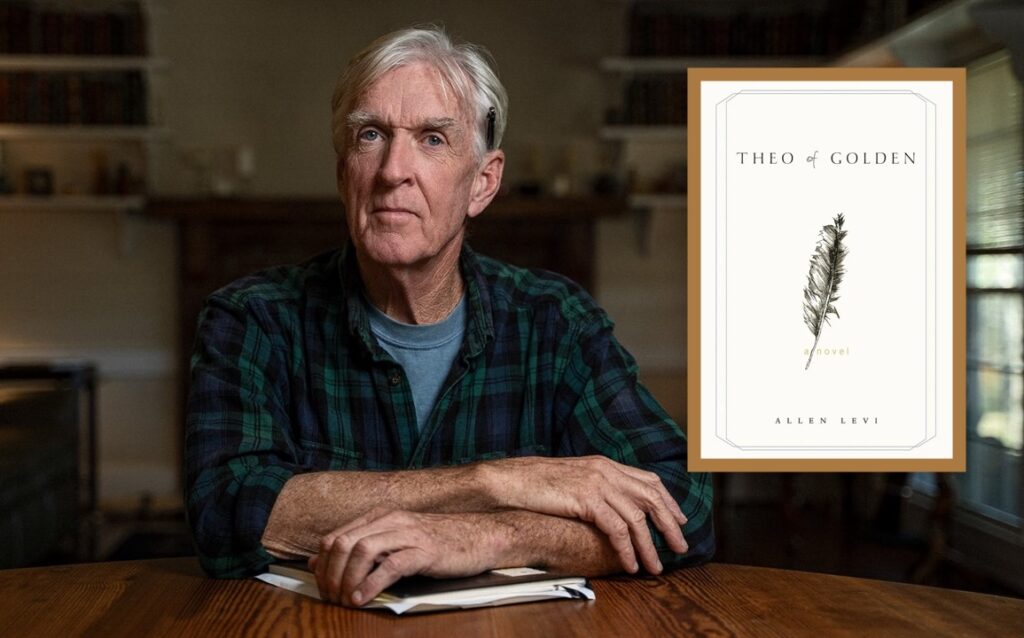
Allen Levi wrote his extraordinary novel Theo of Golden with no plans to publish it and an audience of one in mind.
“I thought to myself very consciously: when I die, I will take this manuscript and I will stand in the presence of my God and my Christ, and I will say, ‘Lord, this is a present that I made for you.’ And that satisfies me completely,” he recently told an interviewer in front of a theater crowd.
Utterly remarkable. Here is an author who labored through a roomful of drafts, and then some, while in all respects unconcerned with whether the book sees the light of day so long as it reflects the light of God.
Yet, his self-published story of a mysterious stranger who arrives one day to captivate and ultimately elevate a Georgia town through simple kindness and empathy has gone viral the old fashioned way: by quickly putting a staggering 150,000 books in people’s hands largely through an excited word of mouth.
Since then, the book has been acquired by Atria Books, an imprint of Simon & Schuster; fans have already been clamoring for the movie; actor David Morse will narrate the audiobook coming in December; and a sequel is in the works.
The homespun Georgian’s wholly unsolicited success is all the more astounding when you consider it’s the 69-year-old lawyer, former judge and modern-day troubadour’s first novel. Moreover, his friends, who had to petition the modest author to see the manuscript, subsequently had to convince him it was worth everyone seeing.
And goodness gracious, is it ever – in large part because it is, indeed, full of goodness and graciousness.
In Levi’s learned, deft hand, Theo of Golden is a gentle, moving reminder that there’s no such thing as an “ordinary” person – and that, while navigating gut-wrenching sorrow in this life, each one of us not only is extraordinary but perhaps capable of some form of saintliness.
We often hear people say something restored their faith in mankind. This book truly does.
Levi, who strikes you as the kind to host large gatherings of friend and kin on his porch – which he actually does – grew up in a family of five children whom he says were taught by two loving parents “to do good, be polite and study hard and be good kids.”
Though he claims to have been a “knucklehead” student “and probably a much worse person” at the University of Georgia, he must have done something right, after what he calls formative classes in the poetry of Milton – “using the poetry and the Scriptures” – and a class in southern fiction.
“By the time I graduated Georgia, I had surrendered my life to the Lord of Heaven and Earth. And everything about me – in ways that are still unfolding – had changed for me.”
He chose to go to law school because of “my utter inability to work with numbers.” After practicing for some 10 years back home in Columbus, Georgia, he left for a masters in Scottish fiction at Edinburgh, returned to Columbus for more law work – then decided to become a traveling musician and songwriter.
After spending “the best year of my life, bar none” devoted to loving on his dying brother Gary – a “best friend, mentor, neighbor” – and being a short-term judge and caring for his parents and the land where he lived, he changed his life yet again in a most unassuming act.
“One day I walked into a coffee shop,” he says matter-of-factly.
That day, he found himself admiring a friend’s various portraits of locals on the shop’s walls – “I thought, wouldn’t it be fun to buy all of these portraits and find their rightful owner” – and decided to buy five of them, later contemplating the subtleties of their unique faces at home.
He realized he had the seed corn for Theo of Golden.
Still, Levi saw writing the book as simply “an expression of my faith” – as well as a test of his writing ability, honed by years of “telling stories” in court briefs and cases.
“I wanted to see if I had the stamina to write long fiction,” he told the audience at the Franklin Theater in Tennessee. “So, I knuckled down and finished it and said, ‘mission accomplished – I have written a piece of long fiction and nobody is ever going to see it.’”
Even now, even as he works on a sequel, he says, “We are not trying to sell books. We are trying to bless people and to bring something good into the world.”
As evidence that he has, Carol, a retired English teacher who had just months to live – and who had centuries of literature to share with students on an internet class she’d started – told Levi that “the last book that I want to read with my students is Theo of Golden.”
“I see the same bad news you do,” an emotional Levi tells the crowd. “But if you could see you like I see you now – or like I saw Carol and her friends – you would say, yeah, there’s a lot of bad in the world, but by God there’s a lot of good. And if we do our parts we can drown it out.
“Be like Theo.”
Be like Theo. He may not be wrong about that. Certainly, born of Levi’s routine visit to a familiar coffee shop, the resulting yarn spun by his highly cultured imagination has gifted the world with a humble but profound addition to literature’s pantheon of unforgettable heroes.
When famed southern author Pat Conroy’s mother described to him Atlanta’s ardent devotion to the new book Gone With The Wind, he once wrote, “it was the first time I knew that literature had the power to change the world.”
Such is the gentlemanly genius of Theo of Golden.