Public schools down more than 1 million students since COVID; biggest losses in blue states
Public schools have lost more than 1 million students since the COVID-19 pandemic, new data show, with the steepest declines in blue states that lack school choice.
Hawaii, Mississippi, Oregon,…
Public schools have lost more than 1 million students since the COVID-19 pandemic, new data show, with the steepest declines in blue states that lack school choice.
Hawaii, Mississippi, Oregon, West Virginia and New Hampshire all lost more than 6% of their public school enrollment between 2020 and 2024. Close behind are New York and New Mexico, which each lost 5.9%. Of these states, only West Virginia and New Hampshire have school choice – and they are the only ones with Republican governors.
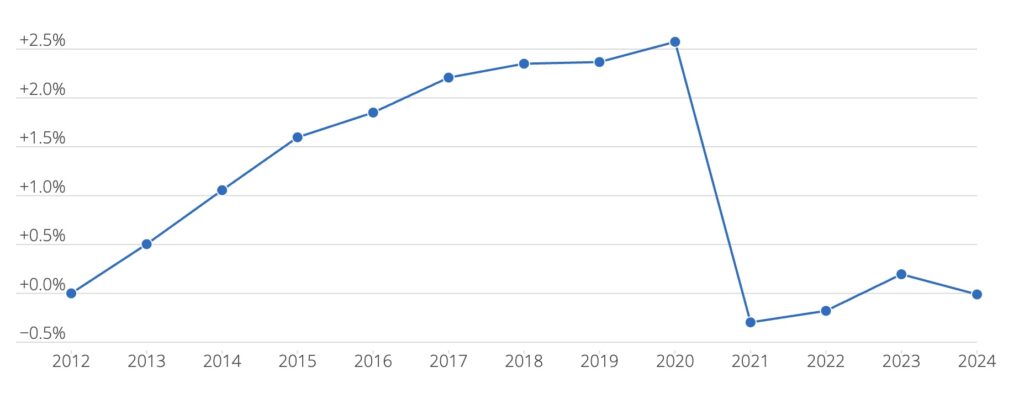
Nationally, public school enrollment fell 2.5%, or about 1.28 million students, since the start of the pandemic, according to data from the National Center for Education Statistics. The Reason Foundation analyzed the data and produced a report on it, analyzing enrollment trends.
On the other end of the spectrum, eight of the nine states where public schools grew are Republican-led, and six of them have implemented or recently approved robust school choice programs.
The numbers reflect both population trends and political dynamics. For example, New York and California – the latter of which lost 5.2% of its enrollment – experienced sharp population declines during COVID-19. Most of the 13 states that lost 5% or more of their public school enrollment lean Democrat, suggesting that dissatisfaction with public schools and COVID-related policies became a tipping point for many families.
Of those 13 states, only West Virginia and New Hampshire have school choice programs, so most of the enrollment losses were not caused by families opting out through private school choice. However, it is possible that some families relocated to states offering greater educational freedom.
States that lost 1% or less of their public school enrollment are mostly red states, many of which have strong school choice initiatives – such as Ohio and Oklahoma – or recently enacted them, such as Tennessee.
This points to studies that have shown public schools improve once school choice becomes available.
The report also found:
- Public school enrollment was growing before the pandemic, but COVID prompted many families to switch to homeschooling, microschools or other alternatives.
- The losses far outweigh gains. While several states lost 6% or more, the top gainer –North Dakota – increased enrollment by just 2.5%, and it was the only state above 2% growth.
- A short-term enrollment recovery in 2022–23 appears to have ended, as enrollment declined again in 2024.
- COVID accelerated pre-pandemic declines in states such as Illinois and West Virginia and halted growth in places such as Washington and Oregon.

The report found public school enrollment is projected to decline another 5.3% by 2032 – a drop of 2.6 million students. And states such as Hawaii, California, Mississippi, New Mexico and New York could lose more than 12% of their public school students. None of those states currently offer school choice.
The decrease will impact everything from facilities and funding to local policies and teacher pensions, the report notes.
“As public schools become increasingly underutilized and districts face financial pressure, state and local policymakers must adapt to current enrollment levels and the projected declines in the decade ahead,” it concludes. “These trends will affect state and local budgets, bond elections and teacher pension obligations.”