Report: Florida business owners concerned with poor math skills of job candidates
Lack of math proficiency in public schools is worrying Florida’s business owners, a new report reveals.
The Florida Chamber of Commerce Foundation surveyed and interviewed business…

Lack of math proficiency in public schools is worrying Florida’s business owners, a new report reveals.
The Florida Chamber of Commerce Foundation surveyed and interviewed business owners, educators and parents about the state of math education and how math proficiency affects job prospects.
It found widespread concern over classroom instruction failing to provide real-world skills needed in many professions.
Nearly half (47%) of surveyed business owners were moderately or very concerned about the math skills of the next generation.
They ranked skills such as creative problem solving, persistence and data analysis as difficult to find in the current applicant pool.
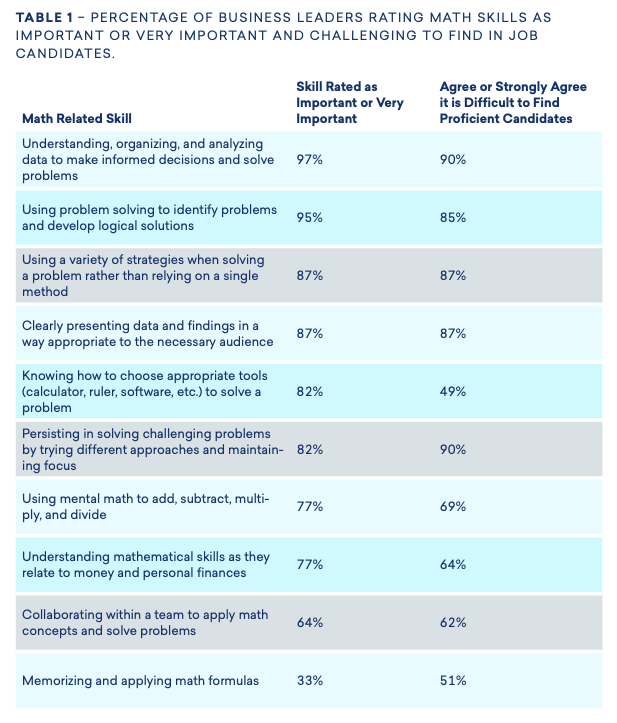
Additionally, many employers reported seeing a decline in math skills (41%) in the past five years, with 36% expecting it to continue declining over the next five years.
When young professionals lack these math skills, it can harm their prospects of advancement and compensation, business leaders say.
Parents and educators who took part in the study also reported frustration with the “disconnect between math education and real-world applications.”
“Educators acknowledged that rigid curriculums and a focus on standardized testing limit opportunities to showcase math’s practical relevance,” the Florida Chamber Foundation wrote.
Business leaders agreed, saying students could learn about fields such as engineering, where minute measurements are required for safety, or how financial literacy is necessary in every business.
“If kids could see how math is used in real careers, like measuring an airplane wing or managing a business budget, they’d be more engaged,” one businessman told the Florida Chamber Foundation.
Currently, only 57% of Florida’s K-12 public school students are proficient at math.
However, the Chamber cited a few positive examples of teachers blazing a trail for better math education. One third grade Florida teacher, for instance, simulates a trip to the grocery store for students, promoting budgeting skills.
Meanwhile, a sixth grade class worked on “building” a golf course, which included calculating the price of materials and figuring out the perimeter and square footage of the project.
Florida is also taking huge strides to be one of the most school choice-friendly states in the nation.
In June, over half of all its students – nearly 1.8 million – used school choice to attend a home or private school or switch to a public school of their choice.
Research suggests school choice students improve their test scores and reach higher educational levels, but numerous studies have also shown it improves the test scores of their public-school counterparts.