Rooted in tradition, pursuing truth: Hillsdale College grad program in classical education ingrains moral responsibility in teachers
Is the goal of education to regurgitate dates, names and facts or to love a topic and entice students to join in its study?
Dr. Daniel…
Is the goal of education to regurgitate dates, names and facts or to love a topic and entice students to join in its study?
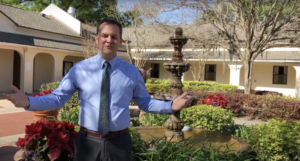
Dr. Daniel Coupland, professor of education at Hillsdale College in Hillsdale, Michigan, says every teacher should aim to instill a love of learning in students – and the graduate program he oversees is training teachers to do just that.
“The teacher comes from a place of knowledge and skill and experience and, most importantly, love,” Coupland told The Lion. “He comes in there to draw and take [the students’] initial attraction to the subject and actually build upon it and help the student to have the knowledge, skill, experience and love the teacher actually has.”
The love of truth is fundamental to Classical education, as is the belief that the truth can be known and defended, Coupland said, explaining how the Christian idea of revelation pairs beautifully with this model.
“So, in that way, the classical approach to education begins with the idea that truth exists and can be known. And in a Christian context, we hang everything on that – in terms of the revealed truth,” he said. “And so just that alone, once you’re starting from the same position, you’re already going to have a lot in common that speaks to the authority of the teacher.”
The Masters of Classical Education at Hillsdale College

Coupland, the dean of the Diana Davis Spencer Graduate School of Classical Education, oversees both the two-year and three-year graduate programs. While the accredited program does not offer a teaching certification, that is no concern for most classical and charter schools that work with “qualified teachers” to meet the necessary standards, Coupland explained.
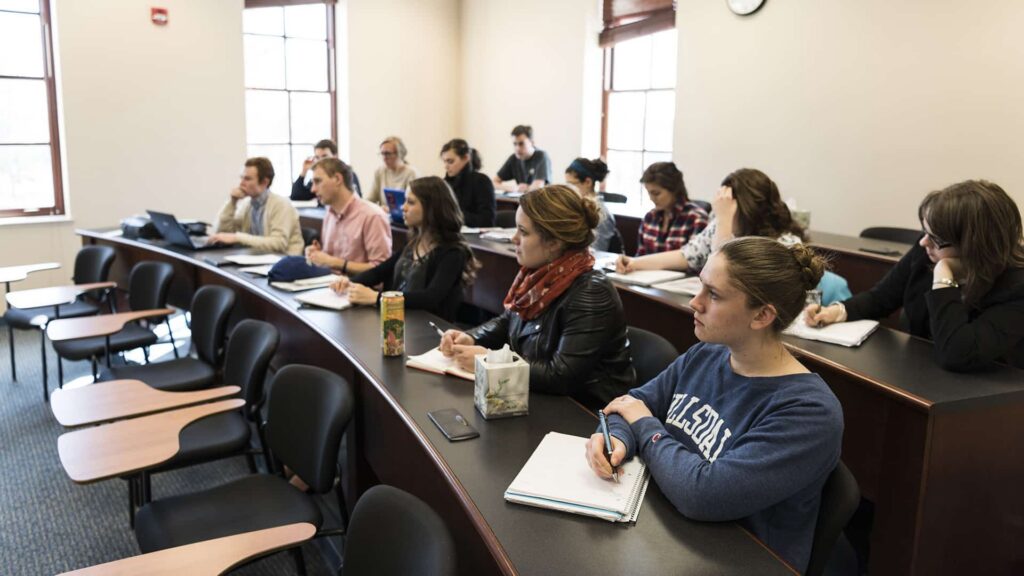
The Master of Arts in Classical Education (MACE) program is two years on campus and tuition-free. MACE welcomed its first cohort of 11 students in fall of 2022. The Master of Classical Education Leadership program is a three-year, remote track, intentionally modeled with an evening course schedule to accommodate full-time teachers.
Coupland explained that many teachers, especially in classical schools, desire a more complete knowledge of the tradition and purpose of classical education. Hillsdale’s program helps “answer the fundamental questions on education” as well as shape the teachers to better lead their students, he said.
Classical schools should not merely offer traditional curriculum but should also ingrain this philosophy in the very structure of the school, specifically in its staff, Coupland explained.
“That’s what I think classical education is a response to: you can’t just say, get the right curriculum in there and everything magical will occur, because that’s not the case,” Coupland told The Lion. “You have to have it in the hands of the right kind of people who understand it and have been marinating in that world and then know how to present it in a way that’s engaging for students.”
The first year of the MACE program provides this exact marinade: three courses each semester that survey classical education through ancient to modern eras in philosophy, history and humane letters. The second year focuses on school leadership and culture in a classical school course and offers various electives for students to specialize in their studies.
Second-year student Samuel Sadler enrolled in the MACE program after teaching for three years at a classical, Christian school to better understand and articulate the meaning and heritage of classical education.
“The philosophy of education course put into perspective why we do classical education,” Sadler told The Lion. “Here are the authors and thinkers that have contributed to our understanding of what classical education is. Here’s what other educators have thought about throughout history. Here’s how our ideas of education have been shaped. Here’s the tradition we are in, and here’s how it’s developed over time.”
But it’s not all theory. Sadler said the program has provided significant practical help for how to teach and manage a classroom, as well as how to lead a classical school in specific areas, such as school culture, board relations and parent communication.
Sadler also said the community of students and faculty has greatly blessed him, referencing the city of Hillsdale’s tagline, “It’s the people.”
“It’s just a lot of people who care about similar things, love similar things, and are committed to the Lord,” Sadler said. “[They] are committed to growing His kingdom through education, and especially through education that really considers: what does it mean to be a whole human? What does it mean to live in community together?”
Why classical education?
Classical education helps students answer important questions by teaching them how to pursue the truth and become “a lifelong learner,” Sadler said.
“It’s going to provide them with not just a bunch of facts or skills, but it’s going to teach them how to think and how to think well and how to learn for the rest of their life,” he said. “And of course, as a Christian, I would say you need the work of the Holy Spirit as well, but classical education is going to provide for them what they need to grow in virtue and knowledge and wisdom.”
Teaching students to love truth is not merely a job, but a lifestyle and vocation, Coupland said. Students are always watching, noticing even the mundane things a teacher does, such as a reaction when “dropping his keys in the parking lot at the end of a long day.”
It’s a lesson Sadler’s already learned: “Teaching already gives you a high standard. There’s a proverb: ‘what the teacher does in moderation, the student does in excess.’”
Because young eyes are always on teachers, the greatest pedagogy, or teaching technique, is to lead by example, Coupland said.
“Leading by example, teaching by example, is one of the most powerful pedagogical tools, and that’s why, if education is about actually shaping the human being and shaping them to be wise and to be good people, then that is incumbent upon the educator to live that life,” he said.
The labor of moral truth versus the speed of intellectual facts
Coupland said the classical approach contrasts the prevailing pedagogy, which presents teachers as “co-learners” or “guides on the side.” In the classical model, teachers still carry authority and demand respect, because they have become experts in their studies.
“The expert, the authority, is one who knows about the thing and knows about its richness and its depth and can explain why it’s so beautiful and why it’s so rich, and why it’s true. And so in that way, the teacher is well positioned to go into a classroom.”
Because the teacher’s goal is to teach students to love truth, and in a way, “replace himself,” quality is more important than efficiency, he said. In contrast, public education in the modern, technological age has become a matter of efficiency: students learn from artificial intelligence programs because the job is quicker and easier.
“There are some things that are worth doing inefficiently,” Coupland countered. “In fact, I would say that probably the most important things are done inefficiently. They’re done human to human. C.S. Lewis talked about ‘old birds teaching birds how to fly.’ That’s a very human interaction, and so it may not be the most efficient, but it is the most powerful, and the most meaningful and the most qualified.”
Similarly, Sadler said the amount of time teachers spend with children also carries a moral responsibility, citing Christ’s warning against leading little ones astray from Mark 9:42 in the Bible.
“If you’re teaching, you’re in the business of leading children,” Sadler said. “It is a high calling. You are responsible for leading these children towards goodness, truth, beauty in the classical context, and, as a Christian, you’re leading them towards God.”