School choice grows as nearly 3% of students enroll in private programs, research finds
School choice is continuing to expand, with nearly 3% of students nationwide now enrolled in a private school choice program and fewer than 75% attending traditional public schools, according to…
School choice is continuing to expand, with nearly 3% of students nationwide now enrolled in a private school choice program and fewer than 75% attending traditional public schools, according to new research.
EdChoice Share, a tool released Tuesday by the school choice advocacy group EdChoice, tracks enrollment by school type and participation in choice programs across all states.
Nationally, 2.8% of students are using a private school choice program, while another 6.1% attend private school through other means, meaning nearly 9% of students are enrolled in private schools overall.
That compares with 5% attending magnet schools, 7.2% enrolled in charter schools and 74% attending traditional public schools. The research also found that 4.8% of students are homeschooled.
Private school choice participation is strongest in Florida and Arizona, where more than 10% of K-12 students are enrolled in a choice program.
Three additional states are close to joining them: Arkansas, Indiana and Iowa have surpassed 8% participation after expanding their programs to make them universally available.
“Interestingly, each of those three states has offered some form of private school choice program to families for nearly a decade,” Colyn Ritter, a senior research associate for EdChoice, told The Lion in an email. “Within the last three years, however, Arkansas and Iowa have enacted universal (all families in the state are eligible to participate) private school choice programs, while Indiana expanded their choice program to become universal. This is the key driver for the increase in these states.”
Ritter added that strong demand for the programs shows parents will take advantage of new options once they become available.
School choice has expanded rapidly since the COVID-19 pandemic, as parents sought alternatives during school shutdowns and a proliferation of woke policies in public schools.
Participation in private school choice programs topped 1.3 million students this school year and is expected to continue rising as additional programs launch and expand. Texas alone is projected to add about 100,000 students as it rolls out its $1 billion program this year.
Overall, 35 states now have some form of private school choice, with 18 offering broad or universal eligibility.
EdChoice Share also ranks states by the percentage of students using school choice, which closely tracks with declines in traditional public school enrollment. From 2001 to 2024, the share of students attending traditional public schools fell from 86% to 51% in Florida and from 89% to 68% in Arizona, illustrating school choice’s broader impact on the education landscape. This includes public schools reforming and offering new programs.
EdChoice additionally surveys parents regularly about where they would prefer to enroll their children if given the option. For 2025, only 32% said they would choose their locally zoned public school, while 33% preferred private school. The remainder were split evenly among homeschooling, charter schools and public schools outside their district.
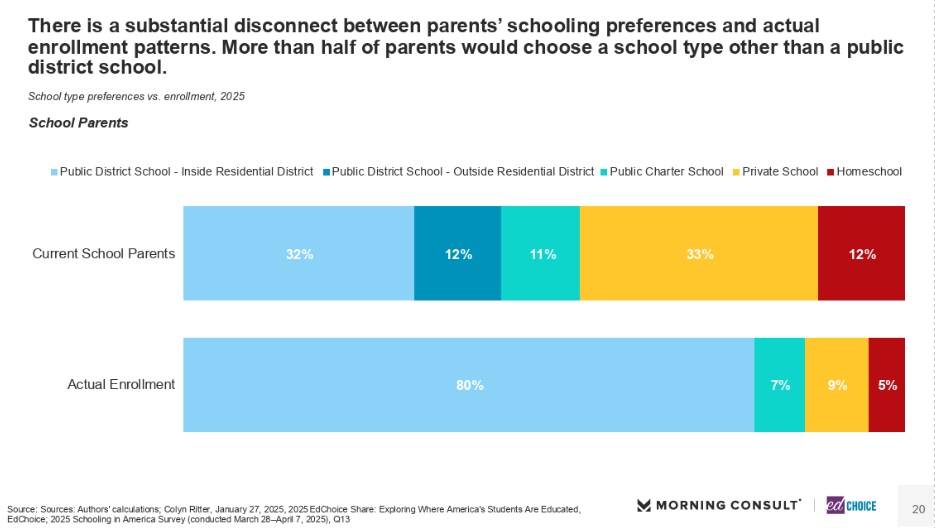
Despite fewer than half of parents preferring traditional public schools, nearly three-quarters of students still attend them, highlighting the need for continued expansion of school choice.
“The massive gap between parents’ schooling preferences and current enrollment trends is the elephant in the room,” Ritter wrote in an analysis of the findings. “In states like Florida and Arizona, that elephant is slowly but surely being shown the door.”