National School Choice Week 2026: Momentum builds as advocates eye expansions
School choice has grown by leaps and bounds over the past six years, but the fight for educational freedom will continue boldly in 2026, advocates say. National School Choice Week is…

School choice has grown by leaps and bounds over the past six years, but the fight for educational freedom will continue boldly in 2026, advocates say. National School Choice Week is Jan. 25-31, with events in various states.
While they are not expecting another banner year like 2025 – when five states approved new school choice programs and another five expanded theirs – various improvements and expansions are in the works.
First among them are efforts to pass broad school choice in Mississippi. A measure there did not advance last year amid divisions in the Republican caucus.
This year, the House passed a school choice bill at the start of the legislative session, which lasts until early April, and everyone from Gov. Tate Reeves to President Donald Trump is putting pressure on the state Senate to approve the plan. The legislation would establish education savings accounts, or ESAs, for students in the state.
Mississippi has improved its public school test scores – something known as the “Mississippi miracle” – and advocates say adding universal school choice would further strengthen the state’s education landscape.
“This would be a huge expansion for school choice in a state that has already made significant gains in its average test scores,” Alex Wolf, a policy analyst with school choice advocate EdChoice, told The Lion in an interview.
Club for Growth, which spent more than $10 million in 2024 to primary anti-school-choice Republicans in Tennessee and Texas – helping those states pass school choice programs the following year – is joining the fight in Mississippi.
“Club for Growth is proud to have invested seven figures across the country advocating for these programs and securing results in Georgia, Idaho, Indiana, Missouri, New Hampshire, Oklahoma, South Carolina, Tennessee, Texas and Wyoming,” club President David McIntosh told The Lion in an email. “As we begin 2026, we look forward to having similar success in Mississippi, and we are prepared to engage with other conservative leaders who prioritize students over failing public education systems.”
More than 1.5 million students in school choice programs
School choice topped 1.5 million participants in 2025 and will expand further this year, thanks to Texas and Idaho launching programs and states such as Tennessee, New Hampshire and Indiana expanding theirs.
Several states are considering adding funds or lifting income restrictions on their programs to boost participation.
Examples include Arkansas, where lawmakers are considering adding $32 million to the state’s school choice program, Wolf said, and Kansas, where Republicans want to raise the cap on the state’s low-income tax credit scholarship program to $15 million or $20 million after the $10 million limit was reached last year.
Wolf also said several states are looking to expand allowable uses of school choice funds, similar to ESAs, which permit spending beyond private school tuition.
“It would give students the ability to take music lessons after school, to participate in sports, to go on field trips and do educational extracurricular activities,” he said. “Those aren’t always a given in every ESA state law, so we want to see as many opportunities as possible be allowed.”
School choice opponents often cite examples of wasteful spending as reasons to oppose educational freedom, but Wolf said audits have found far less fraud in school choice than “the suspected SNAP fraud and other types of government benefits fraud” that have come under recent scrutiny.
“I think when you trust parents to spend a preset amount of money to educate their child, I think that you’re going to see them be very careful with how they’re going to spend that money because there’s not much more that they’re invested in than their child getting the best education he or she can get,” he said.
Choice expands despite legal threats
School choice is also expanding through a new federal tax credit that will become available in 2027. States are already announcing their intention to opt in, including blue states such as Colorado, which does not currently have school choice. Education Secretary Linda McMahon said she hopes at least half of the states will participate.
Under the program, states will have to submit a list of approved scholarship-granting organizations, or SGOs, which will distribute the tax credit donations to students. Once those are established, it would be easier for a state to add its own school choice program, Wolf said.
“The governor must deliver that by early 2027,” he said. “If we see something like that in a more blue state like Colorado, and students and families have positive experiences of having that educational choice and their lives are improved in that way, that’s probably going to provide some more political capital to school choice advocates to begin to put more pressure on blue-state politicians to support a statewide school choice program.”
There are ongoing lawsuits against school choice programs in states including Utah, Montana and Wyoming, but advocates are hopeful for wins.
Thomas M. Fisher, litigation director for EdChoice, told The Lion that school choice opponents are resorting to a 20-year-old decision in Florida that the state doesn’t even enforce.
“Since the US Supreme Court has ruled favorably to school choice programs when it comes to Establishment Clause and Free Exercise Clause questions, now opponents of choice programs turn their attention to state constitutional provisions,” Fisher said.
“They typically focus on the state constitutional commitment to (fund) public schools as a source of authority to argue against private choice programs, but state constitutions don’t have any express restriction against private choice programs.”
Fisher added that he’s “optimistic” about winning in each state and noted how South Carolina fixed its program last year after the state Supreme Court invalidated it.
“I think the message is that we are there at EdChoice are fighting to defend their interests and their rights in these programs and that the arguments being made, I think are not grounded in the actual text of state constitutions,” he said.
Broad public support
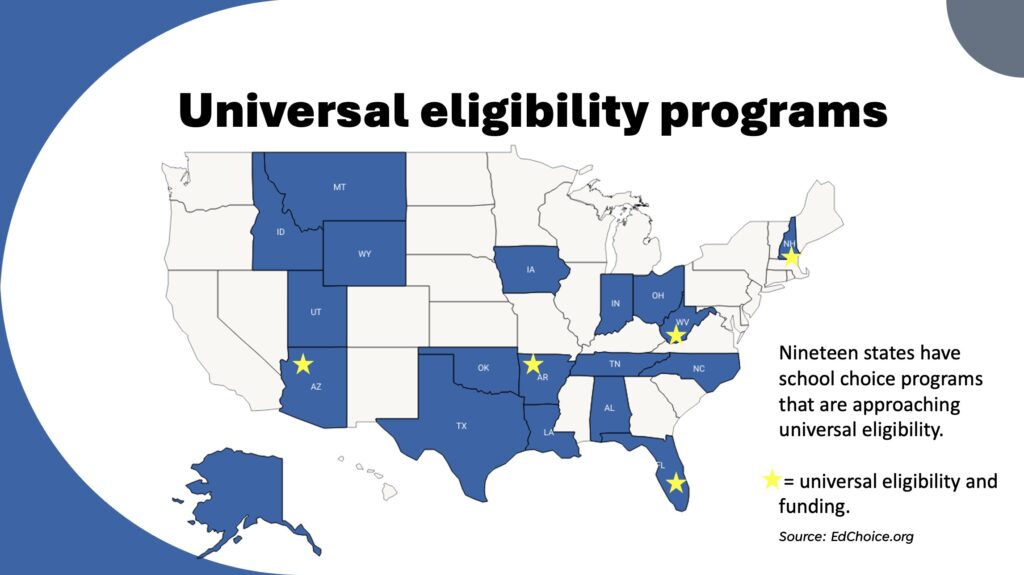
In all, 35 states have some form of school choice, with 19 offering broad or universal eligibility, meaning most students qualify and can receive funding.
Wolf stressed that polling shows the public overwhelmingly supports school choice.
“You’re very hard-pressed to find any kind of subgroup where opposition to school choice is higher than support for school choice,” he said. “It’s regularly between 70% and 80% support, especially when you poll parents of K-12-age children, middle-income parents and lower-income parents.
“There are just so many different demographic profiles that cover so much of the public that shows three out of four or two out of three support school choice broadly.”
Shifting demographics also play a role, as blue states without school choice lose population to red states that have it, such as Arizona, Florida and Texas. If the trend continues, more states may jump on the school choice bandwagon, Wolf said.
Of the 15 states that do not have choice programs, all but six border a state with universal school choice, and five of the six are in the Northeast, a noted school choice desert except for New Hampshire (the sixth state is Hawaii).
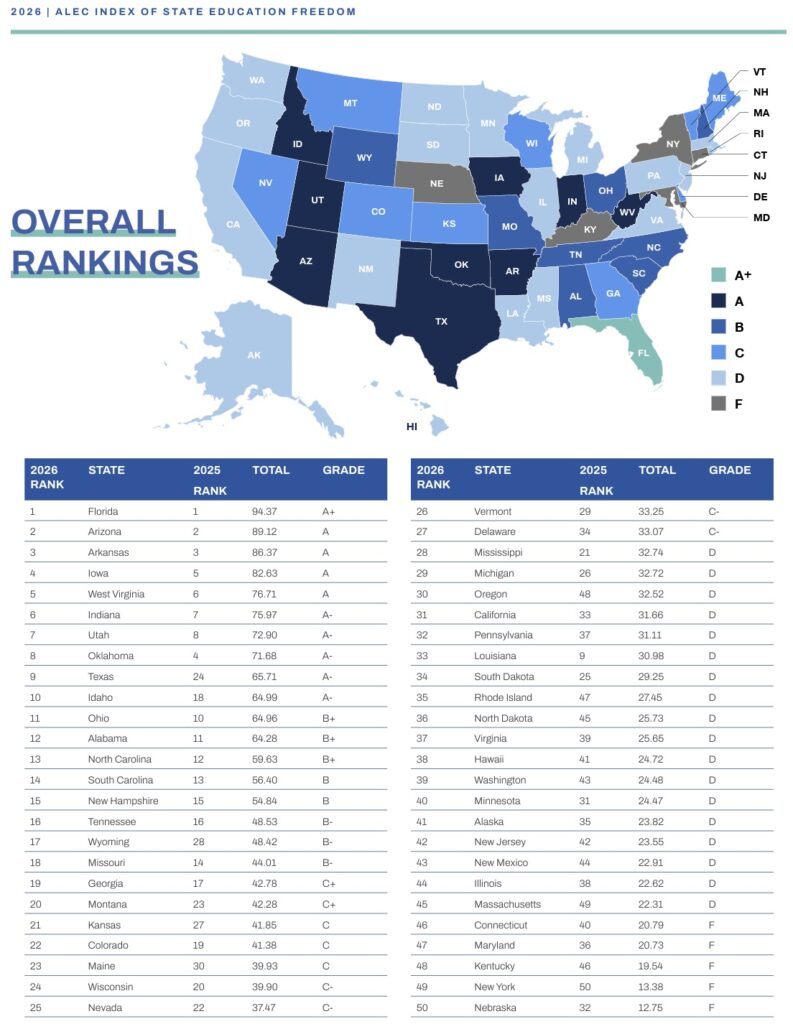
Just in time for National School Choice Week, the American Legislative Exchange Council released its annual Education Freedom rankings of the 50 states: Florida came out on top for the third year in a row, followed by Arizona, Arkansas, Iowa and West Virginia.
See the full rankings, which are based on both private school choice and public school options, below.