South Korea removes propaganda speakers on border to appease North Korea
The new liberal government in South Korea is making good on a promise to be more conciliatory to North Korea by nixing propaganda broadcasts over the demilitarized zone.
Multiple media are…
The new liberal government in South Korea is making good on a promise to be more conciliatory to North Korea by nixing propaganda broadcasts over the demilitarized zone.
Multiple media are reporting South Korea’s government under President Lee Jae Myung has begun to dismantle propaganda loudspeakers previously used to blast anti-communist messages and K-pop music into the North along the border.
“This is a practical measure aimed at easing tensions between the two Koreas, carried out within a scope that does not affect our military’s readiness posture,” the South Korean Ministry of National Defense said in a statement, according to the Korea Times.
But so far, the gesture seems to have fallen flat. Last week, North Korea (DPRK) rejected proposals for negotiating with South Korea about joint areas of concern.
Tellingly, the communists are not moving to dismantle their own propaganda speakers on the DPRK’s side of the border.
Lee criticized the previous South Korean administration under President Yoon Suk-yeol for restarting the broadcasts last year after North Korea floated 350 balloons carrying trash across the border to the south.
The communist trash included “manure, cigarette butts and waste batteries along with cloth scraps and waste papers,” reported NBC News.
South Korea’s army has removed about 20 fixed speakers in the area, the Yonhap News Agency noted. Lee previously had shut down the broadcasts from the speakers in June. In return, North Korea stopped broadcasting its own propaganda across the border.
In addition to K-pop music, the loudspeakers also broadcast “short radio plays that criticized the DPRK regime’s corruption and human rights abuses and sensitive information such as updates on the Ukraine war and casualties during DPRK military construction,” NK News said.
A former officer who defected from the DPRK said the propaganda broadcasts were effective.
“Everyone at the frontline posts hears them,” Lee Soon-sil, a former nursing officer in the DPRK army, told NK News, noting it increased curiosity about the South among the troops.
The South Korean administration is also trying to put an end to civil groups sending anti-DPRK leaflets across the border.
A law prohibiting the launching of such leaflets from South Korea was declared unconstitutional by the country’s Supreme Court in 2023.
The government is now exploring the novel use of aviation, disaster and environmental laws to prohibit the distribution of the leaflets.
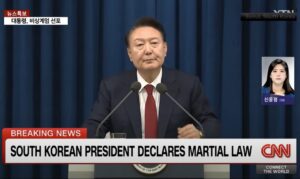
Lee recently assumed the office of the presidency after his predecessor was impeached over the imposition of martial law in the spring.
The New York Times reported the impeachment as part of a cycle of investigations into previous presidents in South Korea to solidify the current president’s hold on power and as a form of political revenge.
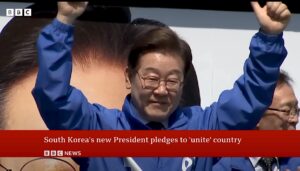
Still, Lee won the presidential election handily in March after campaigning, in part, to restore diplomacy and dialogue with North Korea.
“Dialogue, communication and cooperation are absolutely essential,” he told reporters, according to the Korea Times. “Even during times of war, diplomacy continues. We must be willing to listen, even if we dislike the other party.”
Previously, the propaganda loudspeakers in South Korea were paused in 2015 and 2016, dismantled in 2018, then reinstalled in 2024.
But apart from the cessation of propaganda broadcasts, the DPRK seems unimpressed by Lee’s gesture towards diplomacy.
Kim Yo Jong, the sister of North Korean dictator Kim Jong Un, rejected overtures by the South Korean president to restart nuclear talks with Seoul, an idea reportedly greenlighted by President Donald Trump.
“We clarify once again the official stand that no matter what policy is adopted and whatever proposal is made in Seoul, we have no interest in it and there is neither a reason to meet nor an issue to be discussed with” South Korea, she said in a statement carried by state media this week.
The Kim dynasty has received both cash and cooperation from Russia and China after North Korea sent over 10,000 troops to fight in Ukraine for Russia.
North Korea is reportedly pondering sending another 30,000 troops to Ukraine, even after the current levy reportedly suffered 4,000 casualties.
The alignment of China, Russia and North Korea poses one of the most serious challenges to global security since the end of World War II, Japan warned.
Not coincidentally, the three countries just commemorated the 80th anniversary of Japan’s surrender in World War II in the North’s capital of Pyongyang.