Strong majority of Illinois voters support federal school choice program in Tuesday primary
Residents across Illinois gave a resounding “yes” to school choice Tuesday, with 63% of primary voters indicating they want the state to join the new federal school choice tax credit…

Residents across Illinois gave a resounding “yes” to school choice Tuesday, with 63% of primary voters indicating they want the state to join the new federal school choice tax credit program.
Support was consistent in the 31 of the state’s 102 counties that were asked about school choice.
“In every place in which the nonbinding referendum question was on the ballot, a majority favored opting into the program,” said the Illinois Policy Institute, which released results of the vote on the nonbinding referendum question.
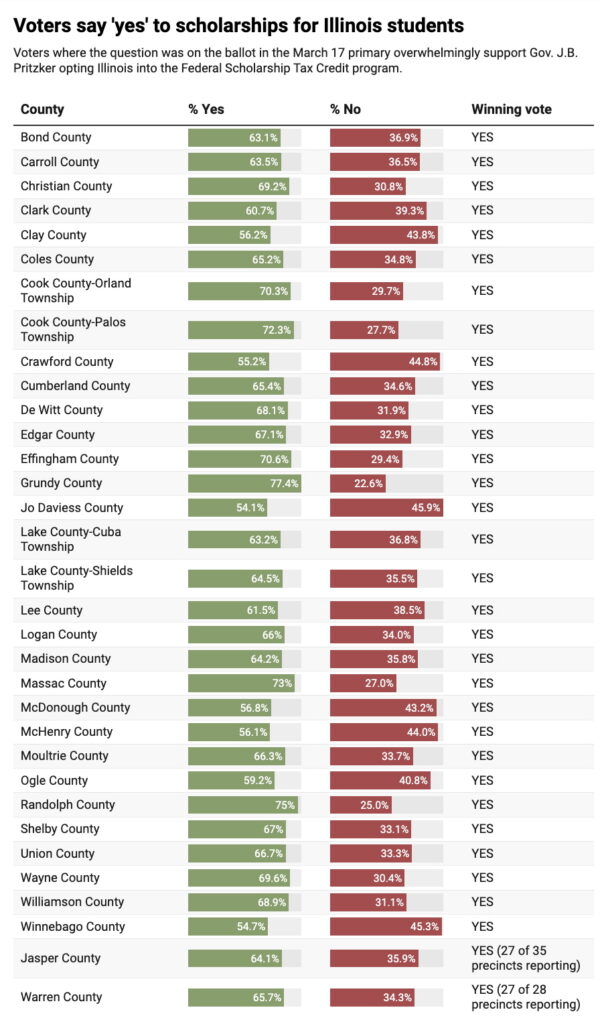
Some of the strongest support came from Cook County – home to Chicago and many of its suburbs – where 70% or more of voters said the state should opt in.
The smallest margin was in Winnebago County, near Rockford, where 54.7% of voters favored participating. The largest was in rural Grundy County, with 77.4% of voters approving.
“Illinois voters overwhelmingly sent a message to Gov. J.B. Pritzker,” the institute wrote.
Pritzker, a Democrat and possible 2028 presidential candidate, has resisted school choice but has said he’s waiting to see the federal program’s rules – expected this summer – before deciding whether to participate. The program starts in 2027, but states are indicating participation now to give families, schools and scholarship organizations time to prepare.
To date, 28 states have said they will join. This includes Kentucky, where Gov. Andy Beshear, a Democrat, vetoed a bill to participate only to have the Republican Legislature override him. Kansas lawmakers passed a similar measure that could withstand a veto from Gov. Laura Kelly, a Democrat.
To date, the only Democrat to voluntarily join is Colorado Gov. Jared Polis, although North Carolina’s Josh Stein has said he is considering it.
Although residents of any state can claim the $1,700 tax credit, which will fund scholarships likely worth more than that, only students in states that opt in can receive them.
Primary results show CTU losing its grip
The institute said Tuesday’s results for state and federal contests show the powerful Chicago Teachers Union is losing its grip on political races.
Union-backed candidates lost seven of 13 races, the institute said, in what it termed “a historic defeat.”
“CTU is officially no longer a political tastemaker in Illinois,” it posted on X.

The union spent heavily in nine of the races, dishing out $763,000 to back mostly Democratic candidates. It also supported Republican state Rep. Norine Hammond, a 14-year incumbent and deputy minority leader, who lost in a landslide to Joshua Higgins, who supports school choice.
Corey DeAngelis, a school choice advocate and senior fellow with Americans for Fair Treatment, said politicians “would be wise to run the other way from the Chicago Teachers Union endorsement,” which he called “the political kiss of death in Republican primaries.”
“Both parties should reject these radical unions,” he told The Lion in a message. “Once enough Democrats say no, the unions won’t be able to control them anymore, either. It’s time for politicians on all sides to prioritize parents and students over special interests.”
The union’s favorability hit a record low before the primary, the institute noted, with nearly half of Chicago voters saying they would be less likely to vote for candidates who received money from CTU.
Its political spending and lobbying in 2025 totaled $4.2 million, and spending on politics, overhead and other union leadership priorities totaled 82% of CTU’s budget. The remaining 18% was spent on representation, which includes contract negotiation, administration and enforcement.
The city’s school system has been plagued by chronically low test scores, with the vast majority of elementary students unable to read or do math at grade level. Its budget woes included an estimated $734 million deficit last year. Nevertheless, spending has risen while enrollment has declined.