
‘This is a crisis’: Hawley urges immediate gas tax pause, dismisses highway fund concerns
Missouri Republican Sen. Josh Hawley is urging Congress to suspend the federal gas tax as the U.S.-Iran conflict passes the 100-day mark and prices continue pinching American consumers at the…
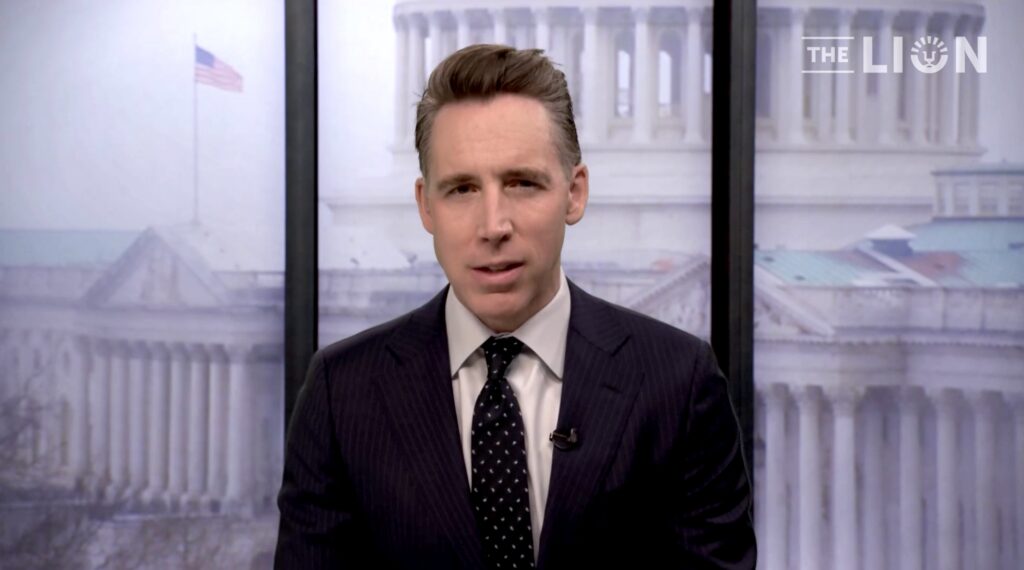
Missouri Republican Sen. Josh Hawley is urging Congress to suspend the federal gas tax as the U.S.-Iran conflict passes the 100-day mark and prices continue pinching American consumers at the pump.
Congressional Republicans and Democrats have introduced separate legislation to pause the 18-cent-per-gallon tax, though some analysts are warning the measure could accelerate Highway Trust Fund insolvency and add to the federal deficit while sparing consumers only a few dollars per fill-up.
Gas prices reached four-year highs heading into Memorial Day weekend, and though the national average recently dropped by several cents it remains more than a dollar above where it was at this time in 2025, according to AAA data.
“Congress can plus up the Highway Trust Fund from any source at once, and my view is that gas prices are so high right now. This is a crisis. We need to act in a timely fashion,” Hawley told The Lion in response to a question about whether his legislation would add to the federal deficit and hasten HTF insolvency. “We can take 20 cents off the price of gas right now, a little bit more even off the price of diesel, and I just think working people need it.
“I think Congress needs to provide relief,” he continued. “The president has endorsed it, and what better way to do that than to cut the gas tax and cut it right now? I don’t know why we’ve delayed.”
The Strait of Hormuz remains effectively closed as the conflict drags on, disrupting global supply chains and maintaining uncertainty that shakes oil markets. Even if the Iran conflict were to end soon, it could take months or years for gas prices to stabilize, GasBuddy petroleum analyst Patrick De Haan told CBS News on June 2.
Hawley noted that high energy costs have a wide-ranging impact on prices across other industries, stating that expensive diesel multiplies grocery and fertilizer costs. He introduced the Gas Tax Suspension Act on May 11, which would pause the federal gas tax for 90 days after enactment.
President Donald Trump signaled support for pausing the federal gas tax, and Hawley’s bill allows for a 90-day extension of the pause at the direction of the president. Only Congress can suspend the federal gas tax and lawmakers across the political aisle have introduced similar measures, including Reps. Anna Paulina Luna, R-Florida, and Chris Pappas, D-New Hampshire, as well as Sens. Richard Blumenthal, D-Connecticut, and Mark Kelly, D-Arizona.
Relief or spending cuts?
“The cost of gas and energy has become increasingly burdensome for American families and Washington should explore every responsible tool for relief,” Nicole Huyer, a senior research associate at The Heritage Foundation’s Thomas A. Roe Institute for Economic Policy Studies, told The Lion. “Suspending the federal gasoline tax can provide modest relief – but only if equivalent spending cuts are made elsewhere.”
Huyer explained that without spending cuts to offset revenue generated through the gas tax, Americans would receive only temporary relief at the pump in exchange for significant long-term costs. She added that the measure would accelerate the Highway Trust Fund’s insolvency, undermine the “user pays” principle and result in greater reliance on the general fund financed by taxpayers.
“Temporary relief should not come at the expense of fiscal responsibility,” she said. “Suspending the gas tax is only defensible if paired with real spending reductions.”
The Congressional Budget Office projects the fund will be exhausted by 2028. Though it was initially created to build the interstate highway system, it is now used more broadly for constructing and maintaining mass-transit infrastructure.
A May Cato Institute analysis found that a federal gas tax holiday could add at least $11 billion to the deficit, given the fund’s waning balance and the likelihood of Congress drawing down the general fund to finance infrastructure projects. The analysis also notes that a gas tax suspension would accelerate insolvency and that Americans could expect to save only about $3.68 per fill-up for a 20-gallon SUV.
Some House Democrats, such as Rep. Richard Neal, D-Massachusetts, argued against a gas tax holiday, citing those fiscal concerns after Trump expressed support for the idea.
When gas topped $5 a gallon in 2022, former President Joe Biden and some congressional Democrats supported a gas tax suspension, though it was controversial and never enacted.
South Dakota Republican Sen. John Thune said in 2022 that the Biden administration was inventing “yet another gimmick, another Band-Aid and something they know is dead on arrival up here in Congress.” Thune, who is now Senate majority leader, told reporters in May that although he has not historically supported a gas tax holiday, “I’ve got some colleagues out there who think it’s a good idea, and so we’ll hear them out.”
Several states have already enacted a gas tax suspension, with Georgia acting first March 20 and Indiana and Utah following suit. After Georgia resumed the gas tax June 2, the governor’s office announced that the pause resulted in a $196.6 million decline in motor fuel tax revenue in May.
Indiana has extended its gas tax suspension until July, and according to local media, the state will examine how to fund infrastructure maintenance during the next budget session. Matt Greller, executive director of Accelerate Indiana Municipalities, said local governments have already asked Gov. Mike Braun to direct other state money to replace gas tax revenue.
“If this becomes a long-term suspension, that’s where the real concern begins,” Greller said. “We can probably make our way through a short-term situation.”