Trump executive order aims to boost AI use in K-12 schools
Instead of shying away from artificial intelligence (AI), public schools should immerse K-12 students in it to stay technologically viable, the Trump administration says.
“To ensure the United…

Instead of shying away from artificial intelligence (AI), public schools should immerse K-12 students in it to stay technologically viable, the Trump administration says.
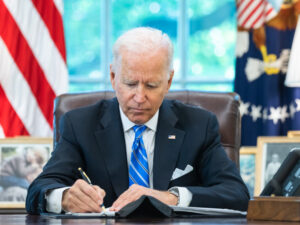
“To ensure the United States remains a global leader in this technological revolution, we must provide our Nation’s youth with opportunities to cultivate the skills and understanding necessary to use and create the next generation of AI technology,” reads an executive order the president signed April 23.
“While AI education in kindergarten through twelfth grade (K-12) is critical, our Nation must also make resources available for lifelong learners to develop new skills for a changing workforce.”
This approach marks a sharp reversal from the Biden administration, which had placed restrictions on expanding AI use. Trump revoked those policies in another executive order in January after his inauguration, according to USA Today.
“We have literally trillions of dollars being invested in AI,” Trump said of the technology, which has drawn bipartisan attention concerning its military, economic and ethical repercussions.
‘Deeply dangerous’ arms race
The order tasks the U.S. Education and Labor Departments with creating high-school AI courses, certification programs, apprenticeships, and other educational initiatives, USA Today notes.
“Democrats and Republicans have expressed fears about American students falling behind other nations, particularly China, as technology becomes more advanced and integrated into the workforce.”
These measures are designed to foster AI competency in what has been described as a “deeply dangerous” arms race between the United States and China.
“Advanced AI is widely seen as a cornerstone of future economic and military strength, and the prospect of parity – or Beijing overtaking Washington – has injected a new sense of urgency on both sides of the Pacific,” writes Thomas English for the Daily Caller News Foundation.
“Fresh metrics from Stanford’s AI Index Report 2025 show the U.S. lead in AI has all but vanished. Chinese AI systems now rival American models on key benchmarks and lead the world in research output, fueling anxiety in both Washington and Beijing.”
Under the order, a new White House Task Force will also help identify “any Federal funding mechanisms, including discretionary grants,” to support AI educational resources for grades K-12.
Such programs may play an ever-increasing role on the international stage as China’s Alibaba and Baidu companies now spar openly with U.S.-owned corporations such as Google and OpenAI, according to the Daily Caller.
“Strategists worry the U.S.-China AI contest could reshape global power dynamics,” English wrote. “Cutting-edge AI can confer advantages in everything from finance to cyberwarfare to autonomous weapons.”
‘Profits ahead of national security’
Secretary of State Marco Rubio has warned of AI’s economic repercussions in previous years.
“The heads of Intel, Nvidia and Qualcomm are putting profits ahead of national security,” he said when he was a senator in 2023. “These CEOs are lobbying against export controls designed to keep the Chinese Communist Party away from AI technology. China is growing stronger by the day, aided by American capital and chips. We cannot allow China to get its hands on advanced AI chips.”
Chinese AI labs are now competitive with American ones, even though China received only $9.3 billion in private investment last year – a twelfth of U.S. tech firms’ $109 billion, the Daily Caller noted.
“It’s impressive and a little scary that China did so much with so much less funding,” said Max Tegmark, MIT physicist and AI researcher. “It shows that talent and strategy are everywhere — a head start is never safe in tech.”
Safety is another top concern for technology professionals.
“We’re sleepwalking into a multipolar world with zero coordination,” said Tegmark. “Calling it an arms race makes it sound zero-sum. But AI safety isn’t like building nukes. It’s more like building aviation standards. Either the whole system works, or it doesn’t.”
Unlike the nuclear-power treaties created during the Cold War era, no “binding international framework for AI” exists, the Daily Caller explained.
“This isn’t just about who launches the best chatbot,” Tegmark argued. “It’s about who sets the agenda for how AI is used in the world — and that has military and geopolitical consequences.”
Such considerations are also raising ethical concerns from “facial recognition surveillance to deepfake propaganda,” English wrote.
‘Training students to use it wisely’
As a result, future generations must learn how to handle this emerging technology in an ethically responsible way – perhaps by using a 2,000-year-old teaching method, argues a classical Christian leader.
“AI will become more and more part of regular life, just as past technological innovations such as the calculator and microwave, already have,” wrote Kolby Atchison in an article, “Classical Education and the Rise of AI.”
“The way forward is not the way of the Luddite – refusing to use technology at all – but rather training students to use it wisely, and being especially careful to not let it replace the assignments, activities, and experiences students must encounter themselves in order to grow as men and women of virtue.”
Meanwhile, the Association of Classical Christian Schools is leading an initiative to formulate AI educational guidelines and principles for 550 member institutions.
“The objective of classical Christian education was to not take anything off the table,” the association’s president, David Goodwin, told The Lion. “Even if (AI) is a scary thing, it fits into the purpose of our operation, which is to train students to take all thoughts captive to Christ, and so we want to model that.”
Goodwin also comes from a technological background, working 15 years for Hewlett-Packard before becoming an educator.
“It’s the old adage that the first kid to get into sexual trouble in college is often the one who was sheltered his whole life,” he said. “You want to prepare your students to know how to use an AI rightly, not to write their papers with it but rather to use it to help with research. We should be reasonable in our approach with AIs.”