US population growth slows as immigration declines; Midwest states, school choice states on rise
U.S. population growth slowed amid a sharp decline in immigration but remained above the low recorded during the COVID-19 pandemic, according to new Census data.
The United States added 1.8…

U.S. population growth slowed amid a sharp decline in immigration but remained above the low recorded during the COVID-19 pandemic, according to new Census data.
The United States added 1.8 million people between July 1, 2024, and June 30, 2025 – a growth rate of 0.5%. That figure was down 1.4 million from the 3.2 million added the previous year, a drop driven almost entirely by reduced immigration.
The slowdown “is largely due to a historic decline in net international migration, which dropped from 2.7 million to 1.3 million,” said Christine Hartley, assistant division chief for Census estimates and projections, in a release.
President Donald Trump has reduced immigration through border enforcement, deportations and encouraging self-deportation, reversing a trend of open immigration under former President Joe Biden.
U.S. births and deaths remained relatively stable, Hartley said, with net natural increase totaling about 519,000 people – “roughly the same as the prior year.”
That figure exceeds population growth during the pandemic but is about half of what it was in 2017 and a third or less of levels seen in the early 2000s.
The Trump administration has said it wants Americans to have more children.
Currently, three prominent women in the White House – Second Lady Usha Vance, Press Secretary Karoline Leavitt and Katie Miller, wife of White House Deputy Chief of Staff Stephen Miller – are pregnant.
Midwest states show growth
Regionally, the Midwest was the only part of the country where every state posted population gains. Michigan, Ohio, Wisconsin, Illinois, Indiana, Iowa, Kansas, Minnesota, Missouri, Nebraska, North Dakota and South Dakota added nearly 900,000 residents combined over the past three years, an encouraging trend.
Some of that growth came from net domestic migration – people moving from other parts of the country – which turned positive “for the first time this decade,” said Marc Perry, a senior Census demographer. Perry noted the shift was “a notable turnaround from the substantial domestic migration losses in 2021 and 2022 of -175,000 or greater.”
Ohio and Michigan, in particular, saw rebounds after losing residents during the height of the pandemic, the release said.
School choice states grow fastest
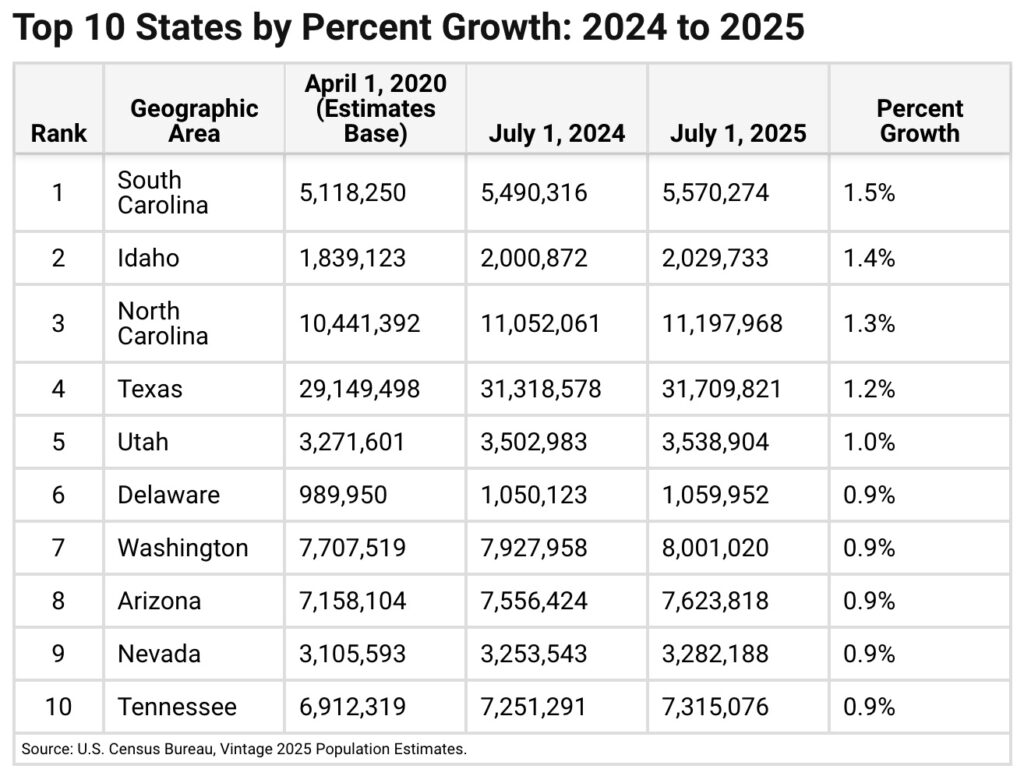
South Carolina was the fastest-growing state last year, increasing its population by 1.5%. Neighboring North Carolina ranked third at 1.3%, with Idaho (1.4%), Texas (1.2%) and Utah (1%) rounding out the top five.
Beyond year-over-year changes, the Census data also tracked population shifts from 2020 to 2025.
The top six gainers during that period – Idaho, Florida, South Carolina, Texas, Utah and North Carolina – all have enacted or expanded broad school choice programs.
By contrast, five of the seven states that lost population during that span lack school choice programs: California, New York, Hawaii, Mississippi and Illinois. Lawmakers in Mississippi are actively working to pass universal school choice.