Washington needs to join states passing school ‘bell-to-bell’ cellphone bans, commentary argues
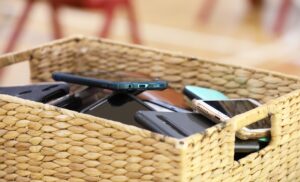
By failing to restrict cellphones in classrooms, Washington schools are rerouting a quarter of their funding to social media instead of education, a recent commentary concludes.
“When you…

By failing to restrict cellphones in classrooms, Washington schools are rerouting a quarter of their funding to social media instead of education, a recent commentary concludes.
“When you consider that Washington state spends more than $30 billion per biennium on public education, 25% of school hours being siphoned up by Big Tech’s addictive social media platforms adds up to a significant amount of money,” writes Ashley Gross for the Washington State Standard.
“This is essentially a transfer of our tax dollars straight to the bottom line of Meta, TikTok, and other platforms — at the expense of our kids’ attention and education.”
Gross, co-lead of the Distraction-Free Schools WA group with two high school children in Seattle, contends the solution is simple: enact a law banning cellphone use for the entire school day.
“The state must reclaim the school day for its intended purpose — educating our children and helping them develop the social and emotional skills they need to succeed. Lawmakers should act now by passing a statewide bell-to-bell phone-free schools law.”
‘Off and away for the day’
Such laws are growing in popularity nationwide, with research continuing to track the hours spent by public-school students on their cellphones – even during class time.
“At this point, 27 states require that phones be kept away during instructional time, with 19 of them, plus the District of Columbia, requiring ‘off and away for the day’ policies,” Gross notes. “States such as Indiana and Georgia that previously adopted weaker phone-restriction policies are now moving to strengthen them.”
Meanwhile, the Evergreen State has fallen behind this curve with Senate Bill 5346, which “simply proposes that the state superintendent deliver recommendations on cell phone use during instructional hours by December 2028,” she laments.
“By that time, Washington may well be the only state in the nation with no statewide policy.”
Gross challenges lawmakers to review the results from schools that have already implemented cellphone bans for the entire school day.
One of them, Robert Eagle Staff Middle School in Seattle, featured testimony in a recent Senate education committee.
“We went from filming fights in the bathrooms to dancing and karaoke at lunch,” said principal Zac Stowell, as quoted by Gross. “It’s magic. Every student deserves that. … Please implement a statewide bell-to-bell cell phone policy.”
Nothing less than a total ban will work as weaker restrictions place undue burdens on teachers, according to Gross.
“My school attempts to institute phone restrictions every year, but without the backing of a bell-to-bell law, these systems fall apart within weeks,” said Dorothea Kaste, who attends Lincoln High School in Seattle.
“The burden of policing phones falls on teachers, who have told me they must choose between spending 20 minutes of each class chasing down devices or teaching. Each year that a law ensuring distraction-free schools doesn’t pass, another class of students graduates having missed out on the academic and social skills that we’re promised with a public education.”