
‘Dangerously unfair’: Male biology doesn’t concede to gender identity, and neither should schools
Olympic women’s boxing just gave the world a clear reminder of why male biology should be kept out of female sports, no matter the circumstances.
Algeria’s Imane Khelif, who reportedly has…

Olympic women’s boxing just gave the world a clear reminder of why male biology should be kept out of female sports, no matter the circumstances.
Algeria’s Imane Khelif, who reportedly has male (XY) chromosomes and such high levels of testosterone that the International Boxing Association (IBA) banned the athlete from competing in the women’s division last year, punched female Italian boxer Angela Carini so hard 30 seconds into the fight, Carini retreated to her corner for help to fix her headgear. But seconds after returning to the fight, she went back to her corner to stop the bout.
“It’s not right,” Carini was heard saying as the referee stood between the fighters, lifting Khelif’s arm to indicate the victor.
It isn’t right, for a host of reasons, including the safety of female fighters and the fairness of female competition.
“It could have been the match of a lifetime, but I had to preserve my life as well in that moment,” Carini tearfully told reporters afterward.
Notably, there is no evidence Khelif is transgender, which is apparently illegal in Algeria. And the boxer’s “female” designation on a passport was sufficient for her eligibility, said the International Olympic Committee.
This has fueled speculation the athlete was born with a condition that falls under Differences in sex development (DSD), which can leave a person with male XY chromosomes but with ambiguous or even female genitals.
But given the high testosterone levels and XY chromosomes, which led the IBA to pull Khelif from a gold medal fight last year, the athlete’s male biology is indisputable – and it’s dangerously unfair.
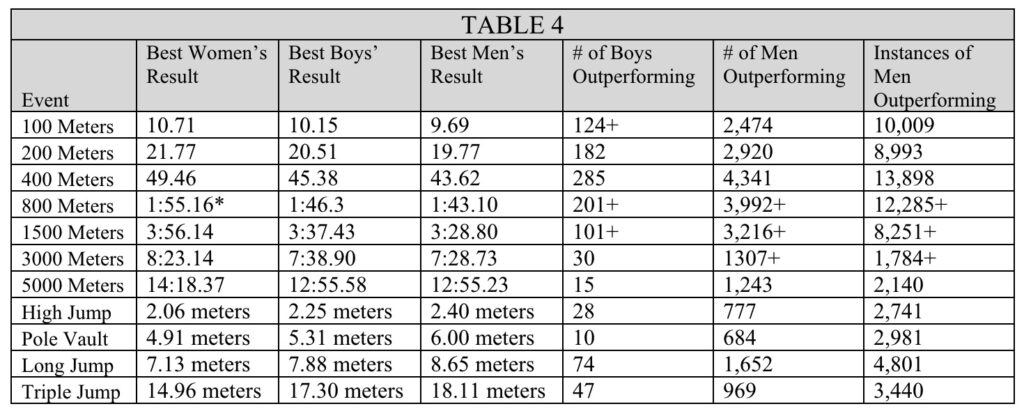
But for those unwilling to trust their eyes and common sense, consider a study on biological differences in sports from two professors at Duke Law School, who found “there is an average 10-12% performance gap between elite males and elite females.”
In fact, even boys (males under 18) regularly beat elite adult women in racing and jumping competitions.
“The number of men and boys beating the world’s best women in the 100 and 400 meters is far from the exception,” the authors write. “It’s the rule.”
Khelif deserves compassion, but the athlete should never have been allowed to compete in female boxing, as the IBA rightly determined last year.
In a coincidence, Thursday’s match in Paris came the very day that, in the U.S., the Biden-Harris administration’s Title IX rules for schools take effect.
The rules reinterpret discrimination under Title IX to include gender identity, potentially forcing schools to allow students to use bathrooms, lockers rooms, and even play sports according to their chosen gender identity, regardless of biological sex.
Temporary injunctions against the rules have been issued in multiple jurisdictions, making the rule-change unenforceable in 26 states: Alaska, Idaho, Indiana, Kansas, Kentucky, Louisiana, Mississippi, Montana, Ohio, Tennessee, Texas, Utah, Virginia, West Virginia, Wyoming, Arkansas, Missouri, Iowa, Nebraska, North Dakota, South Dakota, Oklahoma, Alabama, Florida, Georgia and South Carolina.
But as the litigation plays out, girls in schools across the country are training, sweating and preparing for upcoming seasons in softball, volleyball, basketball, wrestling, swimming and a host of other sports, wondering whether they might come up against male biology in their sport.
God help them if they do.
It happened once in ancient Rome’s Capitoline Games during Nero’s reign, when a senator, Palfurius Sura, convinced a female wrestler to fight him, leading Vespasian to throw him out of the Senate.
Not even ancient Rome in all its barbaric lust for spectacles put up with men in women’s sports.
Photo credit: AP/John Locher