EdChoice Survey: Parents want more options, strongly support school choice
As American public schools continue to struggle with declining performance, a new survey shows parents overwhelmingly want more education options – and they continue to strongly support school…

As American public schools continue to struggle with declining performance, a new survey shows parents overwhelmingly want more education options – and they continue to strongly support school choice.
EdChoice will release the 13th edition of its Schooling in America Survey on Thursday, but a summary of findings shared by the school choice advocate with The Lion revealed several trends.
Although parent optimism about K-12 education improved from last year’s record low, the hunger for more options remains. This is especially relevant given the recent NAEP scores, which touched their lowest point ever.
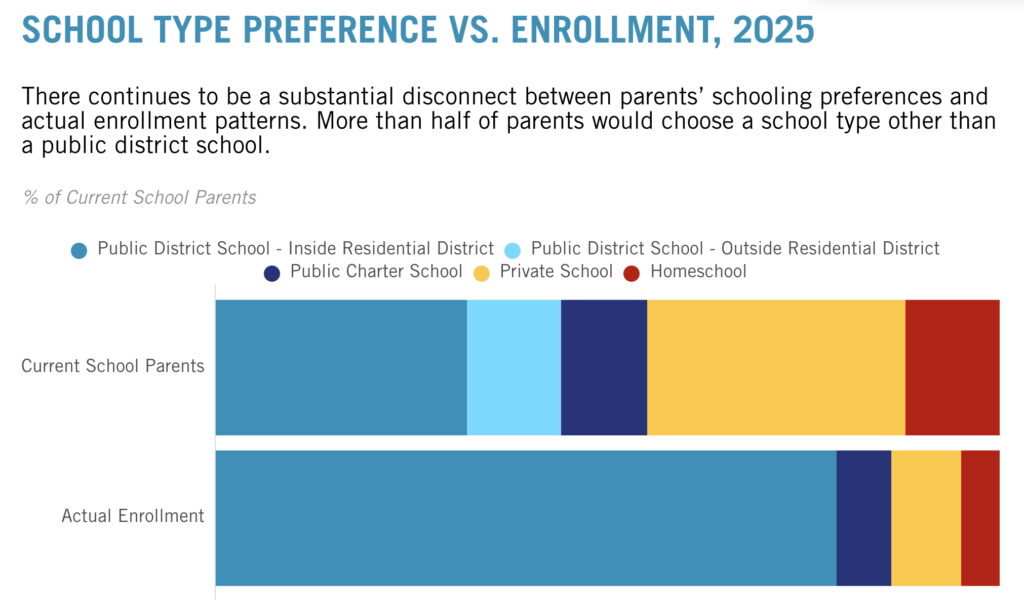
“When we look at school type preference versus the actual enrollment patterns, about 44% of parents say public school, 33% say private school, 11% say charter and 12% say homeschool,” Colyn Ritter, senior researcher at EdChoice, told The Lion. “Actual enrollment is around 80% in public, 9% in private, 7% in charter, and 5% in homeschool.”
Parents weren’t asked about finances or transportation when listing their preferences, but school choice programs are helping families bridge those gaps. That’s especially true for education savings accounts, or ESAs – a parent-directed fund that can pay for tuition, transportation and other education-related expenses.
In the survey, ESAs were the most popular form of school choice, with 74% support generally, and 83% among parents. Support for other choice options such as vouchers, tax-credit scholarships and charter schools ranged from 74% to 79%.
Ritter stressed, however, that supporting school choice doesn’t mean opposing public education.
“For opponents of school choice to say that people that support ESAs and vouchers want to see public schools dismantled or want to see public schools go away” is inaccurate, he said. “There is a very healthy chunk of parents saying that they would prefer a public school and it would be foolish to ignore that.”
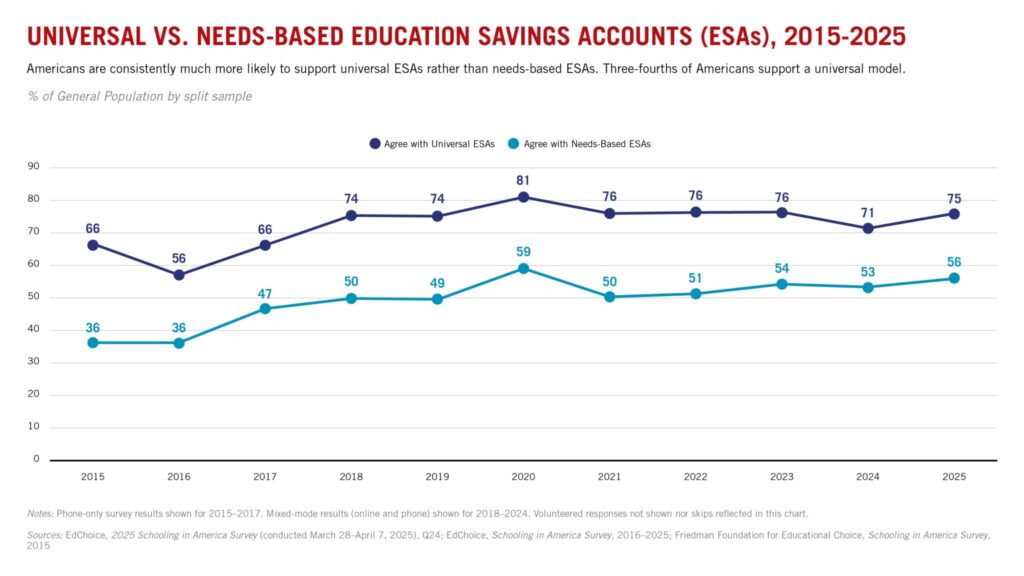
Support for universal ESAs was 75%, versus 56% for ESAs restricted by income or for special needs students, indicating Americans prefer programs available to all students. Universal school choice has proliferated in recent years, with 18 states offering or starting programs that are open to all residents.
Other questions this year included school funding and the federal government’s role in education.
The question about how well public schools are funded was posed two ways: When Americans weren’t giving average funding amounts, 56% said school funding was “too low.” But that flipped when funding numbers were given, with 58% of Americans saying the funding was either “about right” or “too high.” The national average is about $20,000 annually per pupil, though it varies by state.
The Trump administration has made headlines with its stated goal of shutting down the U.S. Department of Education, which was founded in 1979 under Jimmy Carter, but Americans appear to still want the federal government to have a role in education, Ritter said.
“Nearly 80% of parents and Americans feel as though the federal government should at least have a minor role in K-12 education,” he said. Those roles include “providing funding for schools serving students with disabilities or low-income students, as well as ensuring equal opportunities in K-12 education.
“As the Trump administration continues to empower states to do their own thing with K-12 education, there is still a thirst in the public for the federal government having some sort of role.”
Ritter also said awareness of ESAs is growing: Last year, 52% of parents were unsure if their state offered an ESA; this year it dropped to 50%. For vouchers, which have been around longer, it was 43%. Ritter said the number should continue to decrease as more states enact ESAs.
The survey, conducted in the spring, contained a representative sample of the general population (1,514 individuals) and 2,455 current school parents.