
Inside the left’s billionaire-boosted campaign targeting American energy
The strategic effort to punish U.S. energy companies for alleged climate change damages is funded by left-wing…

The strategic effort to punish U.S. energy companies for alleged climate change damages is funded by left-wing billionaires, sources with backgrounds in constitutional law, policy and government told The Lion.
They also say the “lawfare” amounts to an assault on America and humanity itself.
Lawsuits targeting the oil and gas industry are pending in Democratic-leaning jurisdictions across the country – cases critics argue could “cripple” the American energy industry – as the Supreme Court prepares to consider whether companies can be sued in state court over alleged climate change contributions.
Various nonprofits are devoted to different planks of the climate lawfare effort, with some outfits such as the Center for Climate Integrity (CCI) dedicated to arming local communities with tactics to purportedly hold the oil and gas industry accountable for alleged greenhouse gas-related harms. Similar to that of many other nonprofits in the sector, CCI has ties to left-leaning billionaire funding, according to multiple reports and public records.
“These nonprofits are not breaking the law, per se, but it’s just shady to fund litigation because it makes it look like without the funding, the litigation wouldn’t have happened in the first place,” John Shu, constitutional law expert and legal commentator who served in the George H.W. Bush and George W. Bush administrations, told The Lion.
Shu noted that these cases against oil and gas companies are typically tied to funding from left-wing billionaires, including the Rockefellers, the Fords, and Soros’ Open Society groups.
CCI did not respond to The Lion’s multiple requests for comment.
Potential impacts of climate lawfare
Climate related lawsuits could raise energy costs for consumers and businesses while disincentivizing innovation, economic policy analyst Wayne Winegarden wrote for the Pacific Legal Institute in May 2022.
“Relative to the 7.2 billion barrels of oil the U.S. consumed in 2021, every $100 billion in potential judgements equates to approximately $13.85 in additional costs per barrel,” Winegarden noted in his analysis. Several climate lawsuits against energy companies are in the billion and multi-billion-dollar range.
Shu told The Lion he does not believe the climate lawfare “plaintiffs really care if they go to trial or not because they would love to get a huge settlement. … It’s not about the climate or the greenhouse gas. It’s about the settlement.”
“So-called ‘abatement costs’ are where the big plaintiffs’ money is, similar to opioid and tobacco litigation,” Shu said, linking the climate lawfare to the tobacco cases in the 1990s and 2000s. “The tobacco plaintiffs never asked to ban tobacco, even as they claimed how harmful it is, because they didn’t want to ban tobacco. They wanted tobacco companies to stay in business so that they could keep making payments on their massive settlements.”
How CCI fuels the legal fire
CCI “empowers communities with the knowledge and tools they need to hold fossil fuel companies accountable for their deception and the damage they’ve caused,” according to the organization’s website.
The nonprofit also described its role in “providing plaintiffs with key ‘smoking gun’ documents, the latest scientific findings, access to leading legal and scientific experts … and by filing carefully tailored amicus briefs,” on a December 2022 IRS form. “CCI also encourages new climate litigation by building policymaker support for climate accountability and by advising state and municipal officials on their cost recovery options.”
A philanthropic organization of the Rockefeller family and the Tides Foundation – which has received funding from the Open Society Institute founded by billionaire George Soros – have donated to CCI in recent years.
The Rockefeller Family Fund has donated more than $11.5 million to CCI since 2021, according to available IRS records. The Tides Foundation has doled out just over $1 million to CCI from 2023-2024, public documents show.
CCI was originally launched as a project of the Institute For Governance And Sustainable Development Inc. (IGSD). The Rockefeller Family Fund, the Children’s Investment Fund Foundation and the MacArthur Foundation have also donated to IGSD, with the money earmarked for CCI.
The Children’s Investment Fund Foundation was co-founded by British billionaire Chris Hohn, while the MacArthur Foundation has billionaire roots and a history of donating millions to left-of-center groups such as Planned Parenthood, according to InfluenceWatch and public records.
IGSD received at least $2.25 million from the Rockefeller Family Fund, was awarded $7 million from the Children’s Investment Fund Foundation and $500,000 from the MacArthur Foundation since 2018 to support CCI’s work.
CCI has reportedly sought to advance lawfare efforts across the U.S. through several avenues, including paying for billboards, hosting panels at law schools, writing court filings and urging lawmakers to reject proposals that would shield energy companies from such lawsuits.
Several jurisdictions filed lawsuits against oil and gas companies in the months after CCI planned to host or sponsor events at local universities – as was the case in Hawaii, Minnesota, New Jersey and Oregon.
Mapping the network
University of North Carolina Wilmington Associate Professor Jessica Weinkle told The Lion that the “same network” of actors is observable in major climate advocacy and litigation efforts.
Weinkle tracked funding to organizations involved in climate litigation, visualizing the flow of philanthropic funding and the financial connections between green groups through IRS data and Sankey charts.
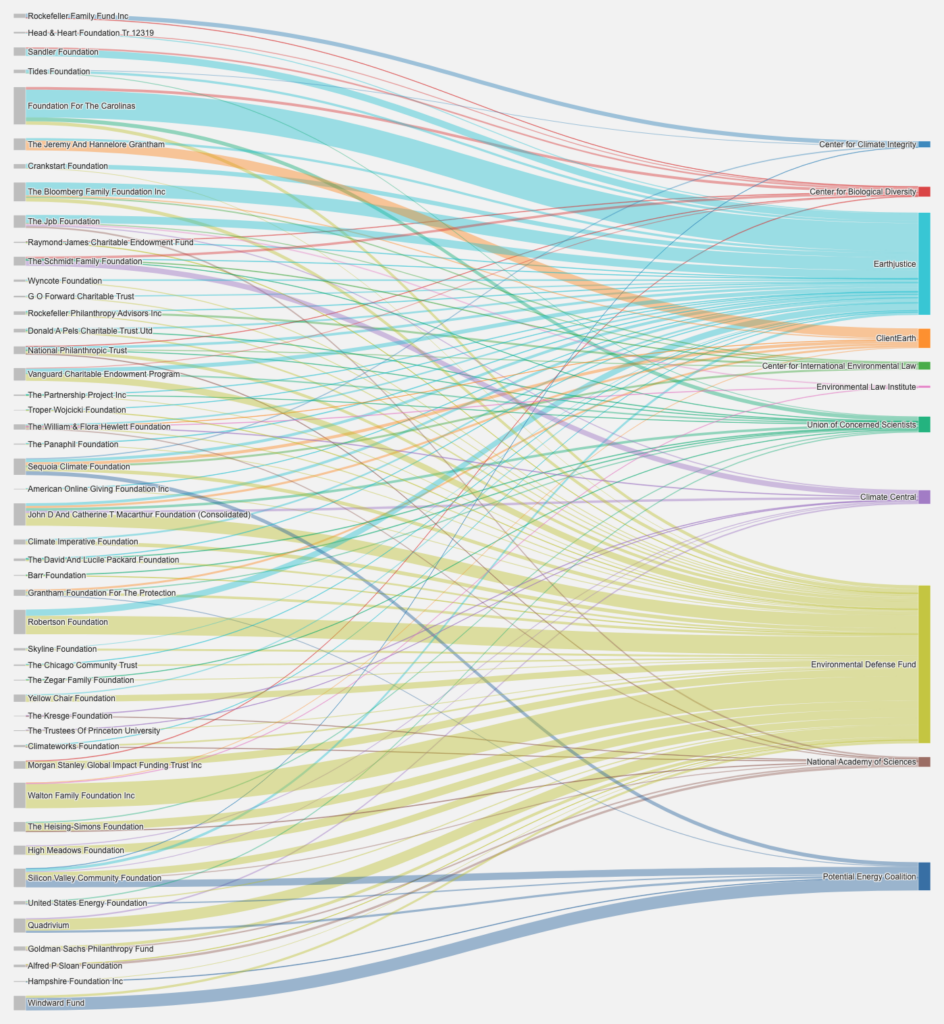
Weinkle’s articles “Angular Momentum” and “The Climate Racket Bezos Bought” also show how philanthropic organizations are “strategically coordinating investment” to advance advocacy that can support litigation, she said.
“There is a very broad range of concern in America, if not the world, about the health of the political process,” Weinkle told The Lion. “When you see this level of control on narratives that undermines not just general access to the agenda by the broad public and various interests but also is targeting the energy system in a very significant way, it is disturbing. … It’s a concern for the health of our politics and our decision-making process.”
“The use of fossil fuels in modern society is just a fact of life,” Weinkle continued. “Any sort of effort to terminate that suddenly is a threat to social stability.”
Congressional pushback
As part of a 2019 grant award description, the MacArthur Foundation noted that CCI was “conceived and developed in 2017 by litigators with extensive experience litigating against the fossil fuel industry and blocking industry efforts to obtain liability waivers from Congress.”
Some members of Congress are now seeking to protect the energy industry from climate lawfare, with Republican Wyoming Sen. Harriet Hageman telling The Lion in an interview she wants to introduce legislation to give oil and gas companies “immunity for producing a product that every one of us use, and has made all of our lives better.”
“All of these companies have obtained every single permit that they were required to obtain,” Hageman said, adding that she would describe the lawfare as “an unconstitutional attempt to impose an ex post facto law against these particular industries.”
Utah became the first state to protect companies from such suits on March 23, barring “clear and convincing evidence that unavoidable and identifiable damage or injury has resulted or will result as a direct cause of the defendant’s violation of statutory and permitting limits.”
Similar legislation is pending in Louisiana, Oklahoma, Tennessee and Iowa, while Congressional Democrats such as Rhode Island Democratic Sen. Sheldon Whitehouse vehemently oppose the idea.
Energy necessary for human flourishing
The United Nations’ Human Development Index (HDI) measures human flourishing through life expectancy, education and standard of living, and as one 2022 Boston University analysis notes, “raising incomes and building robust education and healthcare systems requires energy.”
Energy policy experts also explained to The Lion how energy is closely related to human well-being, with American Enterprise Institute Senior Fellow Benjamin Zycher arguing that “if you oppose fossil fuels, you basically oppose human flourishing.”
“The rise of human flourishing is correlated quite closely with the production and consumption of fossil fuels,” Zycher said. “There is a political left that hates fossil fuels, modern industrial society, and, at a fundamental level, humanity itself.”
Zycher added that “climate lawfare is an obvious attempt to get through the courts what the left can’t get through Congress.”
The Supreme Court in February agreed to consider whether energy companies can be sued in state court over alleged climate change damages, in the case Suncor Energy v. County Commissioners of Boulder County.
The Department of Justice in September weighed in on the case, arguing that, under Colorado’s theory, “every locality in the country could sue essentially anyone in the world for contributing to global climate change.”
Shu told The Lion that “the core of this case is over who gets to regulate greenhouse gases. … Common sense dictates that for a national issue like this, it would be Congress, not each individual state’s tort system.”