
Michigan district continues electric school bus expansion despite concerns, ‘uneven early performance’
One of Michigan’s districts is preparing to implement “full electrification” of its school buses by 2035 – despite concerns over funding, maintenance, infrastructure and “uneven early…
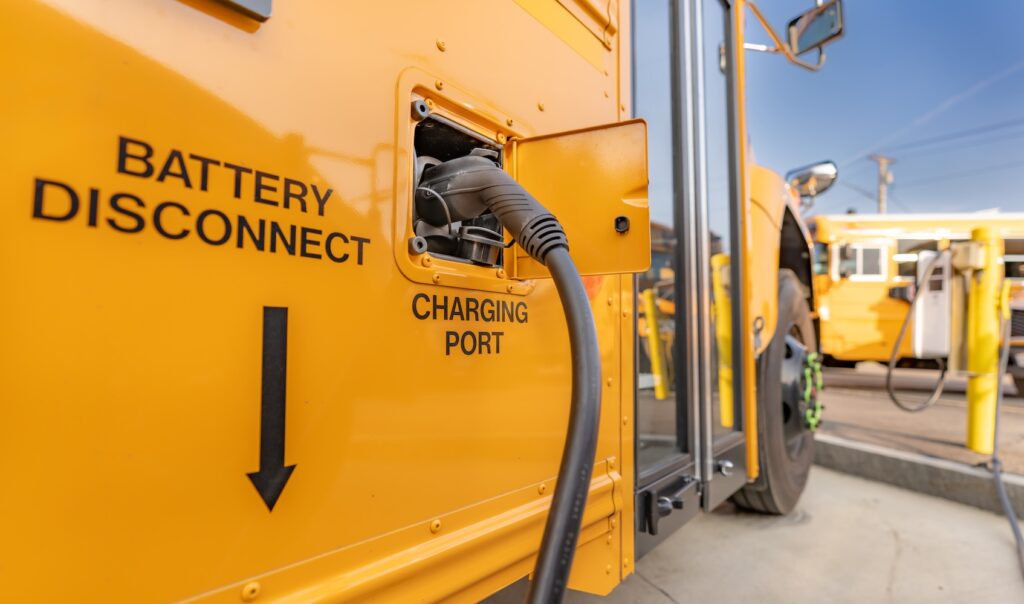
One of Michigan’s districts is preparing to implement “full electrification” of its school buses by 2035 – despite concerns over funding, maintenance, infrastructure and “uneven early performance,” WEMU reports.
“We have to manage through a lot of the funding challenges that are now faced by not just us but anybody who’s trying to do this type of thing,” said Moe Nagpal, Ann Arbor Public Schools (AAPS) construction projects manager.
“And we’re trying to diversify our sources of funding, getting into more local funding as well as private funding, getting also enrolled in some innovative programs that will pay for some of the additional costs.”
The electrification project has already incurred “major state support” with a $4 million energy grant for 10 more buses confirmed in November – “a purchase that public reporting says will bring the total to 24 electric buses out of roughly 130 in daily service,” David Fair writes for WEMU.
“The award sits within Michigan’s Oct. 13, 2025, statewide $35.9 million clean-bus round.”
Nagpal acknowledged the district’s goals will require substantial funding beyond these grants.
“Given the current environment, it’s getting harder to sustain this at the state level and definitely a lot less at the federal level,” he said. “We have the benefit of utilizing bond funds. And sinking funds, if approved in the future, can also be applied for purchasing school busses. And we’re hopeful that if the community approves that, we could utilize those funds, which will essentially be local funds.”
‘A slow start’
As one of the state’s first school districts to test this initiative, AAPS began with four electric buses in 2019.
“Like most early adopters, we were aware there would be challenges, and we definitely use them as a learning experience,” Nagpal said, adding the district had “a slow start but a successful pilot program.”
This included “everything from connecting the chargers and the buses, (communicating) with each other, getting the amount of electric power needed to charge the buses through the local utility DTE, as well as training our own mechanics and, quite frankly, even the drivers to switch.”
Other challenges involved “higher early downtime than diesel buses and subsequent charging-infrastructure reliability issues – both of which AAPS says required phased scaling and direct utility coordination with DTE Energy,” according to WEMU.
Nagpal argues the benefits of lower greenhouse gas emissions outweigh the issues with electric buses.
“Over the lifetime of a diesel bus, it gives out over 300 tons of greenhouse gases,” he said, comparing the projection to an estimated 100 tons for electric vehicles. “So, I would say the opportunity is quite large.”
The district, which enrolls approximately 17,000 students, has enough grant funding to add 16 more electric buses to its current eight vehicles.
‘Backward approach to policy’
Despite Nagpal’s optimism, the district’s electrification project has received scathing reviews from news outlets such as The Washington Free Beacon, which cited AAPS in an article over performance issues.
“During an April 19 presentation to the Ann Arbor Public Schools Board of Education, the district’s environmental sustainability director, Emile Lauzzana, highlighted a number of issues with the district’s electric bus fleet,” journalists reported in 2023.
“Those buses, Lauzzana said, have ‘a lot of downtime and performance issues’ and aren’t ‘fully on the road,’ despite the fact that they are ‘approximately five times more expensive than regular buses.’”
Meanwhile, infrastructure upgrades ballooned to “more like $200,000” from original estimates of $50,000.
“I have a number of colleagues in different states who are facing similar challenges,” Lauzzana said at the time. “For the school bus market, it’s been challenging for us.”
Mary Drabik, communications director for the Michigan Freedom Fund, lambasted the state’s emphasis on electrifying school buses given its problematic implementation.
“Michigan Democrats have put the (electric) cart before the horse,” she said. “The technology and infrastructure for electric buses do not exist at this moment … yet Democrats and school districts insist on purchasing electric buses.”
Ultimately, the detriment to taxpayers will outweigh any environmental benefits, according to Drabik.
“This backward approach to policy only creates more costly problems for residents. As long as Democrats continue to spend the tax dollars of hard-working Michiganders, it will be the residents that truly suffer, not the environment.”
Safety concerns in addition to maintenance, infrastructure problems
Analysts have also raised questions about these buses’ safety compared to diesel ones.
As previously reported by The Lion, electric battery packs involve fire hazards such as arc flashes, which can occur if batteries are not properly deactivated or de-energized.
“I’ve seen the videos of buses in Europe that are all-electric catching on fire and burning, and not just burning slowly but burning quick, fast and in a hurry,” said Nick de Haan, a school bus mechanic in Colorado.
“You have a bus full of elementary kids – it’s like trying to herd cats. You’re not going to evacuate all of them in time.”
Recently, an electric school bus in Los Angeles burst into flames underneath a freeway overpass, causing the driver to be hospitalized because of minor smoke inhalation. No children were on board when the fire occurred.
The bus was operating on lithium ion batteries, which require monitoring for several hours, news outlets noted.
While diesel buses can also catch on fire, they have a slower burn rate, de Haan observed.
“You probably have more reaction time, from the smoke to the point where the bus is totally engulfed,” he said, adding he knew of only two diesel-powered buses catching fire – for causes unrelated to fuel – since he began his career in 2005. “The diesel fuel is really hard to catch on fire, but it was due to a battery cable grounding out.”
De Haan also warned electric battery packs can release heavy-metal toxins if improperly recycled.
“From what I understand, it is an environmental disaster to dispose of these batteries,” he said.
“Manufacturers nowadays might claim that they do research and development, but I can almost guarantee you the consumer is pretty much the guinea pig when it comes to new technology. They don’t have the time, money or resources to do R&D for any length of time.”