New accreditation paths emerge for microschools, hybrids, as school choice explodes
Accreditation for a microschool is often like trying to fit a square peg into a round hole.
Just as education itself is undergoing a seismic shift – with the rise of hybrid schools,…

Accreditation for a microschool is often like trying to fit a square peg into a round hole.
Just as education itself is undergoing a seismic shift – with the rise of hybrid schools, microschools and other alternative models – accrediting agencies are being forced to adapt. Once intended to ensure educational quality and consistency, accreditation is slowly evolving to accommodate nontraditional schools as education options swell nationwide.
Accreditation has become increasingly important with the growth of school choice programs across the country.
In a recent Education Next article, Michael B. Horn and Raphael Gang noted accreditation originated in the late 1800s as a peer-driven effort to help schools improve, not as a gatekeeping tool. The 1965 Higher Education Act, however, tied federal student loans to accreditation, effectively transforming the process into a regulatory regime.
In K–12 education, accreditation developed more slowly. A 2017 Education Next report found fewer than half of states require all public schools to be accredited, although many private and religious schools seek it for marketing purposes. Yet, the growing success of homeschool graduates has raised questions about accreditation’s necessity, Horn and Gang wrote.
A 2022 report found accreditation essentially fails to ensure better outcomes, as few agencies penalize schools for poor performance.
The rise of Education Savings Accounts (ESAs) – now one of the most popular school choice tools – has reignited debate about accreditation’s role.
“From 2011 to 2023, nine states started ESA programs that did not require accreditation, compared to four states that did,” Horn and Gang wrote. “But more recent laws include accreditation requirements and other regulations that make it harder to start up a new school,” including in Texas and Georgia.
Georgia’s new ESA program requires schools to be accredited or in the process of becoming accredited, and to have operated for at least one year. Texas’ program, which begins next school year, adds further restrictions, including pre-approval by the state comptroller and two years of operation.

Florida, by contrast, has seen rapid growth – adding 700 private schools between 2012 and 2022 – because it does not require accreditation.
“This kind of entrepreneurship is what burdensome rules and requirements … risk shutting down,” the authors wrote.
Rigid requirements also tend to favor established private schools in wealthier areas, undermining the intent of school choice programs to serve families across income levels.
While accreditation remains important, Horn and Gang argue better auditing systems, not restrictive rules, are the key to ensuring accountability. They also note that accreditation does not necessarily correlate with school quality – most public schools are accredited despite falling test scores, while many unaccredited schools achieve strong results.
To bridge the gap, two accrediting agencies – the Western Association of Schools and Colleges and the Middle States Association – have launched pilot programs for newer schools.
Middle States’ “Next Generation Accreditation,” for instance, allows brand-new schools to apply immediately. The process takes about two days to complete, costs $1,200 and can lead to accreditation in as little as six months – compared to 18 months or more under traditional methods.
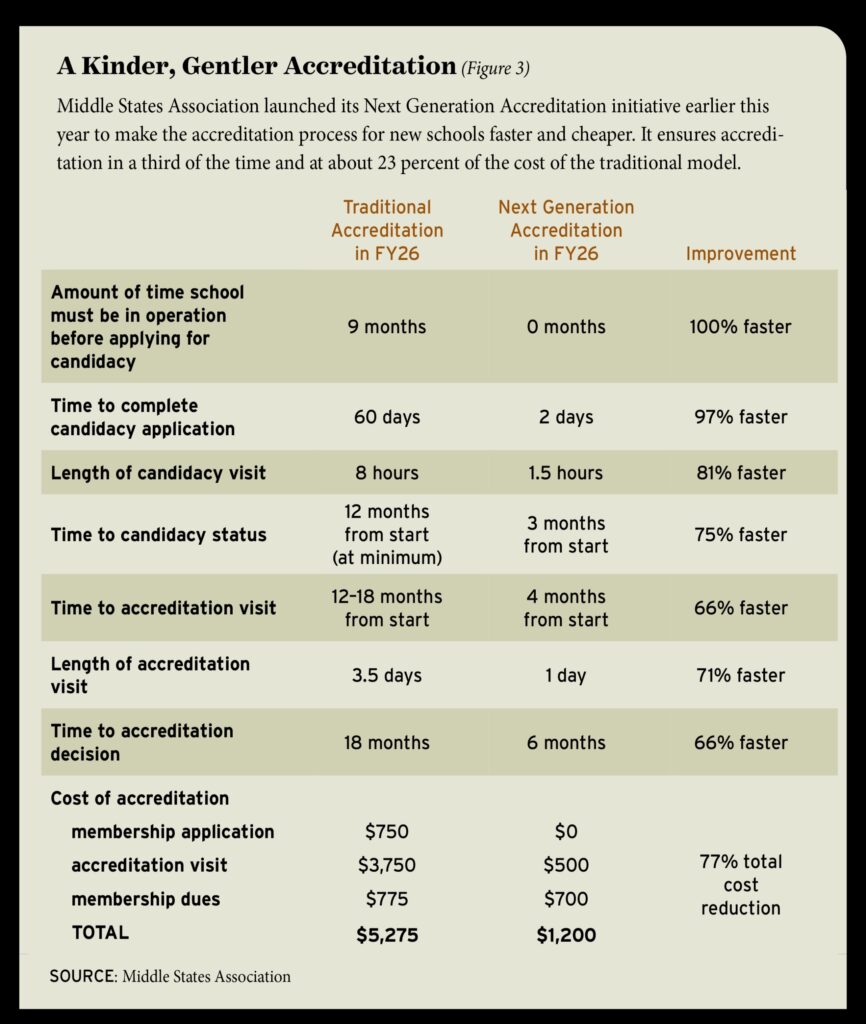
Interest has been strong: Middle States expects to approve 15 new schools by November 2025 and 53 by April 2026.
Genevieve Hinnant, founder of the Montessori-inspired Arbor Learning Lab in Nashville, called the process “incredible,” saying it avoids “a year-and-a-half process with tons of data digging and interviews that cost thousands of dollars.”
Horn and Gang predict as school choice continues to expand – now active in 35 states with a federal program expected by 2027 – accrediting agencies will continue adapting.
“With less restrictive legislation, smart innovation by accreditors and trusting partnerships on the ground,” they write, “we believe these agencies can ensure that new entrants with diverse and differentiated schooling models are able to get started, access public dollars and serve family demand.”
Don Soifer, who runs the National Microschooling Center, said the changes help microschools that offer less traditional models such as outdoor, nature-focused or more experiential learning models.
“During 2025, we have seen encouraging progress from certain leaders in the accreditation industry signaling interest in serving microschools with relevant, microschool-accessible accreditation models,” he told The Lion in an email, noting that some other accrediting agencies and even some state authorities have approved microschools.
“Even with that progress, we see definitely more demand for microschools seeking accreditation, for various reasons, than current capacity to approve or consider them within the next 12 months.”