
‘Together with you, our friends’: Rubio implores Europe to join US in unashamed Western renewal
U.S. Secretary of State Marco Rubio received widespread acclaim for his address Saturday at the Munich Security Conference, calling for Western renewal while emphasizing cooperation between…
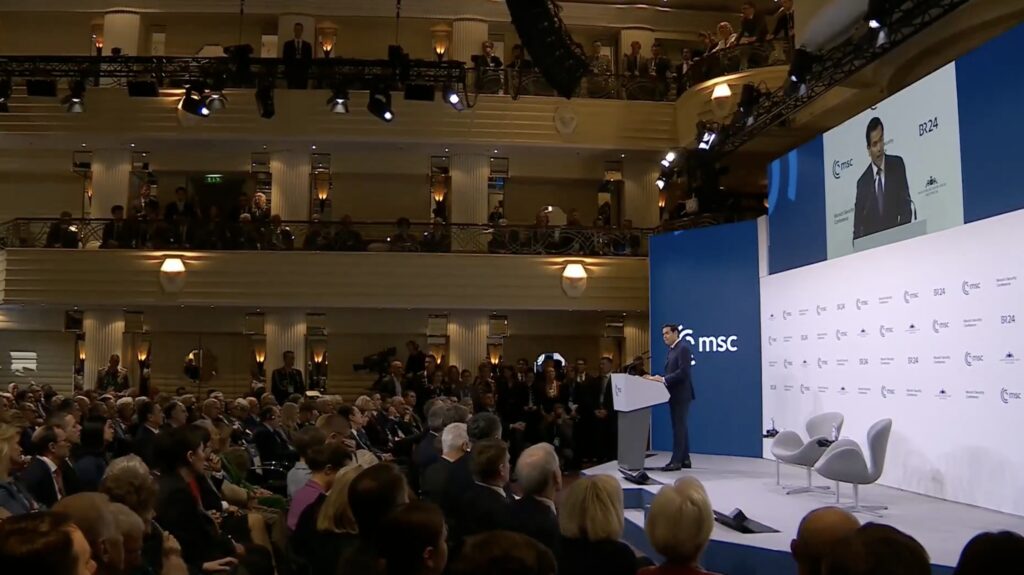
U.S. Secretary of State Marco Rubio received widespread acclaim for his address Saturday at the Munich Security Conference, calling for Western renewal while emphasizing cooperation between America and Europe.
Rubio’s 22-minute speech – interrupted multiple times by applause and punctuated by a standing ovation – were full of historical references and a forward vision consistent with the West’s past.
Rubio began by highlighting the origins of the conference in 1963, a time when Europe was divided by the Iron Curtain, and the Berlin Wall symbolized the ideological clash between communism and freedom.
He reflected on the triumphs of the NATO alliance, which rebuilt Europe after World War II, overcame Soviet communism and reunited East and West Germany.
However, Rubio warned the post-Cold War era marked the beginning of naive optimism.
“The euphoria of this triumph led us to a dangerous delusion: that we had entered, quote, ‘the end of history;’ that every nation would now be a liberal democracy,” Rubio said. “This was a foolish idea that ignored both human nature, and it ignored the lessons of over 5,000 years of recorded human history.”
Rubio criticized past policies that led to unbalanced foreign trade and global institutional order over national well-being.
Those policies led to deindustrialization, dependency on adversaries for supply chains, and mass migration, which has destabilized countries.
In the heart of his speech, Rubio called for European allies to join the U.S. in pursuing new policies to change the tide of defeatism in Europe.
He declared that the U.S. will pursue national renewal and restoration under President Donald Trump, aiming for a future marked by sovereignty and strength “as vital as our civilization’s past.”
“And while we are prepared, if necessary, to do this alone, it is our preference and it is our hope to do this together with you, our friends here in Europe,” Rubio said.
He outlined a vision emphasizing the need for Europe and America to work together to rebuild their economies, strengthen their defenses and embrace new tools such as artificial intelligence, industrial automation and commercial space travel.
The foreign policy chief stressed the importance of creating a Western supply chain for critical minerals and competing in the Global South.
Addressing the ongoing war in Ukraine, Rubio acknowledged the challenges of achieving peace. But he reaffirmed the American commitment to supporting Ukraine through sanctions, military aid and diplomatic efforts, while noting the failures of the United Nations to be a constructive partner.
“The United Nations still has tremendous potential to be a tool for good in the world,” Rubio said. “But we cannot ignore that today, on the most pressing matters before us, it has no answers and has played virtually no role.”
Later, responding to a reporter’s question, he expressed skepticism about Russia’s willingness to compromise on peace with Ukraine, but said the U.S. would continue to work on a deal.
“Look, we’re going to continue to do everything we can to play this role of bringing this war to an end,” Rubio said.
On U.S. relations with China, Rubio noted the inherent conflict between differing national interests. But he stressed the importance of maintaining communication with China to manage tensions and avoid unnecessary conflict, while protecting the West’s national interests.
“The two largest economies in the world, two of the big powers on the planet: we have an obligation to communicate with them and talk, and so do many of you on a bilateral basis as well,” he told the assembled leaders at the security conference. “I mean, it would be geopolitical malpractice to not be in conversations with China.”
Throughout his speech, Rubio said the shared cultural, historical and spiritual ties between the U.S. and Europe should cause both sides to work together to create a prosperous future.
He concluded by urging the transatlantic alliance to reject complacency and fear and instead boldly pursue a new era of strength, prosperity and freedom.
“We should be proud of what we achieved together in the last century,” Rubio concluded. “But now we must confront and embrace the opportunities of a new one – because yesterday is over, the future is inevitable, and our destiny together awaits.”