US-brokered Russian-Ukraine peace talks resume as war reaches 4-year mark
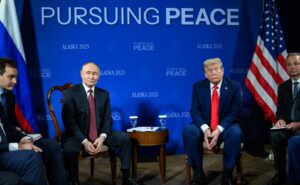
Russian, Ukrainian and American officials reconvened in Geneva this week for another round of U.S.-brokered negotiations aimed at ending nearly four years of war.
But participants on all…

Russian, Ukrainian and American officials reconvened in Geneva this week for another round of U.S.-brokered negotiations aimed at ending nearly four years of war.
But participants on all sides signaled low expectations for a breakthrough, reported the Washington Times.
The talks come as the Russian invasion grinds on with no decisive shift on the battlefield and little sign that Moscow or Ukraine are prepared to abandon their core demands.
The war is in its 48th month.
World War I, the classic example of a modern attritional stalemate, ended after 51 months.
Both delegations entered another round of discussions hardened in their positions, underscoring the steep obstacles facing any potential agreement.
But President Donald Trump is clearly frustrated with Ukraine.
“Ukraine better come to the table, fast,” Trump told reporters aboard Air Force One on Feb. 16, the Kyiv Post reported.
Ukrainian President Volodymyr Zelenskyy made clear ahead of the Geneva meetings that Kyiv will not agree to cede additional territory in the Donbas region to Russia, a key sticking point.
Zelenskyy told Axios he’d be willing to freeze the lines as they are, ceding some territory, but if Russia insists on the entire Donbas region, he can’t agree.
Zelenskyy said any decision involving sovereignty over contested areas would require a referendum, which U.S. negotiators have already agreed to, he claims.
On the Russian side, the Kremlin swapped in a hardline negotiator for the latest round.
Vladimir Medinsky, a close ally of President Vladimir Putin, joined the talks in what observers described as a signal that Moscow is not softening its stance.
One U.S. official characterized the move as “not a step toward a solution,” reported the New York Post.
Meanwhile, American officials are attempting to strike a balance between diplomatic urgency and support for Ukrainian sovereignty.
Previously, U.S. Secretary of State Marco Rubio met with his counterpart at the Munich Security Conference to talk about the negotiations, after delivering a major address to the attendees.
He met with the Ukrainian president subsequently.
“Met with Ukrainian President @ZelenskyyUa on Ukraine’s security and deepening defense and economic partnerships,” Rubio said on social media. “President Trump wants a solution that ends the bloodshed once and for all.”
The tone surrounding the negotiations has been notably sober, a marked departure from Trump’s usual buoyant predictions prior to negotiations.
Participants have acknowledged fundamental disagreements remain unresolvable if neither side is willing to negotiate.
Ukraine continues to seek restoration of its territorial integrity. Russia continues to press for recognition of its control over parts of eastern Ukraine.
Russian forces are continuing offensive operations and launching large-scale strikes against Ukrainian targets, including energy infrastructure, according to an assessment by the Institute for the Study of War (ISW).
The strikes may be intentional pressure by Russia to force Ukraine to compromise.
“Russian forces have been launching large strike packages in recent months in the days before and after bilateral and trilateral negotiations,” ISW said, “but are likely refraining from fully maximizing Russia’s strike capabilities in order to avoid upsetting U.S. President Donald Trump.”
The ongoing military pressure complicates any near-term ceasefire arrangement and signals Moscow believes it can maintain leverage by force.
The high-level diplomacy in Geneva combined with continued attacks on Ukrainian territory reinforces the grim outlook.
“Every Russian missile is the aggressor’s answer to their calls to end the war, which is why we emphasize: only with sufficient pressure on Russia and clear security guarantees for Ukraine can this war realistically be brought to an end,” said Ukraine’s Zelenskyy via social media.
As negotiations proceed, the atmosphere is defined less by optimism than by intransigence.
NATO Secretary General Mark Rutte and Rubio have both noted Russian losses are 30,000 to 35,000 dead per month.
Rutte told the Munich Security Conference attendees, “Russians are not winning.”
“This so-called Russian bear is not there,” Rutte said. “It is basically the stilted speed of a garden snail what we are seeing in Ukraine, this is how the Russians are moving inside Ukraine, very slow. Staggering losses, tens of thousands a month: 35,000 deaths in December, 30,000 deaths in January.”
The Geneva talks represent another attempt to explore a path toward peace.
Yet it may be both sides are simply waiting for the other to break with no other strategy in place, reminiscent of World War I.
For the U.S. and the rest of the world, an unstable Russia with 7,000 nuclear warheads presents a much more serious problem than some extra territory in a region most people have never heard of.
And avoiding this nuclear mess is likely at the top of Trump’s mind as his administration vies for peace.
“In short, the collapse of the Russian empire would look more like 1917 than 1991,” predicted Bruno Tertrais at the Institut Montaigne, drawing comparisons to the dissolution of Russia after World War I leading to the Communist revolution, as opposed to the peaceful breakup of the Soviet Union in the early 1990s.