Wichita Learning Lab offers microschool incubator, co-working space in heart of America
In the heart of the country, the future of school innovation is taking shape: an accelerator for microschools.
While small learning communities have surged in popularity, particularly since…
In the heart of the country, the future of school innovation is taking shape: an accelerator for microschools.
While small learning communities have surged in popularity, particularly since COVID-19, a cluster at Union Station in Wichita, Kansas, could prove to be the template that catalyzes exponential growth in the sector.
By removing barriers to school startups – most significantly a building – and providing other services and shared spaces, the Learning Lab has already grown from hosting four microschools in its first year to seven this year, along with others that use the facility on a part-time basis.
The facility positions itself as the perfect place for an idea to take flight.
“You get micro resources. You have lots of shared spaces. You’re lowering your risk by not having to take everything on your own. You can crowdsource things, crowd share – that’s how Learning Lab is designed,” said Lydia Hampton, who manages it for Stand Together, the philanthropic organization that founded it, in an interview with The Lion.
An ideal facility
Microschools, which are typically small learning communities of 20 students or fewer, often face challenges when looking for space. Zoning restrictions, fire codes and other requirements cause many schools to operate “under the radar” or avoid disclosing their location to escape scrutiny. The Learning Lab offers modernized space that is both visible and up to code, eliminating those concerns.
Every school that launches – and hundreds, perhaps thousands, are launching annually –needs basic services, from internet to printing to security. The lab offers these as part of its rental agreements. Rental contracts are year-to-year but incentivize schools to grow, Hampton said. The goal is for schools to use the facility for three or four years as an incubator before launching independently.
“Our goal is to put incremental pressure on the model so that then you’re not caught off guard when you have to move out because it’s time for you to grow up,” she said. “It costs about $12-$13 per square foot your first year and we do charge a fee per adult and kid that helps cover some of our administrative fees.”
The community aspect is another key feature. While microschools are small by definition, they don’t have to exist in isolation. The lab encourages collaboration rather than competition among tenants. While some worry about schools poaching students, Hampton said families often enroll siblings in different schools to best meet their needs.
“We actually have a lot of siblings across the school models,” Hampton said. “There’s one older brother here that goes to Khan (Lab School) but the two younger sisters go to Creative Minds. We’ve seen that a couple of times.”
A mix of public and private schools
Notably, the incubator isn’t only for private schools. Creative Minds, a Wichita district-run microschool, is the lab’s largest tenant, renting two of its nine available classrooms (a tenth is reserved for occasional use).
The school launched after a district survey showed some parents wanted mixed-age, project-based, and individually paced education with shorter school days. The K-6 program grew from 15 students last year to 40 this year in two classrooms. Apprentice teachers are being trained to launch new branches across the city.
“I’m proud of the public school district for trying something and learning from it,” Hampton said of the district’s decision to split the program into two classrooms to better serve younger and older students. The school has “gotten amazing feedback from the parents and families,” as well as improved test scores, she added.
Building a co-working space
A Wichita native, Hampton taught entrepreneurship at a Kansas City high school for five years before working as a trainer for Empowered, an entrepreneurship curriculum. When she reached out to Khan Academy about starting a school in Wichita, the conversation quickly evolved into creating a space where multiple schools could incubate and thrive.
“That’s where the problem of ‘what would a co-working space for education look like’ came up, because there’s a super high demand for innovative education models but there is very low supply,” Hampton said. “And so there has to be a solution that helps us have an influx of a supply that is sustainable and well informed and well designed.”
She used her entrepreneurship background to pilot the concept, hosting one microschool and events during the test phase before launching the Learning Lab in August 2024 with four schools. The 15,601-square-foot facility includes classrooms, program space and a 4,000-square-foot enclosed patio. This year, 116 students attend the seven schools – a number Hampton said already feels near capacity, which is more than 200.
Homeschool families and other microschools also use the space for special programs and “Fun Fridays,” which she described as “stackable enrichment classes designed to help kids be exposed to a lot of different skills and interest areas. It’s all driven by the kids and what they want to learn about.”
Those classes exemplify collaboration, Hampton said. “The learning operator doesn’t need to learn forensic science. They can bring their kid here and then the kid can participate. You’re not having to carry that burden all on your own.”
A unique facility that could expand
Hampton said she doesn’t know of another facility quite like the Learning Lab, which combines permanent tenants with flexible memberships. While other shared-school environments exist, she said few foster interaction the way the Wichita space does.
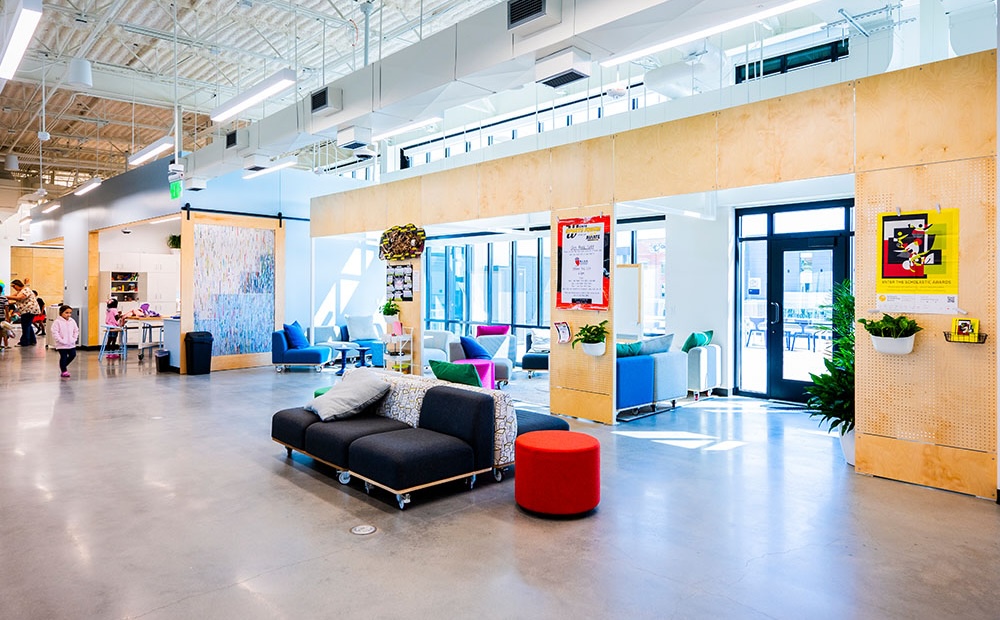
“Our space is designed to be a showcase hub for the community coming in to learn,” she said. “We talk a lot about how people need to see it, feel it, believe it, to take action, to do something different. So our space is very open, lots of visibility.
“And we want the kids and the grown-ups to naturally and organically connect with one another. We want them to walk by. We want a teacher to walk by and see what another group is doing and then follow up and say, okay, hey, what were you doing? I’d love to learn more.”
A hybrid homeschool currently shares space with a wrestling club that has about 20 homeschool students. The hybrid group uses the classroom two mornings a week, while the wrestling club holds practices in the lab’s storm shelter.
“We support operators from all education environments – public, private, homeschool, microschool, faith-based, secular,” Hampton said. “We believe all of education needs to get better and transform. We need more, better and different of all of that so that there is higher supply that is closer and more accessible to whichever pathway that parents and families need or want.”
While most activities take place during the day, Hampton said she is open to offering adult or family programs in the evenings but remains focused on K-12 education.
The downtown location could open new entrepreneurship opportunities if the lab expands into storefront space at Union Station.
“Wichita is building a 300,000-square-foot biomedical campus (nearby), so there’s going to be a lot more people down here in the next two years,” she said. “My dream would be 10,000 more square feet on this top level. And then there’s a level below us that is kind of storefront-facing property I would love to have with a student-operated storefront where the students can create, sell and experience entrepreneurship.”
The concept has drawn visitors “from all over the country,” Hampton said, and the lab is developing a toolkit for others looking to replicate the model.
“Our space has a lot of technology, a podcast studio, video studio and whatnot. If this was in Detroit, maybe it has a lot more music. Maybe it has a lot more auto manufacturing,” she said. “Whatever that might be, we want each community to be able to take that blueprint and color it in with what would serve that population.”
Don Soifer, who runs the National Microschooling Center, said the lab “represents an important model for how communities can most effectively support the healthy growth of vibrant and diversified ecosystems of microschools.”
“We often suggest community leaders look to Learning Lab Wichita as an effective model for how they can catalyze and support a vibrant microschool sector,” he told The Lion in an email.
For now, the hub is thriving – even though Kansas lacks a broad school choice program. Hampton said school choice could help microschools expand but added that the main challenge remains increasing supply.
“If there’s not any options, then you’re still stuck with making a choice that maybe you wouldn’t want to make,” she said. “So yeah, absolutely, I think it would be helpful.”